Department of Internal Medicine, College of Medicine, Dong-A University, Busan, Korea.
Korean Circ J. 2009 Jun;39(6):228-35. doi: 10.4070/kcj.2009.39.6.228. Epub 2009 Jun 30.
Retrograde wire approach has been emerged as a useful tool to enhance success rate in coronary chronic total occlusion (CTO) intervention. Therefore, we tried to report the initial experience of retrograde approach and its clinical implication on CTO intervention.
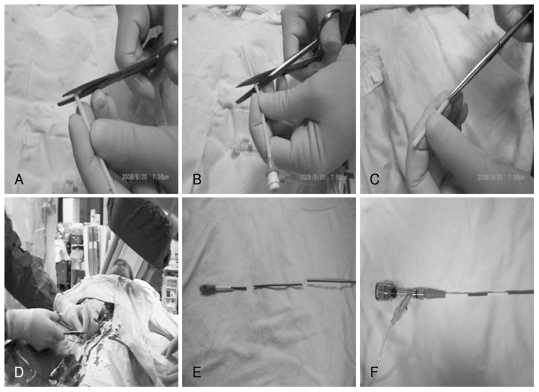
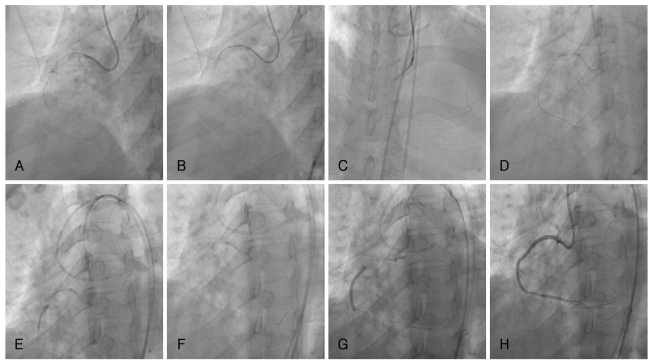
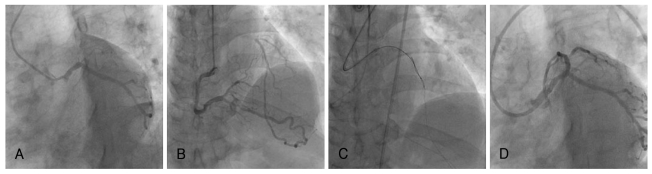
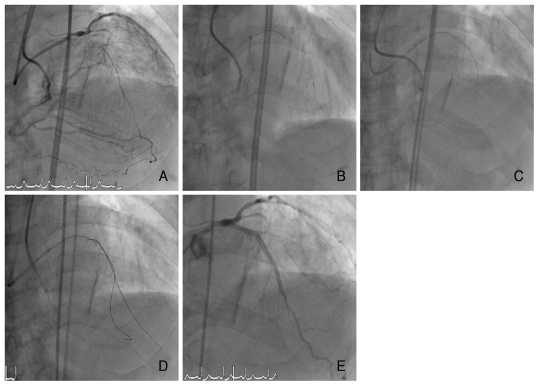
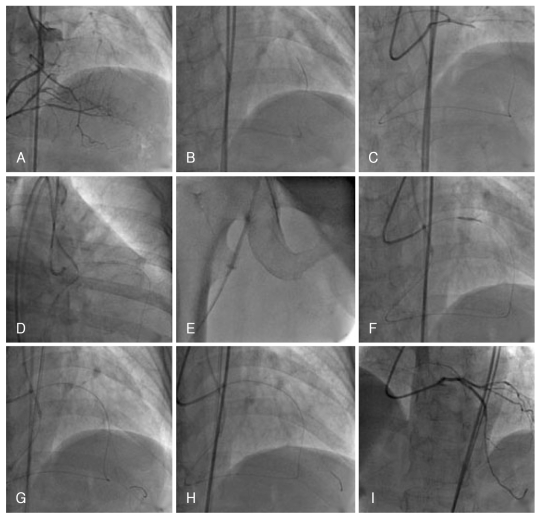
From February 2007 to July 2008, retrograde approaches were performed in 28 patients with 31 CTO lesions out of 61patients. A hydrophilic coated guidewire was inserted by using microcatheter or over-the-wire (OTW) balloon through the collateral channel (septal or epicardial artery) via several strategies.
Mean age of patients was 63.4+/-11.6 years. Male and female were 20 and 8 patients, respectively. The target artery with CTO lesions included the right coronary artery (45.2%), the left anterior descending artery (51.6%), and the left circumflex artery (3.2%). The mean length of CTO lesion was 18.4+/-16.4 mm. Overall technical success rate was 64.5%. The success rate of primary attempt was 78.9%, while the success rate of immediate and secondary attempt was 41.7%. Collateral channel dissections were observed in 3 patients and no patients among these patients developed cardiac tamponade. One patient had a silent non-Q wave myocardial infarction (MI) after the procedure. One failed patient died suddenly 3 days after the procedure. After percutaneous coronary intervention (PCI) procedure, no case was performed target vessel revascularization (TVR), urgent coronary artery bypass graft (CABG), and urgent PCI.
Retrograde approach is an evolving technique to improve the success rate of CTO intervention. After the learning curve period, this technique could be the useful tool to enhance success rate in CTO intervention.
逆行导丝技术已经成为提高冠状动脉慢性完全闭塞(CTO)介入成功率的有效手段。因此,我们尝试报告逆行技术的初步经验及其对 CTO 介入的临床意义。
2007 年 2 月至 2008 年 7 月,61 例患者中有 28 例(31 处 CTO 病变)采用逆行导丝技术。通过几种策略,使用微导管或经导丝(OTW)球囊将亲水涂层导丝插入侧支通道(间隔或心外膜动脉)。
患者平均年龄为 63.4+/-11.6 岁。男 20 例,女 8 例。目标血管 CTO 病变包括右冠状动脉(45.2%)、前降支(51.6%)和左回旋支(3.2%)。CTO 病变的平均长度为 18.4+/-16.4mm。整体技术成功率为 64.5%。首次尝试成功率为 78.9%,即刻和二次尝试成功率为 41.7%。3 例患者出现侧支通道夹层,无心脏压塞发生。1 例患者术后发生无症状非 Q 波心肌梗死(MI)。1 例失败患者在术后 3 天突然死亡。经皮冠状动脉介入治疗(PCI)后,无患者行靶血管血运重建(TVR)、急诊冠状动脉旁路移植术(CABG)或急诊 PCI。
逆行导丝技术是提高 CTO 介入成功率的一项不断发展的技术。经过学习曲线阶段,该技术可能成为提高 CTO 介入成功率的有用手段。