Thomson Viji Samuel, Narayanan Kumar, Singh J Chandra
Department of Urology, Christian Medical College, Vellore, India.
Indian J Urol. 2009 Oct-Dec;25(4):437-45. doi: 10.4103/0970-1591.57904.
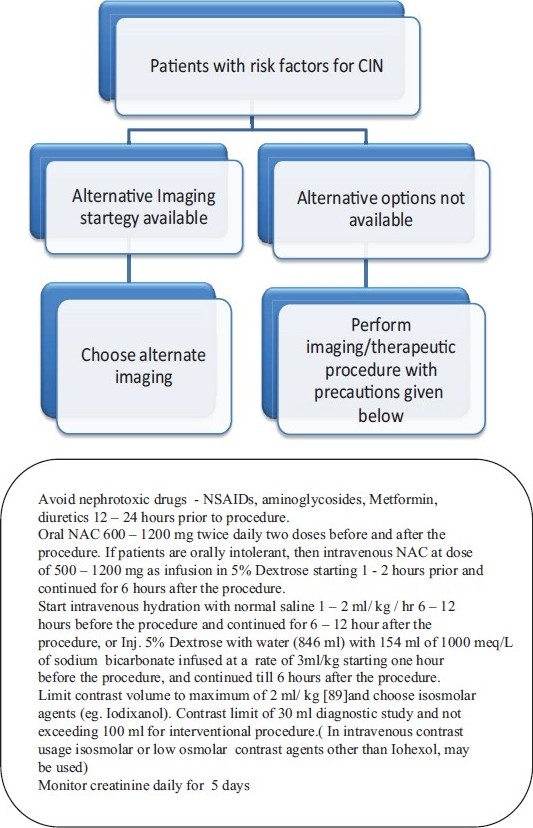
Intravenous contrast agents have a distinct role in urological imaging: to study precise anatomical delineation, vascularity, and to assess the function of the renal unit. Contrast induced nephropathy (CIN) is a known adverse effect of intravenous contrast administration. The literature on incidence, pathophysiology, clinical features, and current preventive strategies available for CIN relevant to urologists was reviewed. A search of the PubMed database was done using the keywords nephropathy and media, prevention and control or prevention Contrast media (explode), all adverse effects, and kidney diseases (explode). An online search of the EMBASE database for the time ranging from 1977 to February 2009 was performed using the keywords ionic contrast medium, adverse drug reaction, major or controlled clinical study, human, nephrotoxicity, and kidney disease. Current publications and data most relevant to urologists were examined. CIN was the third most common cause of hospital-acquired renal failure. The incidence is less common with intravenous contrast administration as compared with intra-arterial administration. The pathogenesis of contrast mediated nephropathy is due to a combination of toxic injury to renal tubules and medullary ischemic injury mediated by reactive oxygen species. CIN most commonly manifests as a nonoliguric and asymptomatic transient decline in renal function. Patients who developed CIN were found to have increased mortality, longer hospital stay, and complicated clinical course. An overview of risk factors and risk prediction score for prognostication of CIN are elaborated. Preventive strategies including choice of contrast agents, maximum tolerated dose, role of hydration, hydration regime, etc. are discussed. The role of N- acetyl cysteine, Theophylline, Fenoldapam, Endothelin receptor antagonists, iloprost, atrial natriuretic peptide, and newer therapies such as targeted renal therapy (TRT) are discussed. A working algorithm based on current evidence is proposed. No current treatment can reverse or ameliorate CIN once it occurs, but prophylaxis is possible.
用于研究精确的解剖结构、血管情况以及评估肾单位功能。造影剂肾病(CIN)是静脉注射造影剂已知的不良反应。本文回顾了与泌尿外科医生相关的CIN的发病率、病理生理学、临床特征及当前预防策略的文献。使用关键词“肾病”和“造影剂”、“预防与控制”或“预防造影剂(展开)”、“所有不良反应”以及“肾脏疾病(展开)”对PubMed数据库进行了检索。使用关键词“离子型造影剂”、“药物不良反应”、“主要或对照临床研究”、“人类”、“肾毒性”和“肾脏疾病”对EMBASE数据库进行了1977年至2009年2月期间的在线检索。研究了与泌尿外科医生最相关的当前出版物和数据。CIN是医院获得性肾衰竭的第三大常见原因。与动脉内注射相比,静脉注射造影剂时其发病率较低。造影剂介导的肾病的发病机制是由于对肾小管的毒性损伤和由活性氧介导的髓质缺血性损伤共同作用所致。CIN最常见的表现是肾功能的非少尿性且无症状的短暂下降。发生CIN的患者死亡率增加、住院时间延长且临床过程复杂。阐述了CIN预后的危险因素和风险预测评分概述。讨论了预防策略,包括造影剂的选择、最大耐受剂量、水化的作用及水化方案等。讨论了N - 乙酰半胱氨酸、茶碱、非诺多泮、内皮素受体拮抗剂、伊洛前列素、心房利钠肽的作用以及靶向肾脏治疗(TRT)等新疗法。基于当前证据提出了一个工作算法。一旦CIN发生,目前没有任何治疗方法可以逆转或改善它,但预防是可行的。