Institute of Healthy Ageing, Department of Genetics Evolution and Environment, University College London, UK.
Nature. 2009 Dec 24;462(7276):1061-4. doi: 10.1038/nature08619. Epub 2009 Dec 2.
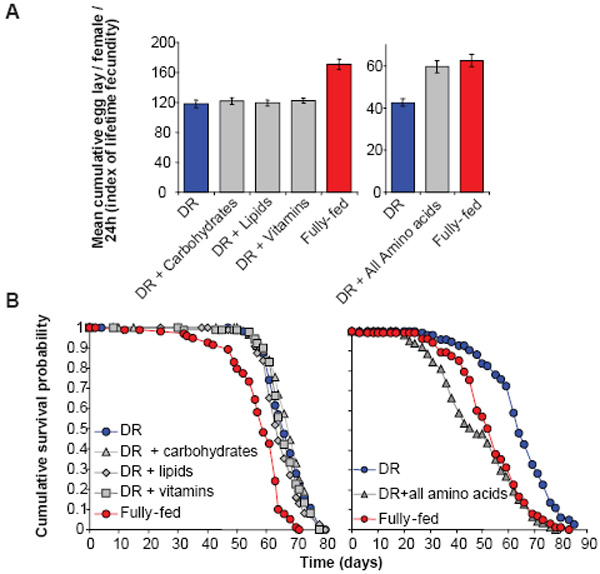
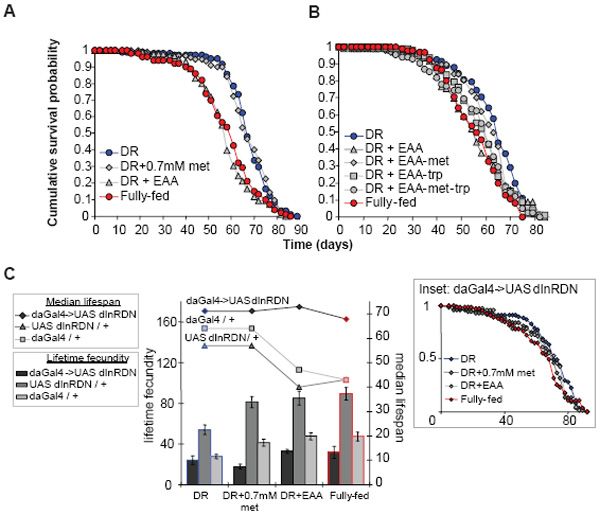
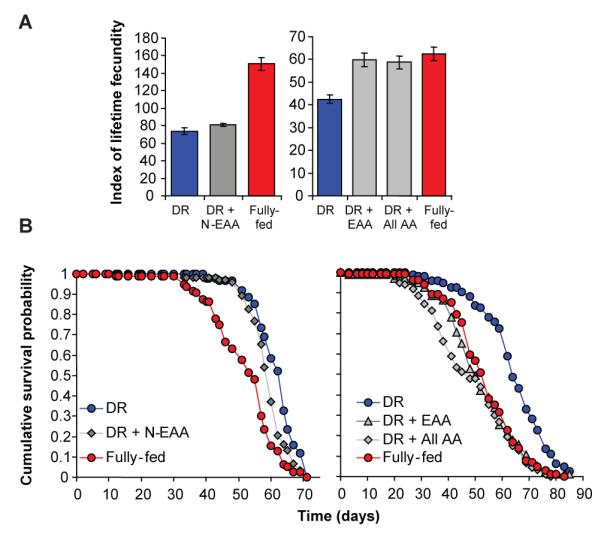
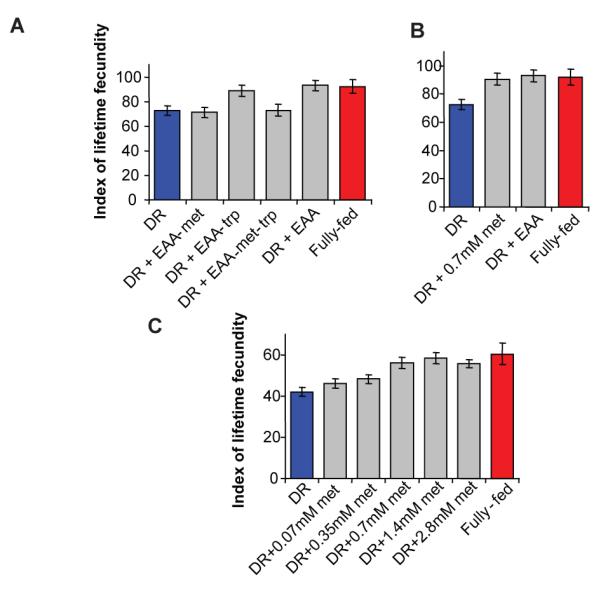
Dietary restriction extends healthy lifespan in diverse organisms and reduces fecundity. It is widely assumed to induce adaptive reallocation of nutrients from reproduction to somatic maintenance, aiding survival of food shortages in nature. If this were the case, long life under dietary restriction and high fecundity under full feeding would be mutually exclusive, through competition for the same limiting nutrients. Here we report a test of this idea in which we identified the nutrients producing the responses of lifespan and fecundity to dietary restriction in Drosophila. Adding essential amino acids to the dietary restriction condition increased fecundity and decreased lifespan, similar to the effects of full feeding, with other nutrients having little or no effect. However, methionine alone was necessary and sufficient to increase fecundity as much as did full feeding, but without reducing lifespan. Reallocation of nutrients therefore does not explain the responses to dietary restriction. Lifespan was decreased by the addition of amino acids, with an interaction between methionine and other essential amino acids having a key role. Hence, an imbalance in dietary amino acids away from the ratio optimal for reproduction shortens lifespan during full feeding and limits fecundity during dietary restriction. Reduced activity of the insulin/insulin-like growth factor signalling pathway extends lifespan in diverse organisms, and we find that it also protects against the shortening of lifespan with full feeding. In other organisms, including mammals, it may be possible to obtain the benefits to lifespan of dietary restriction without incurring a reduction in fecundity, through a suitable balance of nutrients in the diet.
饮食限制延长了多种生物的健康寿命并降低了繁殖力。人们普遍认为,它通过将营养物质从繁殖重新分配到身体维持,有助于在自然界中应对食物短缺。如果是这样,那么在饮食限制下的长寿和在充分喂养下的高繁殖力将通过竞争相同的限制营养素而相互排斥。在这里,我们通过鉴定出影响果蝇寿命和繁殖力对饮食限制反应的营养素来检验这一观点。在饮食限制条件下添加必需氨基酸会增加繁殖力并降低寿命,这与充分喂养的效果相似,而其他营养素的影响很小或没有。然而,单独添加蛋氨酸就足以像充分喂养一样增加繁殖力,而不会降低寿命。因此,营养物质的重新分配并不能解释对饮食限制的反应。添加氨基酸会降低寿命,蛋氨酸与其他必需氨基酸之间的相互作用起着关键作用。因此,饮食中氨基酸的不平衡偏离了最佳繁殖比例,会在充分喂养期间缩短寿命并限制饮食限制期间的繁殖力。胰岛素/胰岛素样生长因子信号通路在多种生物中的活性降低会延长寿命,我们发现它还可以防止充分喂养导致的寿命缩短。在其他生物,包括哺乳动物中,通过饮食中适当的营养平衡,可能在不降低繁殖力的情况下获得饮食限制对寿命的益处。