
细胞表面蛋白游离巯基的调节:倍半萜内酯单萜烯内酯的潜在新型作用机制。
Modulation of cell surface protein free thiols: a potential novel mechanism of action of the sesquiterpene lactone parthenolide.
机构信息
James P. Wilmot Cancer Center, University of Rochester Medical Center, Rochester, New York, United States of America.
出版信息
PLoS One. 2009 Dec 2;4(12):e8115. doi: 10.1371/journal.pone.0008115.
BACKGROUND
There has been much interest in targeting intracellular redox pathways as a therapeutic approach for cancer. Given recent data to suggest that the redox status of extracellular protein thiol groups (i.e. exofacial thiols) effects cell behavior, we hypothesized that redox active anti-cancer agents would modulate exofacial protein thiols.
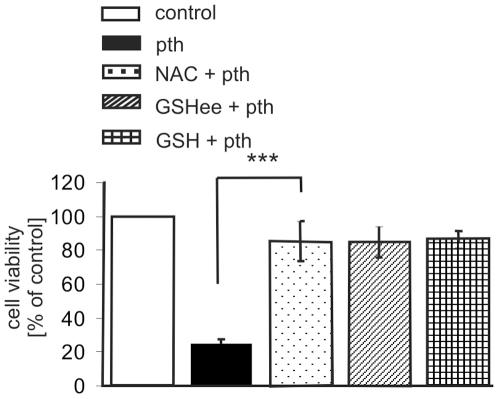
METHODOLOGY/PRINCIPAL FINDINGS: To test this hypothesis, we used the sesquiterpene lactone parthenolide, a known anti-cancer agent. Using flow cytometry, and western blotting to label free thiols with Alexa Fluor 633 C(5) maleimide dye and N-(biotinoyl)-N-(iodoacetyl) ethylendiamine (BIAM), respectively, we show that parthenolide decreases the level of free exofacial thiols on Granta mantle lymphoma cells. In addition, we used immuno-precipitation techniques to identify the central redox regulator thioredoxin, as one of the surface protein thiol targets modified by parthenolide. To examine the functional role of parthenolide induced surface protein thiol modification, we pretreated Granta cells with cell impermeable glutathione (GSH), prior to exposure to parthenolide, and showed that GSH pretreatment; (a) inhibited the interaction of parthenolide with exofacial thiols; (b) inhibited parthenolide mediated activation of JNK and inhibition of NFkappaB, two well established mechanisms of parthenolide activity and; (c) blocked the cytotoxic activity of parthenolide. That GSH had no effect on the parthenolide induced generation of intracellular reactive oxygen species supports the fact that GSH had no effect on intracellular redox. Together these data support the likelihood that GSH inhibits the effect of parthenolide on JNK, NFkappaB and cell death through its direct inhibition of parthenolide's modulation of exofacial thiols.
CONCLUSIONS/SIGNIFICANCE: Based on these data, we postulate that one component of parthenolide's anti-lymphoma activity derives from its ability to modify the redox state of critical exofacial thiols. Further, we propose that cancer cell exofacial thiols may be important and novel targets for therapy.
背景
靶向细胞内氧化还原途径作为癌症治疗方法已引起广泛关注。鉴于最近的数据表明细胞外蛋白巯基的氧化还原状态(即细胞外巯基)影响细胞行为,我们假设氧化还原活性抗癌剂将调节细胞外蛋白巯基。
方法/主要发现:为了验证这一假设,我们使用了倍半萜内酯白头翁内酯,一种已知的抗癌剂。我们使用流式细胞术和 Western blot 分别用 Alexa Fluor 633 C(5)马来酰亚胺染料和 N-(生物素酰基)-N-(碘乙酰胺基)乙二胺 (BIAM)标记游离巯基,表明白头翁内酯降低了 Granta 曼氏淋巴瘤细胞表面游离巯基的水平。此外,我们使用免疫沉淀技术鉴定了中央氧化还原调节剂硫氧还蛋白,作为被白头翁内酯修饰的表面蛋白巯基靶标之一。为了研究白头翁内酯诱导的表面蛋白巯基修饰的功能作用,我们在用白头翁内酯处理前用细胞不可渗透的谷胱甘肽 (GSH)预处理 Granta 细胞,并表明 GSH 预处理:(a)抑制了白头翁内酯与细胞外巯基的相互作用;(b)抑制了白头翁内酯介导的 JNK 激活和 NFkappaB 抑制,这是白头翁内酯活性的两种已确立机制;(c)阻断了白头翁内酯的细胞毒性活性。GSH 对白头翁内酯诱导的细胞内活性氧产生没有影响,这支持了 GSH 对细胞内氧化还原没有影响的事实。这些数据共同支持了 GSH 通过直接抑制白头翁内酯对细胞外巯基的调节,抑制 GSH 对 JNK、NFkappaB 和细胞死亡的影响的可能性。
结论/意义:基于这些数据,我们假设白头翁内酯抗淋巴瘤活性的一个组成部分来自于其调节关键细胞外巯基氧化还原状态的能力。此外,我们提出癌细胞外巯基可能是治疗的重要和新颖的靶点。


 Zotero 插件