Department of Medical and Molecular Genetics, King's College London School of Medicine, London, United Kingdom.
PLoS One. 2009 Nov 30;4(11):e8025. doi: 10.1371/journal.pone.0008025.
Huntington's disease (HD) is an inherited progressive neurodegenerative disorder caused by a CAG repeat expansion in the ubiquitously expressed HD gene resulting in an abnormally long polyglutamine repeat in the huntingtin protein. Polyglutamine inclusions are a hallmark of the neuropathology of HD. We have previously shown that inclusion pathology is also present in the peripheral tissues of the R6/2 mouse model of HD which expresses a small N-terminal fragment of mutant huntingtin. To determine whether this peripheral pathology is a consequence of the aberrant expression of this N-terminal fragment, we extend this analysis to the genetically precise knock-in mouse model of HD, HdhQ150, which expresses mutant mouse huntingtin.
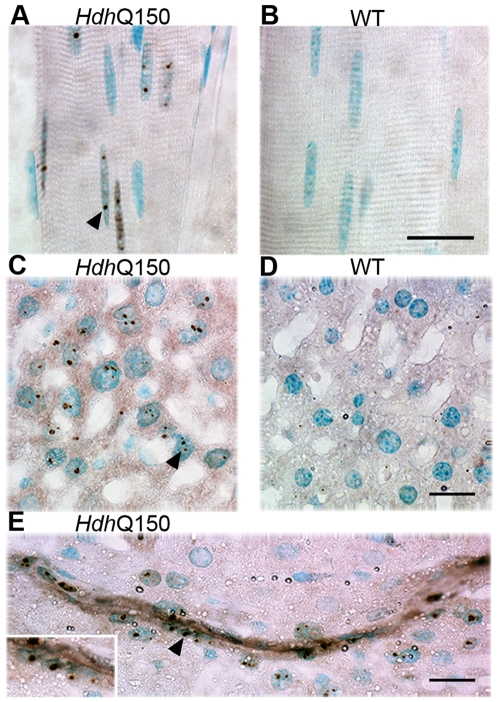
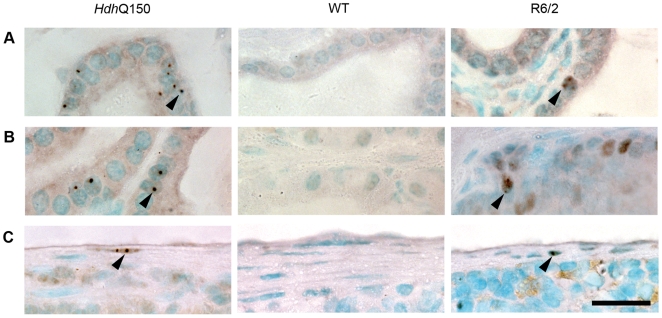
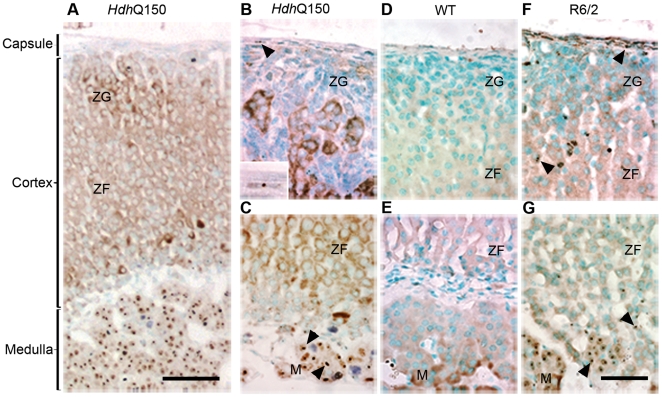
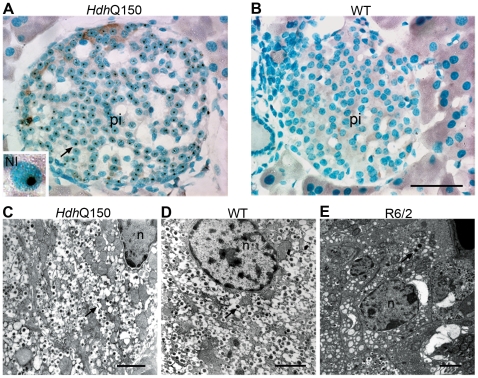
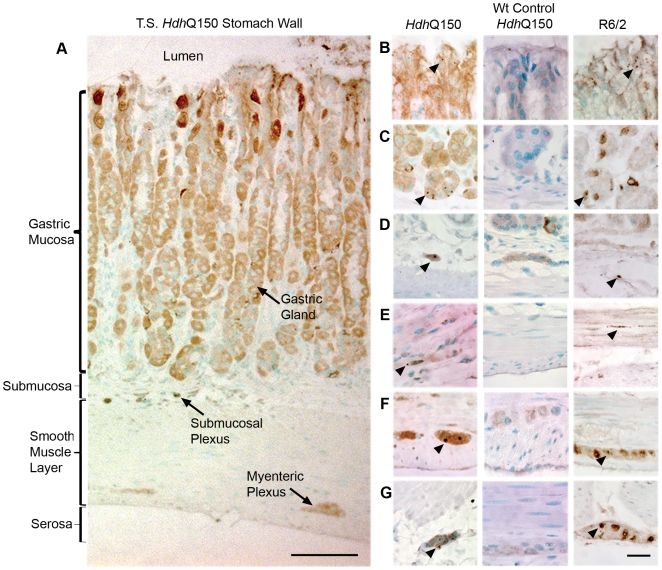
METHODOLOGY/PRINCIPAL FINDINGS: We have previously standardized the CAG repeat size and strain background of the R6/2 and HdhQ150 knock-in mouse models and found that they develop a comparable and widespread neuropathology. To determine whether HdhQ150 knock-in mice also develop peripheral inclusion pathology, homozygous Hdh(Q150/Q150) mice were perfusion fixed at 22 months of age, and tissues were processed for histology and immunohistochemistry with the anti-huntingtin antibody S830. The peripheral inclusion pathology was almost identical to that found in R6/2 mice at 12 weeks of age with minor differences in inclusion abundance.
CONCLUSIONS/SIGNIFICANCE: The highly comparable peripheral inclusion pathology that is present in both the R6/2 and HdhQ150 knock-in models of HD indicates that the presence of peripheral inclusions in R6/2 mice is not a consequence of the aberrant expression of an N-terminal huntingtin protein. It remains to be determined whether peripheral inclusions are a pathological feature of the human disease. Both mouse models carry CAG repeats that cause childhood disease in humans, and therefore, inclusion pathology may be a feature of the childhood rather than the adult forms of HD. It is important to establish the extent to which peripheral pathology causes the peripheral symptoms of HD from the perspective of a mechanistic understanding and future treatment options.
亨廷顿病(HD)是一种遗传性进行性神经退行性疾病,由广泛表达的 HD 基因中的 CAG 重复扩展引起,导致亨廷顿蛋白中的异常长聚谷氨酰胺重复。聚谷氨酰胺包含物是 HD 神经病理学的一个标志。我们之前已经表明,包含体病理学也存在于 R6/2 小鼠模型的周围组织中,该模型表达突变型亨廷顿蛋白的小 N 端片段。为了确定这种周围病理学是否是该 N 端片段异常表达的结果,我们将这种分析扩展到 HD 的遗传上精确的基因敲入小鼠模型 HdhQ150,该模型表达突变型小鼠亨廷顿蛋白。
方法/主要发现:我们之前已经标准化了 R6/2 和 HdhQ150 基因敲入小鼠模型的 CAG 重复大小和品系背景,并发现它们发展出一种类似的广泛的神经病理学。为了确定 HdhQ150 基因敲入小鼠是否也会发展出周围包含体病理学,我们在 22 个月大时对纯合 Hdh(Q150/Q150)小鼠进行灌注固定,并使用抗亨廷顿蛋白抗体 S830 对组织进行组织学和免疫组织化学处理。周围的包含体病理学与在 12 周龄 R6/2 小鼠中发现的几乎完全相同,仅在包含物丰度上存在细微差异。
结论/意义:在 R6/2 和 HdhQ150 HD 基因敲入模型中都存在的高度相似的周围包含体病理学表明,R6/2 小鼠中周围包含体的存在不是 N 端亨廷顿蛋白异常表达的结果。仍然需要确定周围包含体是否是人类疾病的病理特征。两种小鼠模型都携带导致人类儿童疾病的 CAG 重复,因此,包含体病理学可能是儿童而非成人 HD 形式的特征。从机制理解和未来治疗选择的角度来看,确定周围病理学在多大程度上导致 HD 的周围症状非常重要。