
亨廷顿病基因敲入小鼠的表型发作与突变 huntingtin 基因的不完全剪接相关。
Phenotype onset in Huntington's disease knock-in mice is correlated with the incomplete splicing of the mutant huntingtin gene.
机构信息
Department of Neurology, David Geffen School of Medicine, University of California, Los Angeles, Los Angeles, California.
Department of Pharmacology, University of Tartu, Tartu, Estonia.
出版信息
J Neurosci Res. 2019 Dec;97(12):1590-1605. doi: 10.1002/jnr.24493. Epub 2019 Jul 7.
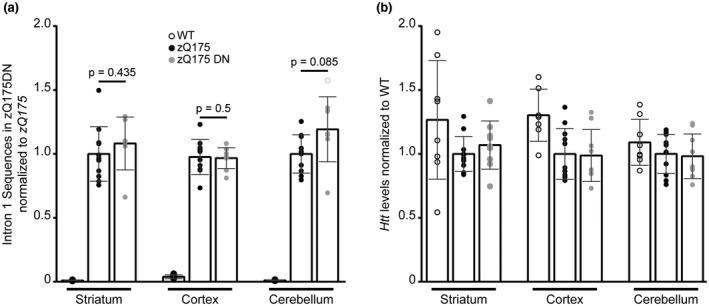
Huntington's disease (HD) is a progressive neurodegenerative disorder caused by an expanded CAG repeat within the huntingtin (HTT) gene. The Q140 and HdhQ150 knock-in HD mouse models were generated such that HdhQ150 mice have an expanded CAG repeat inserted into the mouse Htt gene, whereas in the Q140s, mouse exon 1 Htt was replaced with a mutated version of human exon 1. By standardizing mouse strain background, breeding to homozygosity and employing sensitive behavioral tests, we demonstrate that the onset of behavioral phenotypes occurs earlier in the Q140 than the HdhQ150 knock-in mouse models and that huntingtin (HTT) aggregation appears earlier in the striata of Q140 mice. We have previously found that the incomplete splicing of mutant HTT from exon 1 to exon 2 results in the production of a small polyadenylated transcript that encodes the highly pathogenic mutant HTT exon 1 protein. In this report, we have identified a functional consequence of the sequence differences between these two models at the RNA level, in that the level of incomplete splicing, and of the mutant exon 1 HTT protein, are greater in the brains of Q140 mice. While differences in the human and mouse exon 1 HTT proteins (e.g., proline rich sequences) could also contribute to the phenotypic differences, our data indicate that the incomplete splicing of HTT and approaches to lower the levels of the exon 1 HTT transcript should be pursued as therapeutic targets.
亨廷顿病(HD)是一种进行性神经退行性疾病,由亨廷顿(HTT)基因内的 CAG 重复扩展引起。Q140 和 HdhQ150 基因敲入 HD 小鼠模型的产生方式是,HdhQ150 小鼠的 HTT 基因中插入了扩展的 CAG 重复序列,而在 Q140s 中,小鼠外显子 1 的 HTT 被突变的人类外显子 1 取代。通过标准化小鼠品系背景、杂交至纯合子并采用敏感的行为测试,我们证明 Q140 比 HdhQ150 基因敲入小鼠模型更早出现行为表型,并且 Q140 小鼠纹状体中的亨廷顿蛋白(HTT)聚集更早出现。我们之前发现,从外显子 1 到外显子 2 的突变 HTT 的不完全剪接导致产生一个小的多聚腺苷酸化转录本,该转录本编码高度致病性的突变 HTT 外显子 1 蛋白。在本报告中,我们在 RNA 水平上确定了这两个模型之间序列差异的功能后果,即 Q140 小鼠大脑中的不完全剪接和突变外显子 1 HTT 蛋白的水平更高。虽然人类和小鼠外显子 1 HTT 蛋白(例如脯氨酸丰富序列)之间的差异也可能导致表型差异,但我们的数据表明,HTT 的不完全剪接和降低外显子 1 HTT 转录本水平的方法应作为治疗靶点进行研究。


 Zotero 插件