Department of Clinical Sciences, Division of Urological Cancers, Clinical Research Center, University Hospital Malmö, Lund University, Malmö, Sweden.
PLoS One. 2009 Nov 23;4(11):e7953. doi: 10.1371/journal.pone.0007953.
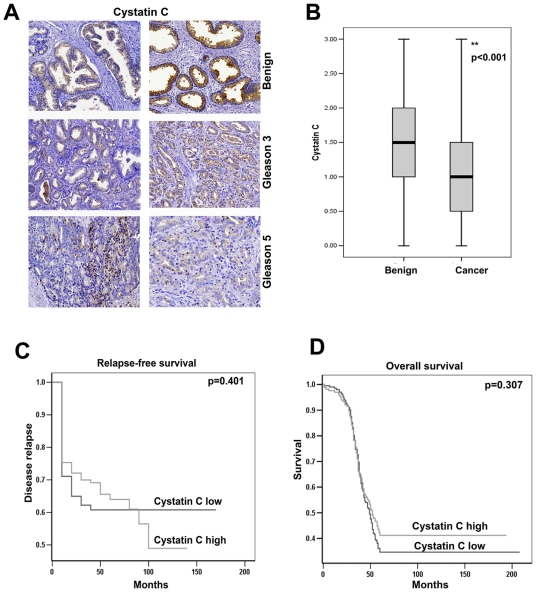
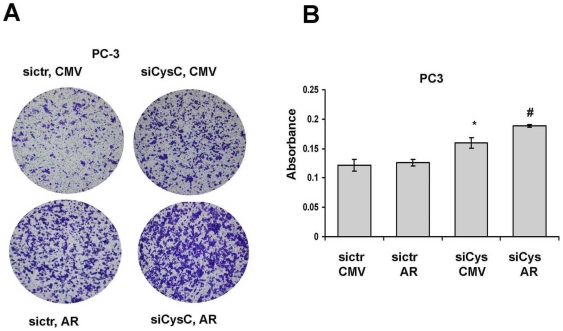
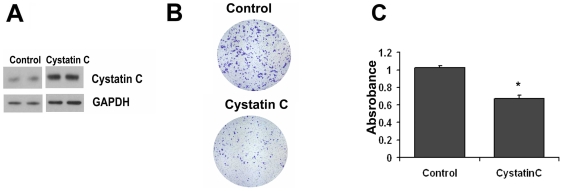
Cystatin C is believed to prevent tumor progression by inhibiting the activities of a family of lysosomal cysteine proteases. However, little is known about the precise mechanism of cystatin C function in prostate cancer. In the present study, we examined the expression of cystatin C and its association with matrix metalloproteinases 2 (MMP2) and androgen receptor (AR) in a tissue microarray comparing benign and malignant specimens from 448 patients who underwent radical prostatectomy for localized prostate cancer. Cystatin C expression was significantly lower in cancer specimens than in benign tissues (p<0.001) and there was a statistically significant inverse correlation between expression of cystatin C and MMP2 (r(s) (2) = -0.056, p = 0.05). There was a clear trend that patients with decreased level of cystatin C had lower overall survival. Targeted inhibition of cystatin C using specific siRNA resulted in an increased invasiveness of PC3 cells, whereas induction of cystatin C overexpression greatly reduced invasion rate of PC3 in vitro. The effect of cystatin C on modulating the PC3 cell invasion was provoked by Erk2 inhibitor that specifically inhibited MAPK/Erk2 activity. This suggests that cystatin C may mediate tumor cell invasion by modulating the activity of MAPK/Erk cascades. Consistent with our immunohistochemical findings that patients with low expression of cystatin C and high expression of androgen receptor (AR) tend to have worse overall survival than patients with high expression of cystatin C and high AR expression, induced overexpression of AR in PC3 cells expressing cystatin C siRNA greatly enhanced the invasiveness of PC3 cells. This suggests that there may be a crosstalk between cystatin C and AR-mediated pathways. Our study uncovers a novel role for cystatin C and its associated cellular pathways in prostate cancer invasion and metastasis.
半胱氨酸蛋白酶抑制剂 C 被认为通过抑制溶酶体半胱氨酸蛋白酶家族的活性来阻止肿瘤的进展。然而,关于半胱氨酸蛋白酶抑制剂 C 在前列腺癌中的确切作用机制知之甚少。在本研究中,我们通过组织微阵列比较了 448 例接受根治性前列腺切除术的局限性前列腺癌患者的良性和恶性标本,研究了半胱氨酸蛋白酶抑制剂 C 的表达及其与基质金属蛋白酶 2(MMP2)和雄激素受体(AR)的关系。与良性组织相比,癌组织中半胱氨酸蛋白酶抑制剂 C 的表达明显降低(p<0.001),并且半胱氨酸蛋白酶抑制剂 C 的表达与 MMP2 呈显著负相关(r(s) (2) = -0.056,p = 0.05)。有明显的趋势表明,半胱氨酸蛋白酶抑制剂 C 水平降低的患者总生存率降低。使用特异性 siRNA 靶向抑制半胱氨酸蛋白酶抑制剂 C 导致 PC3 细胞侵袭性增加,而诱导半胱氨酸蛋白酶抑制剂 C 过表达则大大降低了 PC3 细胞的体外侵袭率。半胱氨酸蛋白酶抑制剂 C 对调节 PC3 细胞侵袭的作用是通过 Erk2 抑制剂引起的,该抑制剂特异性抑制 MAPK/Erk2 活性。这表明半胱氨酸蛋白酶抑制剂 C 可能通过调节 MAPK/Erk 级联的活性来介导肿瘤细胞的侵袭。与我们的免疫组织化学发现一致,即半胱氨酸蛋白酶抑制剂 C 表达低且雄激素受体(AR)表达高的患者总生存率比半胱氨酸蛋白酶抑制剂 C 表达高且 AR 表达高的患者差,诱导 AR 在表达半胱氨酸蛋白酶抑制剂 C siRNA 的 PC3 细胞中的过表达大大增强了 PC3 细胞的侵袭性。这表明半胱氨酸蛋白酶抑制剂 C 与 AR 介导的途径之间可能存在串扰。我们的研究揭示了半胱氨酸蛋白酶抑制剂 C 及其相关细胞途径在前列腺癌侵袭和转移中的新作用。