Ganguly Bratati, Srivastava D K
Department of Chemistry, Biochemistry and Molecular Biology, North Dakota State University, Fargo, ND 58105.
J Biomed Nanotechnol. 2008 Dec 1;4(4):457-462. doi: 10.1166/jbn.2008.010.
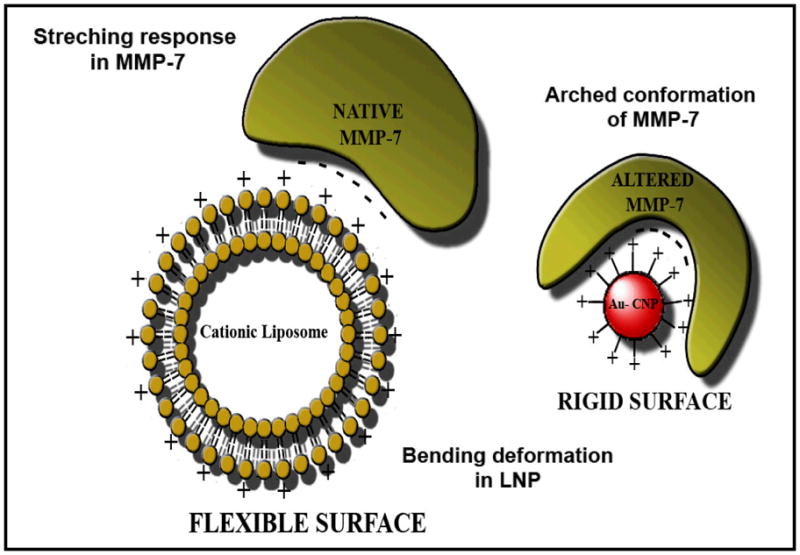
Matrix Metalloproteinase-7 (MMP-7) is invariably expressed in a variety of cancer cells, and exhibits the potentials to interact with differently charged macromolecular surfaces 1. To ascertain whether the nature of the charge carrying surfaces influences the stability as well as catalytic properties of the enzyme, we compared the effects of differently charged lipid (representative of "flexible") and gold ("rigid") nanoparticles. The experimental data revealed that the catalytic activity of MMP-7 is impaired only by the positively charged lipid nanoparticles, and it remains unaffected by their negatively charged or neutral counterparts. On the other hand, both positively and negatively charged gold nanoparticles impair the enzyme activity with nearly equal potency; no significant influence of neutral gold nanoparticles was noted on the enzyme activity. Unlike lipid nanoparticles, the charged gold nanoparticles mediated effects were found to be manifested partially via the inactivation of the enzyme. Arguments are presented that both the "rigidity" as well as the surface curvature of the lipid ("flexible") vis a vis the gold ("rigid") nanoparticles are responsible for eliciting differential influence on the catalytic activity as well as the stability of MMP-7.
基质金属蛋白酶-7(MMP-7)在多种癌细胞中均有表达,并具有与不同电荷的大分子表面相互作用的潜力1。为了确定携带电荷表面的性质是否会影响该酶的稳定性及催化特性,我们比较了不同电荷的脂质(代表“柔性”)和金(“刚性”)纳米颗粒的影响。实验数据表明,MMP-7的催化活性仅受到带正电荷的脂质纳米颗粒的损害,而其带负电荷或中性的对应物对其没有影响。另一方面,带正电荷和负电荷的金纳米颗粒对酶活性的损害程度几乎相同;未观察到中性金纳米颗粒对酶活性有显著影响。与脂质纳米颗粒不同,带电荷的金纳米颗粒介导的效应部分是通过酶的失活表现出来的。有观点认为,脂质(“柔性”)相对于金(“刚性”)纳米颗粒的“刚性”以及表面曲率是对MMP-7的催化活性和稳定性产生不同影响的原因。