The Center of Inquiry to Improve Outpatient Safety Through Effective Electronic Communication, VA Medical Center (152) 2002 Holcombe Blvd, Houston, TX 77030, USA.
BMC Med Inform Decis Mak. 2009 Dec 9;9:49. doi: 10.1186/1472-6947-9-49.
Early detection of colorectal cancer through timely follow-up of positive Fecal Occult Blood Tests (FOBTs) remains a challenge. In our previous work, we found 40% of positive FOBT results eligible for colonoscopy had no documented response by a treating clinician at two weeks despite procedures for electronic result notification. We determined if technical and/or workflow-related aspects of automated communication in the electronic health record could lead to the lack of response.
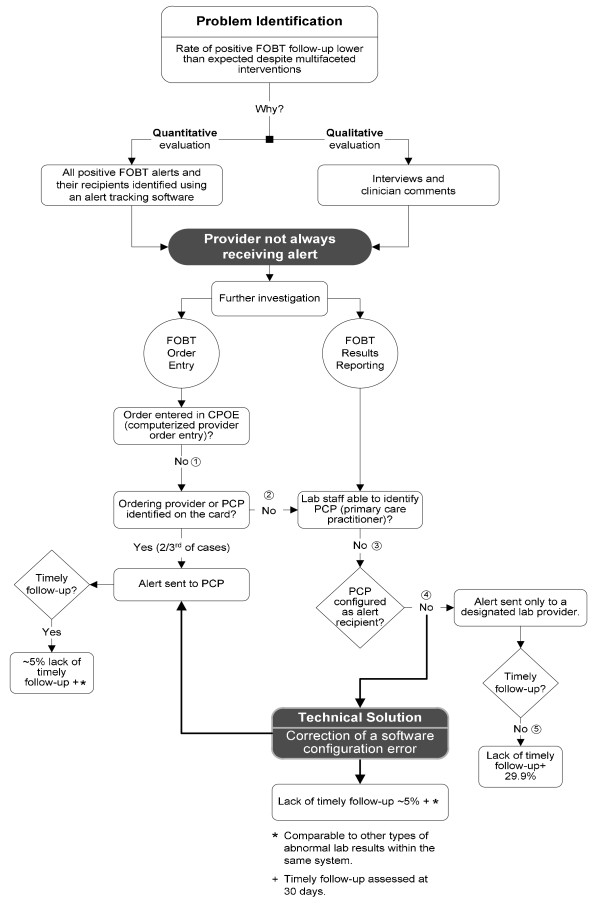
Using both qualitative and quantitative methods, we evaluated positive FOBT communication in the electronic health record of a large, urban facility between May 2008 and March 2009. We identified the source of test result communication breakdown, and developed an intervention to fix the problem. Explicit medical record reviews measured timely follow-up (defined as response within 30 days of positive FOBT) pre- and post-intervention.
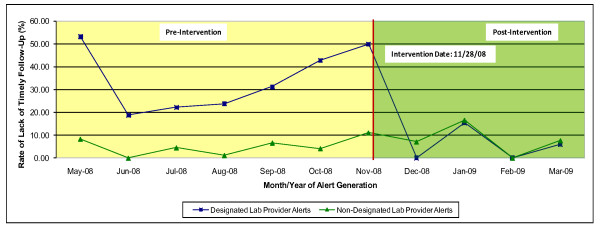
Data from 11 interviews and tracking information from 490 FOBT alerts revealed that the software intended to alert primary care practitioners (PCPs) of positive FOBT results was not configured correctly and over a third of positive FOBTs were not transmitted to PCPs. Upon correction of the technical problem, lack of timely follow-up decreased immediately from 29.9% to 5.4% (p<0.01) and was sustained at month 4 following the intervention.
Electronic communication of positive FOBT results should be monitored to avoid limiting colorectal cancer screening benefits. Robust quality assurance and oversight systems are needed to achieve this. Our methods may be useful for others seeking to improve follow-up of FOBTs in their systems.
通过及时随访粪便潜血试验(FOBT)阳性结果来早期发现结直肠癌仍然具有挑战性。在我们之前的工作中,我们发现尽管有电子结果通知程序,但在两周内,有 40%的阳性 FOBT 结果的治疗医生没有记录到任何回复。我们确定电子病历中自动化通信的技术和/或工作流程相关方面是否会导致缺乏回复。
我们使用定性和定量方法,评估了 2008 年 5 月至 2009 年 3 月期间,一家大型城市医疗机构中电子病历中阳性 FOBT 的通信情况。我们确定了测试结果通信中断的来源,并开发了一种干预措施来解决该问题。明确的病历回顾测量了干预前后的及时随访情况(定义为阳性 FOBT 后 30 天内的回复)。
11 次访谈的数据和 490 次 FOBT 警报的跟踪信息显示,旨在提醒初级保健医生(PCP)阳性 FOBT 结果的软件配置不正确,超过三分之一的阳性 FOBT 未传输给 PCP。在纠正了技术问题后,及时随访的缺乏立即从 29.9%降至 5.4%(p<0.01),并在干预后的第 4 个月持续保持。
应监测阳性 FOBT 结果的电子通信,以避免限制结直肠癌筛查的益处。需要健全的质量保证和监督系统来实现这一目标。我们的方法可能对其他寻求改善其系统中 FOBT 随访的人有用。