Li Yi, Atkin Graham M, Morales Marti M, Liu Li Qian, Tong Mingjie, Duncan R Keith
University of Illinois at Chicago, USA.
BMC Dev Biol. 2009 Dec 15;9:67. doi: 10.1186/1471-213X-9-67.
Cochlear hair cells are high-frequency sensory receptors. At the onset of hearing, hair cells acquire fast, calcium-activated potassium (BK) currents, turning immature spiking cells into functional receptors. In non-mammalian vertebrates, the number and kinetics of BK channels are varied systematically along the frequency-axis of the cochlea giving rise to an intrinsic electrical tuning mechanism. The processes that control the appearance and heterogeneity of hair cell BK currents remain unclear.
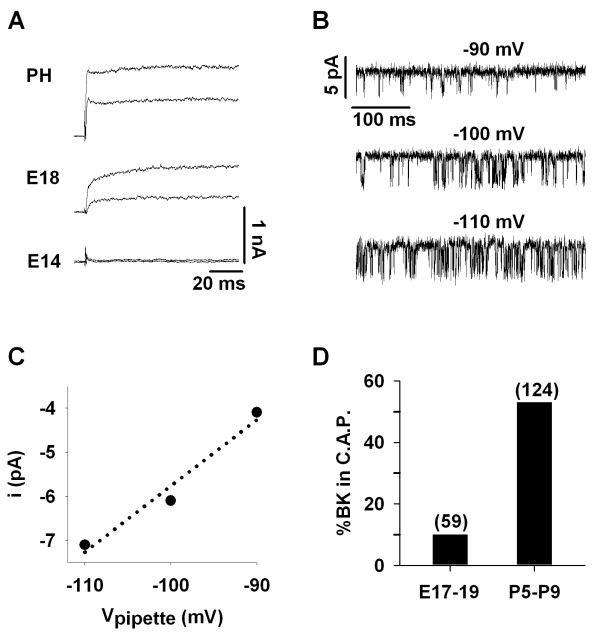
Quantitative PCR results showed a non-monotonic increase in BK alpha subunit expression throughout embryonic development of the chick auditory organ (i.e. basilar papilla). Expression peaked near embryonic day (E) 19 with six times the transcript level of E11 sensory epithelia. The steady increase in gene expression from E11 to E19 could not explain the sudden acquisition of currents at E18-19, implicating post-transcriptional mechanisms. Protein expression also preceded function but progressed in a sequence from diffuse cytoplasmic staining at early ages to punctate membrane-bound clusters at E18. Electrophysiology data confirmed a continued refinement of BK trafficking from E18 to E20, indicating a translocation of BK clusters from supranuclear to subnuclear domains over this critical developmental age.
Gene products encoding BK alpha subunits are detected up to 8 days before the acquisition of anti-BK clusters and functional BK currents. Therefore, post-transcriptional mechanisms seem to play a key role in the delayed emergence of calcium-sensitive currents. We suggest that regulation of translation and trafficking of functional alpha subunits, near voltage-gated calcium channels, leads to functional BK currents at the onset of hearing.
耳蜗毛细胞是高频感觉受体。在听力开始时,毛细胞获得快速的钙激活钾(BK)电流,将未成熟的放电细胞转变为功能性受体。在非哺乳动物脊椎动物中,BK通道的数量和动力学沿耳蜗的频率轴系统变化,产生一种内在的电调谐机制。控制毛细胞BK电流出现和异质性的过程仍不清楚。
定量PCR结果显示,在鸡听觉器官(即基底乳头)的整个胚胎发育过程中,BKα亚基表达呈非单调增加。在胚胎第19天(E19)左右表达达到峰值,转录水平是E11感觉上皮的6倍。从E11到E19基因表达的稳定增加无法解释在E18 - 19时电流的突然获得,这暗示了转录后机制。蛋白质表达也先于功能,但发展顺序是从早期的弥漫性细胞质染色到E18时的点状膜结合簇。电生理数据证实从E18到E20 BK转运持续优化,表明在这个关键发育阶段BK簇从核上区域向核下区域移位。
在获得抗BK簇和功能性BK电流前8天就能检测到编码BKα亚基的基因产物。因此,转录后机制似乎在钙敏感电流的延迟出现中起关键作用。我们认为,在电压门控钙通道附近对功能性α亚基的翻译和转运进行调控,会在听力开始时产生功能性BK电流。