Sandra A, Rotman Laboratories, McLaughlin-Rotman Centre for Global Health, University Health Network-Toronto General Hospital, McLaughlin Centre for Molecular Medicine, University of Toronto, Toronto ON, Canada.
Malar J. 2009 Dec 15;8:295. doi: 10.1186/1475-2875-8-295.
Severe and cerebral malaria are associated with endothelial activation. Angiopoietin-1 (ANG-1) and angiopoietin-2 (ANG-2) are major regulators of endothelial activation and integrity. The aim of this study was to investigate the clinical utility of whole blood angiopoietin (ANG) levels as biomarkers of disease severity in Plasmodium falciparum malaria.
The utility of whole blood ANG levels was examined in Thai patients to distinguish cerebral (CM; n = 87) and severe (non-cerebral) malaria (SM; n = 36) from uncomplicated malaria (UM; n = 70). Comparative statistics are reported using a non-parametric univariate analysis (Kruskal-Wallis test or Chi-squared test, as appropriate). Multivariate binary logistic regression was used to examine differences in whole blood protein levels between groups (UM, SM, CM), adjusting for differences due to ethnicity, age, parasitaemia and sex. Receiver operating characteristic curve analysis was used to assess the diagnostic accuracy of the ANGs in their ability to distinguish between UM, SM and CM. Cumulative organ injury scores were obtained for patients with severe disease based on the presence of acute renal failure, jaundice, severe anaemia, circulatory collapse or coma.
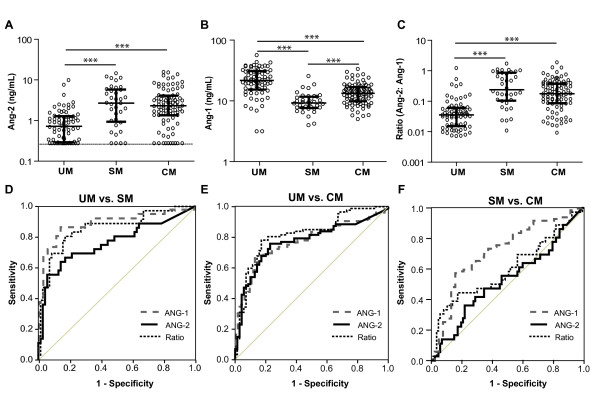
ANG-1 and ANG-2 were readily detectable in whole blood. Compared to UM there were significant decreases in ANG-1 (p < 0.001) and significant increases in ANG-2 (p < 0.001) levels and the ratio of ANG-2: ANG-1 (p < 0.001) observed in patients with SM and CM. This effect was independent of covariates (ethnicity, age, parasitaemia, sex). Further, there was a significant decrease in ANG-1 levels in patients with SM (non-cerebral) versus CM (p < 0.001). In participants with severe disease, ANG-2, but not ANG-1, levels correlated with cumulative organ injury scores; however, ANG-1 correlated with the presence of renal dysfunction and coma. Receiver operating characteristic curve analysis demonstrated that the level of ANG-1, the level of ANG-2 or the ratio of ANG-2: ANG-1 discriminated between individuals with UM and SM (area under the curve, p-value: ANG-2, 0.763, p < 0.001; ANG-1, 0.884, p < 0.001; Ratio, 0.857, p < 0.001) or UM and CM (area under the curve, p-value: ANG-2, 0.772, p < 0.001; ANG-1, 0.778, p < 0.001; Ratio, 0.820, p < 0.001).
These results suggest that whole blood ANG-1/2 levels are promising clinically informative biomarkers of disease severity in malarial syndromes.
严重疟疾和脑型疟疾与血管内皮细胞激活有关。血管生成素-1(ANG-1)和血管生成素-2(ANG-2)是血管内皮细胞激活和完整性的主要调节因子。本研究旨在探讨全血血管生成素(ANG)水平作为恶性疟原虫疟疾疾病严重程度的生物标志物的临床应用价值。
在泰国患者中检测全血 ANG 水平,以区分脑型疟疾(CM;n=87)和严重非脑型疟疾(SM;n=36)与无并发症疟疾(UM;n=70)。使用非参数单变量分析(Kruskal-Wallis 检验或卡方检验,视情况而定)报告比较统计数据。使用多元二项逻辑回归检查全血蛋白水平在 UM、SM 和 CM 组之间的差异,同时调整种族、年龄、寄生虫血症和性别差异。使用受试者工作特征曲线分析评估 ANGs 区分 UM、SM 和 CM 的诊断准确性。根据急性肾功能衰竭、黄疸、严重贫血、循环衰竭或昏迷,对严重疾病患者的累积器官损伤评分进行评估。
ANG-1 和 ANG-2 可在全血中轻易检测到。与 UM 相比,SM 和 CM 患者的 ANG-1 水平显著降低(p<0.001),ANG-2 水平显著升高(p<0.001),ANG-2:ANG-1 比值显著升高(p<0.001)。这种影响独立于协变量(种族、年龄、寄生虫血症、性别)。此外,SM(非脑型)患者的 ANG-1 水平与 CM(脑型)患者相比也显著降低(p<0.001)。在严重疾病患者中,ANG-2 水平与累积器官损伤评分相关,而不是 ANG-1 水平;然而,ANG-1 与肾功能障碍和昏迷相关。受试者工作特征曲线分析表明,ANG-1、ANG-2 或 ANG-2:ANG-1 比值可区分 UM 和 SM(曲线下面积,p 值:ANG-2,0.763,p<0.001;ANG-1,0.884,p<0.001;比值,0.857,p<0.001)或 UM 和 CM(曲线下面积,p 值:ANG-2,0.772,p<0.001;ANG-1,0.778,p<0.001;比值,0.820,p<0.001)。
这些结果表明,全血 ANG-1/2 水平是疟疾综合征疾病严重程度有前景的临床信息生物标志物。