Department of Maternal and Pediatric Sciences, University of Milan, Fondazione IRCCS Ospedale Maggiore Policlinico, Mangiagalli e Regine Elena, Via Commenda 9, 20122 Milan, Italy.
Vaccine. 2010 Feb 10;28(6):1558-65. doi: 10.1016/j.vaccine.2009.11.055. Epub 2009 Dec 8.
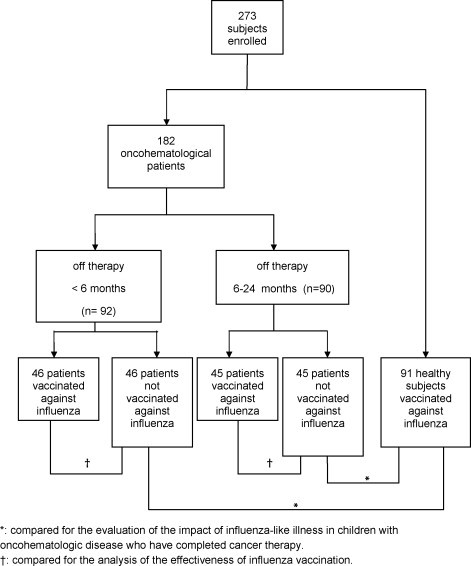
In order to evaluate the impact of influenza-like illness and the effectiveness of influenza vaccination in children with oncohematological disease who have completed cancer therapy, 182 children with a diagnosis of oncohematological disease were divided into two subgroups on the basis of the length of time off therapy (<6 months or 6-24 months) and randomised 1:1 to receive influenza vaccination or not. The controls were 91 otherwise healthy children unvaccinated against influenza. The results show that the clinical and socioeconomic impact of influenza-like illnesses and the effectiveness of influenza vaccination in oncohematological children who have completed cancer therapy are related to the length of the off therapy period, and seem to be significantly greater in those who have been off therapy for less than 6 months in comparison with healthy controls. This suggests that the administration of influenza vaccination should be strongly recommended only among oncohematological children who have been off therapy for less than 6 months.
为了评估流感样疾病对已完成癌症治疗的肿瘤血液病患儿的影响,以及流感疫苗接种的效果,根据治疗结束时间(<6 个月或 6-24 个月),将 182 名诊断为肿瘤血液病的患儿分为两个亚组,并以 1:1 的比例随机分配接受流感疫苗接种或不接种。对照组为 91 名未接种流感疫苗的健康儿童。结果表明,流感样疾病的临床和社会经济学影响以及流感疫苗接种在已完成癌症治疗的肿瘤血液病患儿中的效果与治疗结束时间有关,与健康对照组相比,治疗结束时间不足 6 个月的患儿的影响似乎明显更大。这表明,仅应强烈建议在治疗结束时间不足 6 个月的肿瘤血液病患儿中接种流感疫苗。