Department of Public Health and Epidemiology, Swiss Tropical Institute, Basel, Switzerland.
PLoS One. 2009 Dec 9;4(12):e8215. doi: 10.1371/journal.pone.0008215.
Bovine tuberculosis (BTB) today primarily affects developing countries. In Africa, the disease is present essentially on the whole continent; however, little accurate information on its distribution and prevalence is available. Also, attempts to evaluate diagnostic tests for BTB in naturally infected cattle are scarce and mostly complicated by the absence of knowledge of the true disease status of the tested animals. However, diagnostic test evaluation in a given setting is a prerequisite for the implementation of local surveillance schemes and control measures.
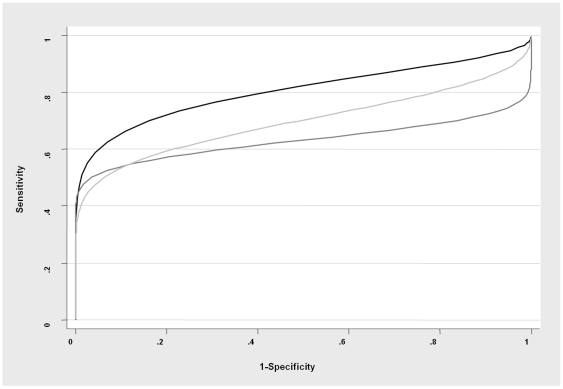
METHODOLOGY/PRINCIPAL FINDINGS: We subjected a slaughterhouse population of 954 Chadian cattle to single intra-dermal comparative cervical tuberculin (SICCT) testing and two recently developed fluorescence polarization assays (FPA). Using a Bayesian modeling approach we computed the receiver operating characteristic (ROC) curve of each diagnostic test, the true disease prevalence in the sampled population and the disease status of all sampled animals in the absence of knowledge of the true disease status of the sampled animals. In our Chadian setting, SICCT performed better if the cut-off for positive test interpretation was lowered from >4 mm (OIE standard cut-off) to >2 mm. Using this cut-off, SICCT showed a sensitivity and specificity of 66% and 89%, respectively. Both FPA tests showed sensitivities below 50% but specificities above 90%. The true disease prevalence was estimated at 8%. Altogether, 11% of the sampled animals showed gross visible tuberculous lesions. However, modeling of the BTB disease status of the sampled animals indicated that 72% of the suspected tuberculosis lesions detected during standard meat inspections were due to other pathogens than Mycobacterium bovis.
CONCLUSIONS/SIGNIFICANCE: Our results have important implications for BTB diagnosis in a high incidence sub-Saharan African setting and demonstrate the practicability of our Bayesian approach for diagnostic test evaluation.
牛结核病(BTB)目前主要影响发展中国家。在非洲,该疾病基本上存在于整个非洲大陆;然而,关于其分布和流行情况的准确信息很少。此外,评估在自然感染牛中的 BTB 诊断测试的尝试很少,并且大多数都因缺乏对受测试动物真实疾病状态的了解而复杂化。然而,在特定环境中评估诊断测试是实施本地监测计划和控制措施的前提。
方法/主要发现:我们对 954 头乍得牛进行了单次皮内比较颈结核菌素(SICCT)检测和两种新开发的荧光偏振检测(FPA)。使用贝叶斯建模方法,我们计算了每种诊断测试的接收者操作特征(ROC)曲线、采样人群中的真实疾病流行率以及在不知道采样动物真实疾病状态的情况下所有采样动物的疾病状态。在乍得的情况下,如果将阳性测试解释的截断值从>4 毫米(OIE 标准截断值)降低到>2 毫米,则 SICCT 的性能会更好。使用该截断值,SICCT 的灵敏度和特异性分别为 66%和 89%。两种 FPA 测试的灵敏度均低于 50%,但特异性均高于 90%。真实疾病流行率估计为 8%。总共,11%的采样动物表现出明显可见的结核病变。然而,对采样动物的 BTB 疾病状态进行建模表明,在标准肉品检验中检测到的疑似结核病病变中有 72%是由除牛分枝杆菌以外的其他病原体引起的。
结论/意义:我们的结果对高发病率撒哈拉以南非洲环境中的 BTB 诊断具有重要意义,并证明了我们的贝叶斯方法用于诊断测试评估的可行性。