Johns Hopkins University School of Medicine, Baltimore, Maryland 21287, USA.
J Urol. 2010 Feb;183(2):571-5. doi: 10.1016/j.juro.2009.09.085. Epub 2009 Dec 16.
Previous epidemiological works have reported that obesity is a risk factor for kidney stone disease. However, the effect of increasing degrees of obesity on stone formation has yet to be defined. To address this question we examined how an increasing body mass index affects the risk of kidney stone disease.
We evaluated claims from a 5-year period (2002 to 2006) in a national private insurance database to identify subjects diagnosed with or treated for kidney stones. From a data set of 95,598 patients, subjects were identified by ICD-9 or CPT codes specific to kidney stone disease. Descriptive analyses were performed and odds ratios were calculated.
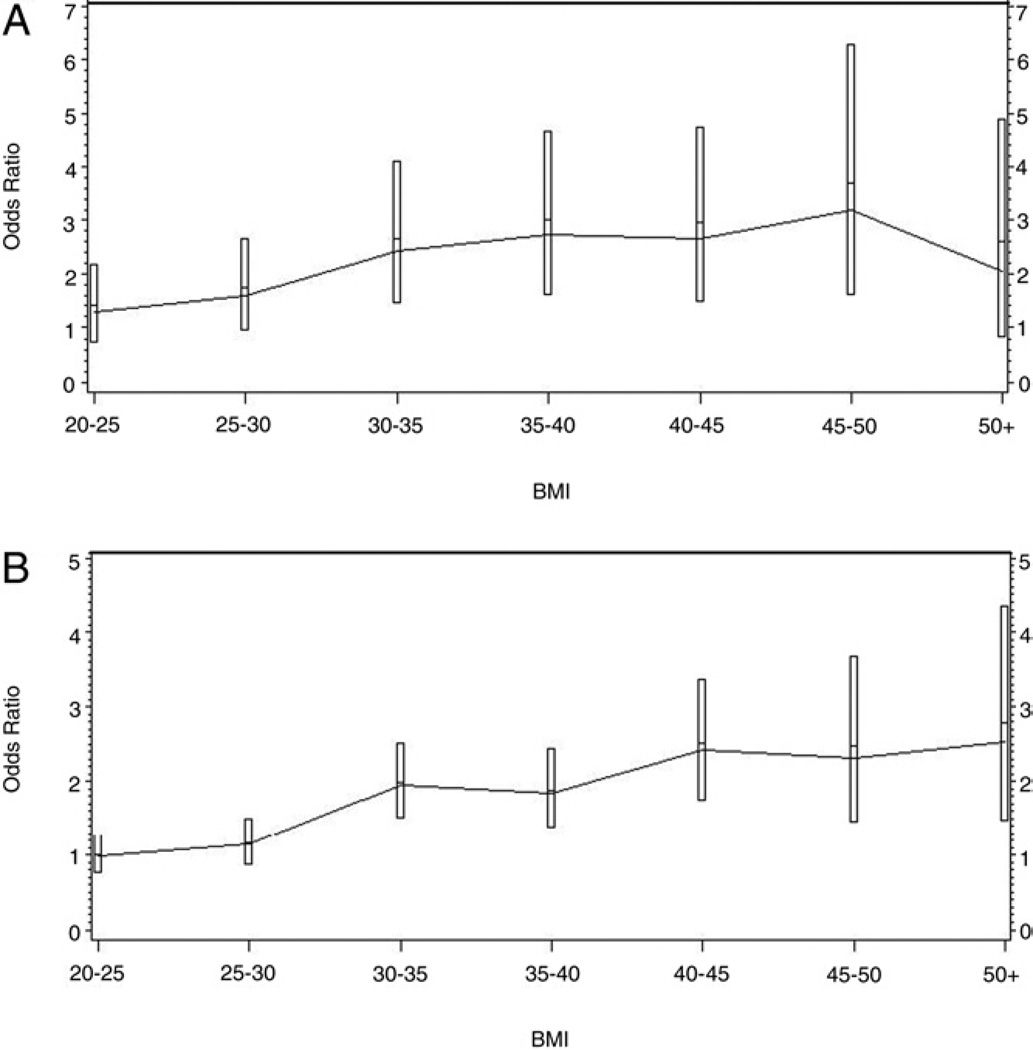
Gender distribution of the 3,257 stone formers was 42.9% male and 57.1% female. Obesity (body mass index greater than 30 kg/m(2)) was associated with a significantly greater likelihood of being diagnosed with a kidney stone. However, when obese patients were stratified by body mass index there were no significant differences in the likelihood of a kidney stone diagnosis, suggesting a stabilization of risk once body mass index increased above 30 kg/m(2). The association of body mass index and a stone removal procedure was significant only for men and women with a body mass index between 30 and 45 kg/m(2) relative to a body mass index less than 25 kg/m(2) (p <0.001).
An obese body mass index is associated with an increased risk of kidney stone disease. However, the magnitude of this risk appears to be stable in the morbidly obese population. Once body mass index is greater than 30 kg/m(2), further increases do not appear to significantly increase the risk of stone disease.
之前的流行病学研究报告指出,肥胖是肾结石病的一个危险因素。然而,肥胖程度增加对结石形成的影响尚未确定。为了解决这个问题,我们研究了体重指数的增加如何影响肾结石病的风险。
我们评估了一个全国性私人保险数据库中 5 年(2002 年至 2006 年)的索赔数据,以确定诊断为肾结石或接受肾结石治疗的患者。从一个包含 95598 名患者的数据集中,通过 ICD-9 或 CPT 代码识别出特定于肾结石病的患者。进行了描述性分析并计算了比值比。
3257 名结石形成者的性别分布为男性占 42.9%,女性占 57.1%。肥胖(体重指数大于 30 kg/m2)与被诊断为肾结石的可能性显著增加相关。然而,当肥胖患者按体重指数分层时,其肾结石诊断的可能性没有显著差异,这表明一旦体重指数增加到 30 kg/m2 以上,风险就趋于稳定。体重指数与结石清除术之间的关联仅对体重指数在 30 至 45 kg/m2 之间的男性和女性与体重指数小于 25 kg/m2 的患者有意义(p<0.001)。
肥胖的体重指数与肾结石病的风险增加相关。然而,这种风险的程度在病态肥胖人群中似乎是稳定的。一旦体重指数大于 30 kg/m2,进一步增加似乎不会显著增加结石病的风险。