Department of Urology, Mayo Clinic, Rochester, Minnesota, USA.
J Urol. 2012 Jul;188(1):247-52. doi: 10.1016/j.juro.2012.03.021. Epub 2012 May 15.
We conducted a population based pediatric study to determine the incidence of symptomatic kidney stones during a 25-year period and to identify factors related to variation in stone incidence during this period.
The Rochester Epidemiology Project was used to identify all patients younger than 18 years who were diagnosed with kidney stones in Olmsted County, Minnesota from 1984 to 2008. Medical records were reviewed to validate first time symptomatic stone formers with identification of age appropriate symptoms plus stone confirmation by imaging or passage. The incidence of symptomatic stones by age, gender and study period was compared. Clinical characteristics of incident stone formers were described.
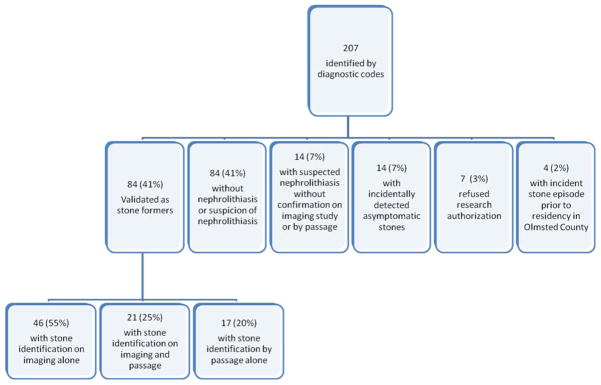
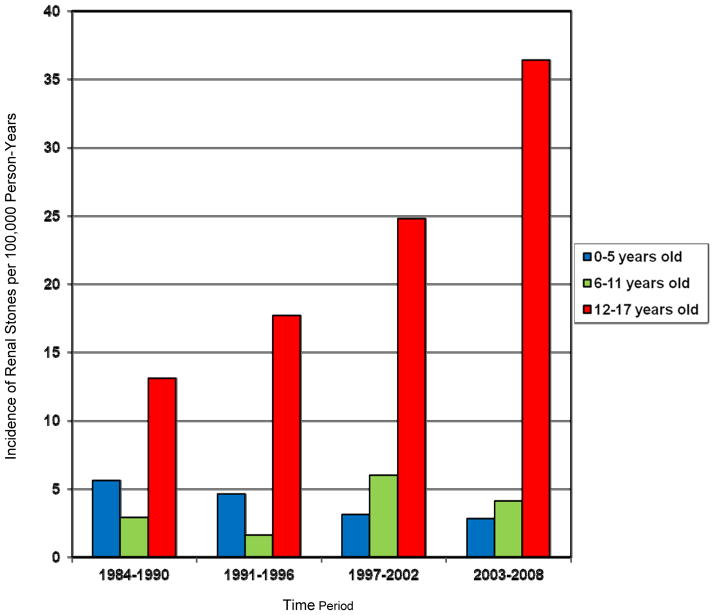
A total of 207 children received a diagnostic code for kidney stones, of whom 84 (41%) were validated as incident stone formers. The incidence rate increased 4% per calendar year (p = 0.01) throughout the 25-year period. This finding was due to a 6% yearly increased incidence in children 12 to 17 years old (p = 0.02 for age × calendar year interaction) with an increase from 13 per 100,000 person-years between 1984 and 1990 to 36 per 100,000 person-years between 2003 and 2008. Computerized tomography identified the stone in 6% of adolescent stone formers (1 of 18) from 1984 to 1996 vs 76% (34 of 45) from 1997 to 2008. The incidence of spontaneous stone passage in adolescents did not increase significantly between these 2 periods (16 vs 18 per 100,000 person-years, p = 0.30).
The incidence of kidney stones increased dramatically among adolescents in the general population during a 25-year period. The exact cause of this finding remains to be determined.
我们进行了一项基于人群的儿科研究,旨在确定 25 年内症状性肾结石的发病率,并确定在此期间结石发病率变化相关的因素。
使用罗切斯特流行病学项目来确定明尼苏达州奥姆斯特德县所有 18 岁以下被诊断为肾结石的患者。通过影像学或通过结石确认来回顾医疗记录,以验证首次出现症状性结石形成者,其年龄适合出现症状加上结石。按年龄、性别和研究期间比较症状性结石的发病率。描述新发性结石形成者的临床特征。
共有 207 名儿童获得肾结石诊断代码,其中 84 名(41%)被确认为新发性结石形成者。整个 25 年期间,发病率每年增加 4%(p = 0.01)。这一发现是由于 12 至 17 岁儿童每年发病率增加 6%(年龄×日历年交互作用的 p = 0.02),1984 年至 1990 年每 10 万人年发病率为 13 例,2003 年至 2008 年增加到每 10 万人年 36 例。1984 年至 1996 年,计算机断层扫描在 6%的青少年结石形成者(18 例中的 1 例)中发现结石,而在 1997 年至 2008 年期间为 76%(45 例中的 34 例)。这两个时期青少年自发性结石通过的发生率没有显著增加(每 10 万人年分别为 16 例和 18 例,p = 0.30)。
在 25 年内,普通人群中青少年肾结石的发病率显著增加。这一发现的确切原因仍有待确定。