UMR 6553 Ecobio, Université Rennes1/CNRS, Paimpont, France.
PLoS One. 2009 Dec 18;4(12):e8375. doi: 10.1371/journal.pone.0008375.
Emerging infectious diseases in wildlife are major threats for both human health and biodiversity conservation. Infectious diseases can have serious consequences for the genetic diversity of populations, which could enhance the species' extinction probability. The Ebola epizootic in western and central Africa induced more than 90% mortality in Western lowland gorilla population. Although mortality rates are very high, the impacts of Ebola on genetic diversity of Western lowland gorilla have never been assessed.
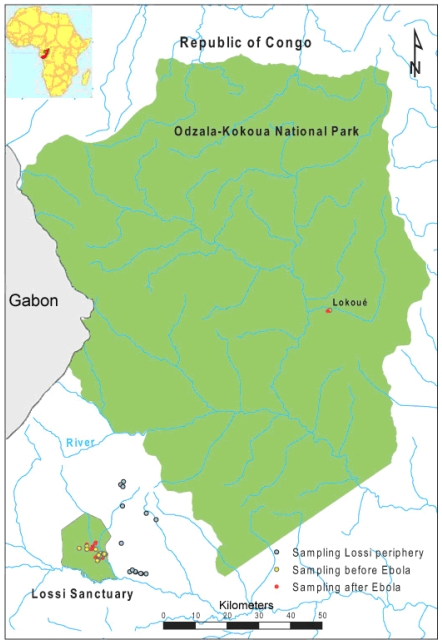
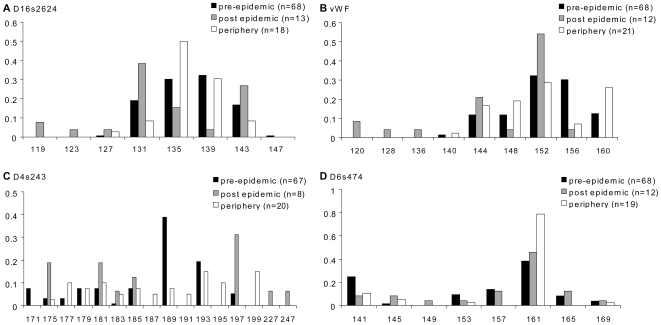
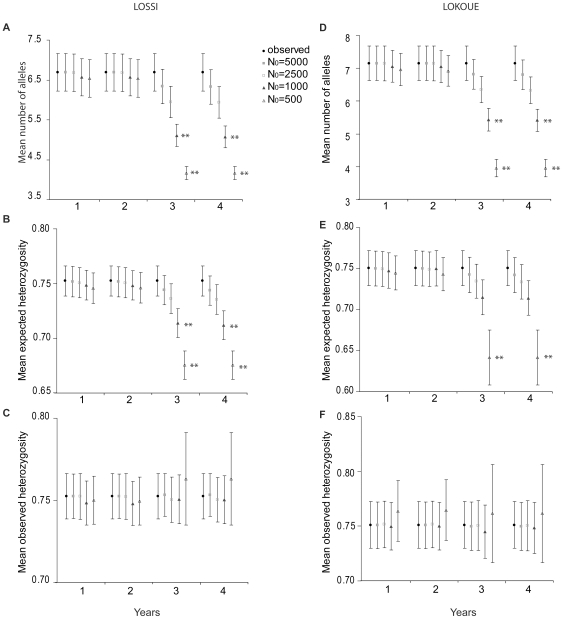
METHODOLOGY/PRINCIPAL FINDINGS: We carried out long term studies of three populations of Western lowland gorilla in the Republic of the Congo (Odzala-Kokoua National Park, Lossi gorilla sanctuary both affected by Ebola and Lossi's periphery not affected). Using 17 microsatellite loci, we compared genetic diversity and structure of the populations and estimate their effective size before and after Ebola outbreaks. Despite the effective size decline in both populations, we did not detect loss in genetic diversity after the epizootic. We revealed temporal changes in allele frequencies in the smallest population.
CONCLUSIONS/SIGNIFICANCE: Immigration and short time elapsed since outbreaks could explain the conservation of genetic diversity after the demographic crash. Temporal changes in allele frequencies could not be explained by genetic drift or random sampling. Immigration from genetically differentiated populations and a non random mortality induced by Ebola, i.e., selective pressure and cost of sociality, are alternative hypotheses. Understanding the influence of Ebola on gorilla genetic dynamics is of paramount importance for human health, primate evolution and conservation biology.
野生动物中的新发传染病是人类健康和生物多样性保护的主要威胁。传染病会对种群的遗传多样性产生严重影响,从而增加物种灭绝的概率。在西非和中非爆发的埃博拉疫情导致西部低地大猩猩种群的死亡率超过 90%。尽管死亡率非常高,但埃博拉对西部低地大猩猩遗传多样性的影响从未得到评估。
方法/主要发现:我们对刚果共和国(奥扎拉-科库阿国家公园、洛西大猩猩保护区均受到埃博拉影响和洛西外围未受影响)的三个西部低地大猩猩种群进行了长期研究。利用 17 个微卫星基因座,我们比较了种群的遗传多样性和结构,并在埃博拉爆发前后估计了它们的有效种群大小。尽管两个种群的有效种群大小都有所下降,但我们没有发现疫情后遗传多样性的丧失。我们揭示了最小种群中等位基因频率的时间变化。
结论/意义:移民和疫情爆发后时间较短,可以解释在种群崩溃后遗传多样性的保护。等位基因频率的时间变化不能用遗传漂变或随机抽样来解释。来自遗传分化种群的移民和埃博拉导致的非随机死亡率,即选择压力和社会性成本,是替代假说。了解埃博拉对大猩猩遗传动态的影响对于人类健康、灵长类进化和保护生物学至关重要。