Department of Experimental Psychology, Helmholtz Research Institute, Utrecht University, Heidelberglaan 2, 3584 CS Utrecht, The Netherlands.
Psychopharmacology (Berl). 2010 Feb;208(3):469-74. doi: 10.1007/s00213-009-1747-5. Epub 2009 Dec 18.
Alcohol has renowned behavioral disinhibitory properties which are suggested to involve reductions in frontal lobe functioning as a result of diminished interhemispheric connectivity.
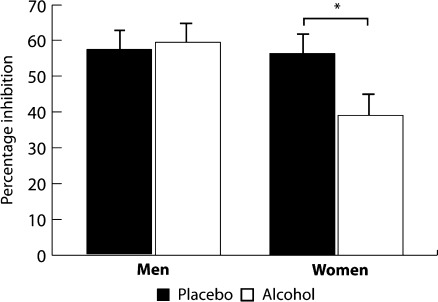
To examine sex differences in frontal interhemispheric connectivity in response to alcohol, 12 female and ten male healthy volunteers received a single administration of 0.5 per thousand alcohol in a placebo-controlled counterbalanced crossover design. Paired-pulse transcranial magnetic stimulation was applied to measure transcallosal inhibition (TCI) between the left and right primary motor cortex (M1).
Results showed significant reductions in TCI after alcohol administration in female participants exclusively.
These findings provide the first evidence that moderate doses of alcohol differentially affect frontal interhemispheric connectivity in males and females. The present data may shed new light on the physiological mechanisms underlying sex differences in the susceptibility to alcohol.
酒精具有众所周知的行为抑制特性,据推测,这与由于半球间连接减少导致的额叶功能下降有关。
为了研究酒精对额叶半球间连接的性别差异,12 名女性和 10 名男性健康志愿者接受了单剂量 0.5‰的酒精和安慰剂对照的交叉设计。应用成对脉冲经颅磁刺激测量左、右侧初级运动皮层(M1)之间的皮质间抑制(TCI)。
结果显示,女性参与者在饮酒后 TCI 显著降低。
这些发现首次提供了证据,表明中等剂量的酒精会对男性和女性的额叶半球间连接产生不同的影响。本研究结果可能为酒精易感性的性别差异的生理机制提供新的见解。