Program of Cancer Biology, Department of Cancer Biology and Pharmacology, University of Illinois College of Medicine at Peoria, Peoria, IL 61605, USA.
Int J Cancer. 2010 Sep 1;127(5):1081-95. doi: 10.1002/ijc.25134.
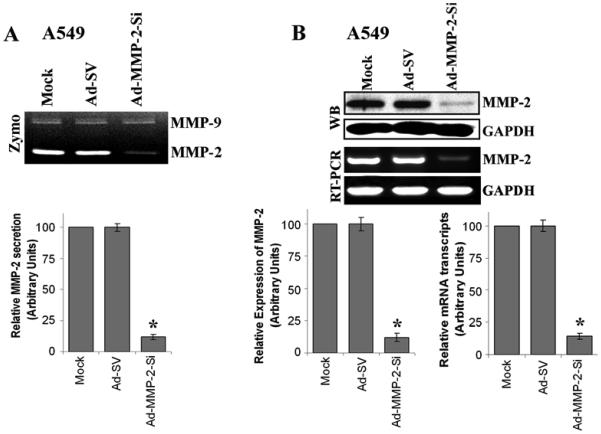
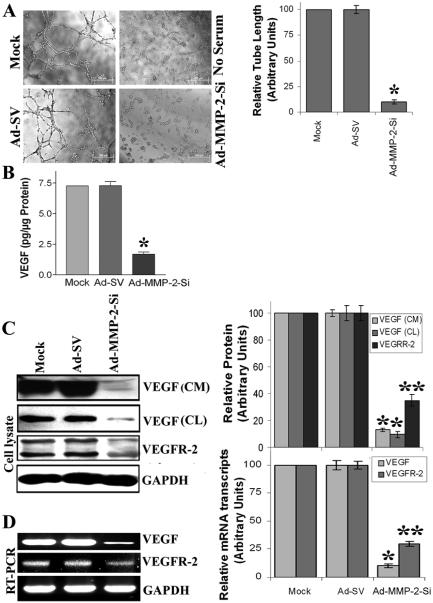
Vascular endothelial growth factor (VEGF) is one of the most important angiogenic growth factors for tumor angiogenesis. Here, we sought to explore whether RNA interference (RNAi) targeting matrix metalloproteinase-2 (MMP-2) could disrupt VEGF-mediated angiogenesis in lung cancer. MMP-2 siRNA inhibited lung cancer cell-induced tube formation of endothelial cells in vitro; addition of recombinant human-MMP-2 restored angiogenesis. MMP-2 transcriptional suppression decreased VEGF, phosphatidylinositol 3-kinase (PI3K) protein levels and AKT phosphorylation in lung cancer cells. In addition, MMP-2 suppression decreased hypoxia inducible factor-1alpha (HIF-1alpha), a transcription factor for VEGF, as determined by electrophoretic mobility shift assay (EMSA). We also show that MMP-2 suppression disrupted PI3K dependent VEGF expression; ectopic expression of myr-AKT restored VEGF inhibition. Further, MMP-2 suppression decreased the interaction of integrin-alphaVbeta3 and MMP-2 as confirmed by immunoprecipitation analyses. Studies with either function blocking integrin-alphaVbeta3 antibody or MMP-2 specific inhibitor (ARP-100) indicate that suppression of MMP-2 decreased integrin-alphaVbeta3-mediated induction of PI3K/AKT leading to decreased VEGF expression. Moreover, A549 xenograft tissue sections from mice that treated with MMP-2 siRNA showed reduced expression of VEGF and the angiogenic marker, factor-VIII. The inhibition of tumor angiogenesis in MMP-2 suppressed tumor sections was associated with decreased co-localization of integrin-alphaVbeta3 and MMP-2. In summary, these data provide new insights into the mechanisms underlying MMP-2-mediated VEGF expression in lung tumor angiogenesis.
血管内皮生长因子(VEGF)是肿瘤血管生成中最重要的血管生成生长因子之一。在这里,我们试图探讨针对基质金属蛋白酶-2(MMP-2)的 RNA 干扰(RNAi)是否可以破坏肺癌中的 VEGF 介导的血管生成。MMP-2 siRNA 抑制了 MMP-2 对肺癌细胞诱导的内皮细胞管形成的抑制作用;添加重组人-MMP-2 恢复了血管生成。MMP-2 转录抑制降低了肺癌细胞中 VEGF、磷酸肌醇 3-激酶(PI3K)蛋白水平和 AKT 磷酸化。此外,电泳迁移率变动分析(EMSA)表明,MMP-2 抑制降低了缺氧诱导因子-1alpha(HIF-1alpha),即 VEGF 的转录因子。我们还表明,MMP-2 抑制破坏了 PI3K 依赖的 VEGF 表达;外源性表达 myr-AKT 恢复了 VEGF 的抑制。此外,免疫沉淀分析证实,MMP-2 抑制减少了整合素-αVβ3 和 MMP-2 的相互作用。用功能阻断整合素-αVβ3 抗体或 MMP-2 特异性抑制剂(ARP-100)进行的研究表明,MMP-2 的抑制降低了整合素-αVβ3 介导的 PI3K/AKT 诱导,从而导致 VEGF 表达减少。此外,用 MMP-2 siRNA 处理的小鼠的 A549 异种移植组织切片显示 VEGF 和血管生成标志物因子-VIII 的表达减少。MMP-2 抑制肿瘤组织中的肿瘤血管生成与整合素-αVβ3 和 MMP-2 的共定位减少有关。总之,这些数据为 MMP-2 介导的肺癌血管生成中 VEGF 表达的机制提供了新的见解。