Comparative Oncology Program, Center for Cancer Research, National Cancer Institute, National Institutes of Health, Bethesda, MD 20892, USA.
BMC Genomics. 2009 Dec 23;10:625. doi: 10.1186/1471-2164-10-625.
Pulmonary metastasis continues to be the most common cause of death in osteosarcoma. Indeed, the 5-year survival for newly diagnosed osteosarcoma patients has not significantly changed in over 20 years. Further understanding of the mechanisms of metastasis and resistance for this aggressive pediatric cancer is necessary. Pet dogs naturally develop osteosarcoma providing a novel opportunity to model metastasis development and progression. Given the accelerated biology of canine osteosarcoma, we hypothesized that a direct comparison of canine and pediatric osteosarcoma expression profiles may help identify novel metastasis-associated tumor targets that have been missed through the study of the human cancer alone.
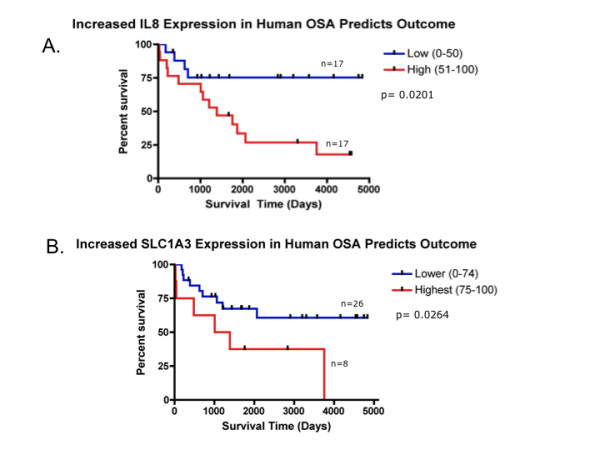
Using parallel oligonucleotide array platforms, shared orthologues between species were identified and normalized. The osteosarcoma expression signatures could not distinguish the canine and human diseases by hierarchical clustering. Cross-species target mining identified two genes, interleukin-8 (IL-8) and solute carrier family 1 (glial high affinity glutamate transporter), member 3 (SLC1A3), which were uniformly expressed in dog but not in all pediatric osteosarcoma patient samples. Expression of these genes in an independent population of pediatric osteosarcoma patients was associated with poor outcome (p = 0.020 and p = 0.026, respectively). Validation of IL-8 and SLC1A3 protein expression in pediatric osteosarcoma tissues further supported the potential value of these novel targets. Ongoing evaluation will validate the biological significance of these targets and their associated pathways.
Collectively, these data support the strong similarities between human and canine osteosarcoma and underline the opportunities provided by a comparative oncology approach as a means to improve our understanding of cancer biology and therapies.
肺转移仍然是骨肉瘤患者最常见的死亡原因。事实上,20 多年来,新诊断的骨肉瘤患者的 5 年生存率没有显著变化。需要进一步了解这种侵袭性儿科癌症的转移和耐药机制。宠物狗自然会患上骨肉瘤,为模拟转移的发展和进展提供了一个新的机会。鉴于犬骨肉瘤的生物学加速,我们假设对犬和儿科骨肉瘤表达谱进行直接比较,可能有助于确定通过研究人类癌症而遗漏的新的转移相关肿瘤靶点。
使用平行寡核苷酸阵列平台,鉴定了物种之间的共享直系同源物并进行了标准化。基于层次聚类,骨肉瘤表达谱无法区分犬科和人类疾病。交叉物种的靶点挖掘确定了两个基因,白细胞介素 8(IL-8)和溶质载体家族 1(谷氨酸转运体高亲和力胶质)成员 3(SLC1A3),这两个基因在犬科中普遍表达,但在所有儿科骨肉瘤患者样本中并不表达。这些基因在另一组儿科骨肉瘤患者中的表达与不良预后相关(分别为 p = 0.020 和 p = 0.026)。在儿科骨肉瘤组织中对 IL-8 和 SLC1A3 蛋白表达的验证进一步支持了这些新靶点的潜在价值。正在进行的评估将验证这些靶标及其相关通路的生物学意义。
总的来说,这些数据支持人类和犬科骨肉瘤之间的高度相似性,并强调了比较肿瘤学方法提供的机会,这是提高我们对癌症生物学和治疗的理解的一种手段。