Department of Cellular and Molecular Medicine, St George's University, Cranmer Terrace, London, SW17 0RE, UK.
Gut Pathog. 2009 Dec 23;1:25. doi: 10.1186/1757-4749-1-25.
Antibiotic therapy targeting chronic mycobacterial disease is often ineffective due to problems with the emergence of drug resistance and non-replicating persistent intracellular antibiotic resistant phenotypes. Strategies which include agents able to enhance host cell killing mechanisms could represent an alternative to conventional methods with the potential for host clearance if active against dormant phenotypes. Investigations of agents with potential activity against non-replicating mycobacteria however are restricted due to a need for assays that can assess bacterial viability without having to culture.
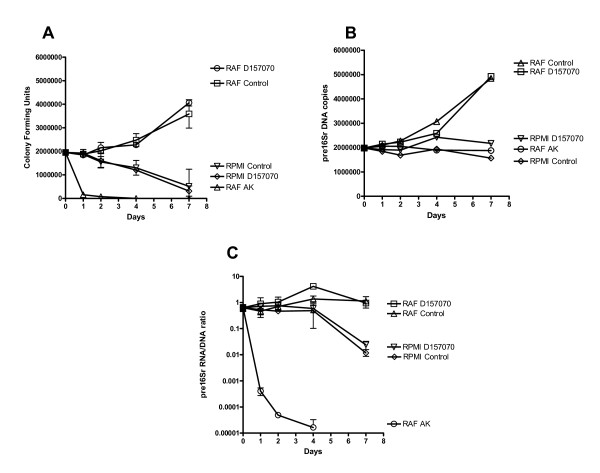
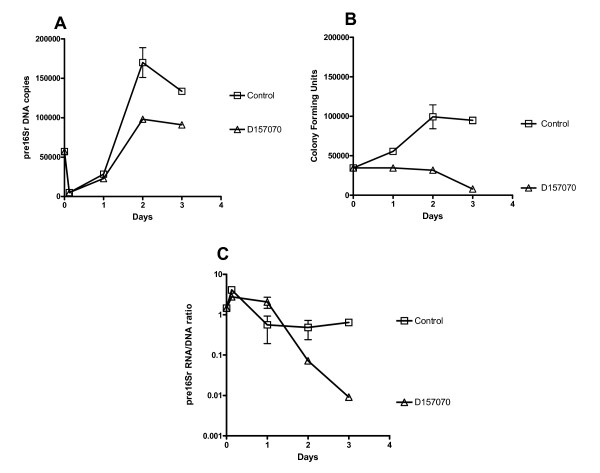
This study describes the development and use of a pre16S ribosomal gene RNA/DNA ratio viability assay which is independent of the need for culture, supported by a novel thin layer accelerated mycobacterial colony forming method for determining viability and culturability of MAP in intracellular environments. We describe the use of these tools to demonstrate intracellular killing activity of a novel rhodanine agent (D157070) against the intracellular pathogen Mycobacterium avium subspecies paratuberculosis (MAP) and show that the culturability of MAP decreases relative to its viability on intracellular entry suggesting the induction of a non-culturable phenotype. We further demonstrate that D157070, although having no direct activity against the culturability of extracellular MAP, can bind to cultured MAP cells and has significant influence on the MAP transcriptome, particularly with respect of delta(L )associated genes. D157070 is shown to be taken up by bovine and human cells and able to enhance host cell killing, as measured by significant decreases in both culturability and viability of intracellular MAP.
This work suggests that pre16srRNA gene ratios represent a viable method for studying MAP viability. In addition, the rhodanine agent D157070 tested is non-toxic and enhances cell killing activity against both growing and latent MAP phenotypes.
针对慢性分枝杆菌病的抗生素治疗通常由于药物耐药性的出现和非复制性持续存在的细胞内抗生素耐药表型的问题而无效。包括能够增强宿主细胞杀伤机制的药物在内的策略可能代表了一种替代传统方法的方法,如果对休眠表型有效,则有可能清除宿主。然而,由于需要能够在不培养的情况下评估细菌活力的测定方法,因此对具有潜在非复制性分枝杆菌活性的药物的研究受到限制。
本研究描述了一种新的前 16S 核糖体基因 RNA/DNA 比活力测定法的开发和应用,该方法不依赖于培养,同时支持一种新的薄层加速分枝杆菌集落形成方法,用于确定 MAP 在细胞内环境中的活力和可培养性。我们描述了这些工具的用途,以证明新型罗丹明试剂(D157070)对细胞内病原体禽分枝杆菌亚种副结核分枝杆菌(MAP)的细胞内杀伤活性,并表明 MAP 的可培养性相对于其进入细胞内的活力降低,表明诱导了非可培养表型。我们进一步证明,尽管 D157070 对培养 MAP 的可培养性没有直接活性,但它可以与培养的 MAP 细胞结合,并对 MAP 转录组产生重大影响,特别是与 delta(L)相关基因。D157070 被证明可以被牛和人细胞摄取,并能够增强宿主细胞杀伤作用,如细胞内 MAP 的可培养性和活力均显著降低所证明的那样。
这项工作表明,前 16srRNA 基因比代表了研究 MAP 活力的一种可行方法。此外,测试的罗丹明试剂 D157070 无毒,并且能够增强对生长和潜伏 MAP 表型的细胞杀伤活性。