Dept of Anesthesia and Critical Care, Massachusetts General Hospital, 55 Fruit St, Boston, MA 02114-2696, USA.
Eur Respir J. 2010 Sep;36(3):569-76. doi: 10.1183/09031936.00153809. Epub 2009 Dec 23.
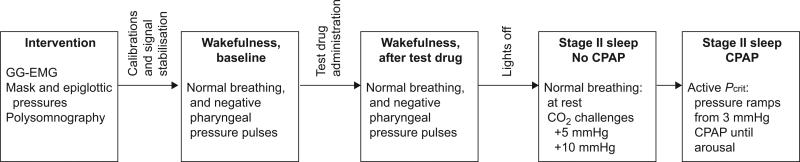
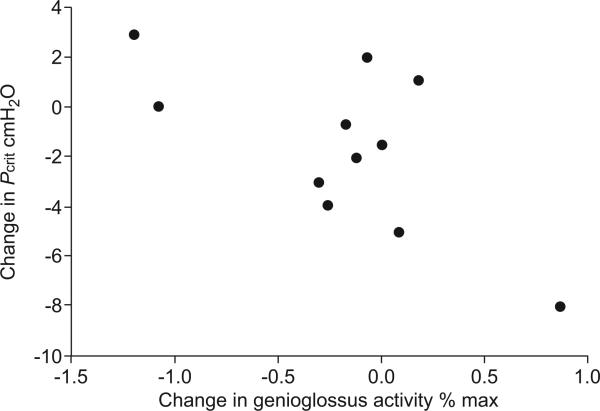
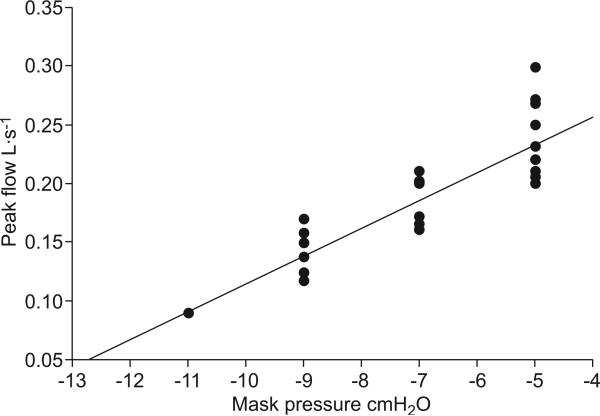
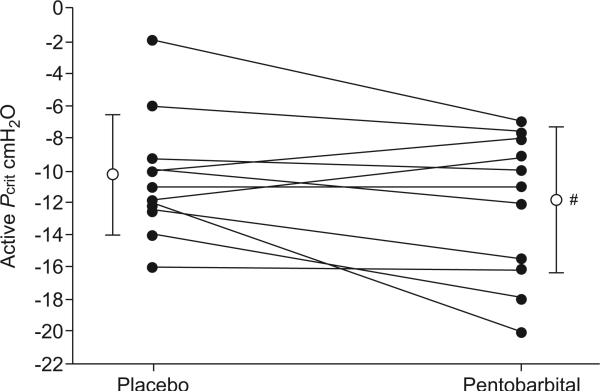
We hypothesised that pentobarbital would improve upper airway mechanics based on an increase in latency to arousal and amplitude of the phasic genioglossus electromyogram (EMG), and a decrease in the active upper airway critical closing pressure (P(crit)). 12 healthy subjects received pentobarbital (100 mg) or placebo in a double-blind, crossover protocol. During wakefulness, we measured the genioglossus reflex response to negative pressure pulses. During sleep, carbon dioxide was insufflated into the inspired air. Airway pressure was then decreased in a stepwise fashion until arousal from sleep. With basal breathing during sleep: flow rate was lower in volunteers given pentobarbital; end-tidal CO(2) concentration and upper airway resistance were greater; and P(crit) was unaffected (pentobarbital mean ± SD -11.7 ± 4.5 versus placebo -10.25 ± 3.6 cmH(2)O; p = 0.11). Pentobarbital increased the time to arousal (297 ± 63s versus 232 ± 67 s; p<0.05), at which time phasic genioglossus EMG was higher (6.2 ± 4.8% maximal versus 3.1 ± 3%; p<0.05) as were CO(2) levels. The increase in genioglossus EMG after CO(2) administration was greater after pentobarbital versus placebo. Pentobarbital did not affect the genioglossus negative-pressure reflex. Pentobarbital increases the time to arousal and stimulates genioglossus muscle activity, but it also increases upper airway resistance during sleep.
我们假设戊巴比妥可通过增加觉醒潜伏期和瞬态颏舌肌肌电图(EMG)幅度,以及降低主动上气道临界关闭压(Pcrit)来改善上气道力学。12 名健康受试者采用双盲交叉方案接受戊巴比妥(100mg)或安慰剂治疗。在觉醒状态下,我们测量了颏舌肌对负压脉冲的反射反应。在睡眠期间,将二氧化碳吹入吸入空气中。然后逐步降低气道压力,直至从睡眠中觉醒。在睡眠期间进行基础呼吸时:给予戊巴比妥的志愿者的流速较低;呼气末二氧化碳浓度和上气道阻力增加;而 Pcrit 不受影响(戊巴比妥平均值 ± SD-11.7 ± 4.5 与安慰剂-10.25 ± 3.6cmH2O;p=0.11)。戊巴比妥增加了觉醒时间(297 ± 63s 与 232 ± 67s;p<0.05),此时瞬态颏舌肌 EMG 更高(6.2 ± 4.8%最大与 3.1 ± 3%;p<0.05),二氧化碳水平也更高。与安慰剂相比,给予二氧化碳后,颏舌肌 EMG 的增加在戊巴比妥后更大。戊巴比妥不影响颏舌肌负压反射。戊巴比妥可延长觉醒时间并刺激颏舌肌肌肉活动,但也会增加睡眠期间的上气道阻力。