Boehringer Ingelheim Pharmaceuticals, Ridgefield, CT 06877-0368, USA.
Int J Chron Obstruct Pulmon Dis. 2009;4:397-409. doi: 10.2147/copd.s4802. Epub 2009 Nov 29.
Tiotropium is a long-acting inhaled anticholinergic developed for the treatment of chronic obstructive pulmonary disease (COPD) and has been available since 2002. We sought to update an evaluation of the safety of tiotropium in the HandiHaler formulation as significant clinical trial data have become available over time.
Pooled analysis of adverse event reporting from phase III and IV tiotropium HandiHaler clinical trials with the following characteristics was performed: randomized, double-blind, parallel group, placebo-controlled design, tiotropium 18 microg once-daily dosing, COPD indication, duration of at least four weeks. Incidence rates by treatment group, rate differences (tiotropium-placebo), and 95% confidence intervals were determined.
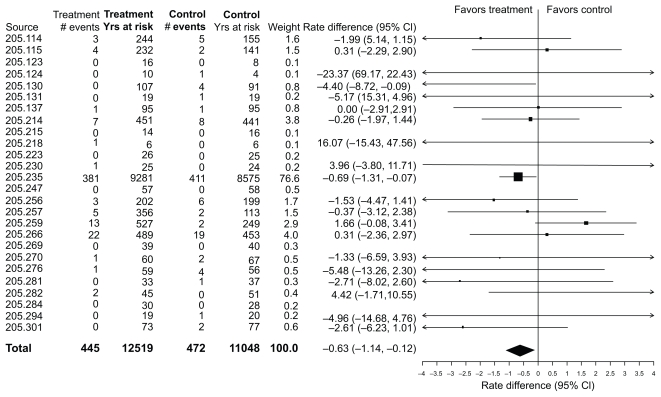
Twenty-six trials were identified involving 17,014 patients. Mean age was 65 years, mean forced expiratory volume in one second was 1.16 L (41% predicted), 76% men. Total exposure to study drug was 11,958 patient-years (tiotropium) and 10,578 patient-years (placebo). Tiotropium was associated with a reduced risk (expressed as rate difference [95% confidence interval] per 100 patients-years at risk) for an adverse event (-17.5 [-22.9, -12.2]), serious adverse event (-1.41 [-2.81, -0.00]) and a fatal event (-0.63 [-1.14, -0.12]). A reduced risk was present for adverse events that were cardiac (-0.79 [-1.48, -0.09]), lower respiratory (-14.2 [-17.0, -11.5]) and for a composite endpoint of major adverse cardiovascular events (-0.45 [-0.85, -0.05]). Typical expected inhaled anticholinergic effects such as dry mouth, constipation, and urinary difficulties were observed in the safety database.
The safety data review does not indicate an increased risk for death or cardiovascular morbidity during tiotropium treatment in patients with COPD.
噻托溴铵是一种长效吸入性抗胆碱能药物,用于治疗慢性阻塞性肺疾病(COPD),自 2002 年以来已上市。随着时间的推移,我们寻求更新噻托溴铵在 HandiHaler 制剂中的安全性评估,因为已有大量的临床试验数据可用。
对噻托溴铵 HandiHaler 临床试验的不良反应报告进行了汇总分析,这些临床试验具有以下特征:随机、双盲、平行组、安慰剂对照设计,噻托溴铵 18μg 每日一次给药,COPD 适应证,至少四周的疗程。按治疗组确定发生率、发生率差异(噻托溴铵-安慰剂)和 95%置信区间。
共确定了 26 项试验,涉及 17014 名患者。平均年龄为 65 岁,平均用力呼气量为 1.16L(预测值的 41%),76%为男性。研究药物的总暴露量为 11958 患者年(噻托溴铵)和 10578 患者年(安慰剂)。噻托溴铵与不良反应风险降低相关(用每 100 患者年风险的发生率差异[95%置信区间]表示),包括不良事件(-17.5[-22.9,-12.2])、严重不良事件(-1.41[-2.81,-0.00])和致死事件(-0.63[-1.14,-0.12])。不良反应风险降低与心脏不良事件(-0.79[-1.48,-0.09])、下呼吸道不良事件(-14.2[-17.0,-11.5])和主要不良心血管事件的复合终点(-0.45[-0.85,-0.05])相关。在安全性数据库中观察到了典型的预期吸入性抗胆碱能药物的作用,如口干、便秘和排尿困难。
在 COPD 患者中,噻托溴铵治疗不会增加死亡或心血管发病率的风险。