University of Massachusetts Medical School, 55 Lake Ave Worcester, MA 01655-0002, USA.
BMC Cardiovasc Disord. 2009 Dec 29;9:56. doi: 10.1186/1471-2261-9-56.
Despite the potentially life-saving benefits of the implantable cardioverter-defibrillator (ICD), a significant group of patients experiences emotional distress after ICD implantation. Different psychosocial interventions have been employed to improve this condition, but previous reviews have suggested that methodological issues may limit the validity of such interventions.
To review the methodology of previously published studies of psychosocial interventions in ICD patients, according to CONSORT statement guidelines for non-pharmacological interventions, and provide recommendations for future research.
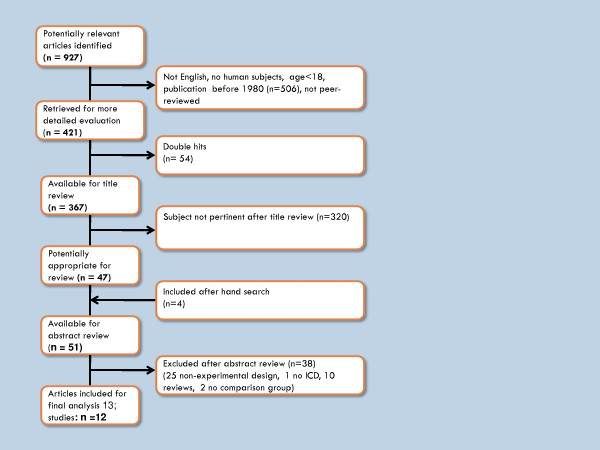
We electronically searched the PubMed, PsycInfo and Cochrane databases. To be included, studies needed to be published in a peer-reviewed journal between 1980 and 2008, to involve a human population aged 18+ years and to have an experimental design.
Twelve studies met the eligibility criteria. Samples were generally small. Interventions were very heterogeneous; most studies used cognitive behavioural therapy (CBT) and exercise programs either as unique interventions or as part of a multi-component program. Overall, studies showed a favourable effect on anxiety (6/9) and depression (4/8). CBT appeared to be the most effective intervention. There was no effect on the number of shocks and arrhythmic events, probably because studies were not powered to detect such an effect. Physical functioning improved in the three studies evaluating this outcome. Lack of information about the indication for ICD implantation (primary vs. secondary prevention), limited or no information regarding use of anti-arrhythmic (9/12) and psychotropic (10/12) treatment, lack of assessments of providers' treatment fidelity (12/12) and patients' adherence to the intervention (11/12) were the most common methodological limitations.
Overall, this review supports preliminary evidence of a positive effect of psychosocial interventions on anxiety and physical functioning in ICD patients. However, these initial findings must be interpreted cautiously because of important methodological limitations. Future studies should be designed as large RCTs, whose design takes into account the specific challenges associated with the evaluation of behavioural interventions.
尽管植入式心脏复律除颤器(ICD)具有潜在的救生效益,但相当一部分患者在 ICD 植入后会经历情绪困扰。已经采用了不同的心理社会干预措施来改善这种情况,但之前的综述表明,方法学问题可能会限制此类干预措施的有效性。
根据 CONSORT 非药物干预声明指南,审查之前发表的 ICD 患者心理社会干预研究的方法,并为未来的研究提供建议。
我们通过电子方式在 PubMed、PsycInfo 和 Cochrane 数据库中进行了搜索。为了符合纳入标准,研究必须在 1980 年至 2008 年期间在同行评审的期刊上发表,涉及 18 岁及以上的人群,并采用实验设计。
有 12 项研究符合入选标准。样本通常较小。干预措施非常多样化;大多数研究使用认知行为疗法(CBT)和运动方案,要么作为单一干预措施,要么作为多组分方案的一部分。总体而言,研究显示对焦虑(6/9)和抑郁(4/8)有有利影响。CBT 似乎是最有效的干预措施。对电击和心律失常事件的数量没有影响,这可能是因为研究没有足够的能力来检测这种影响。评估这一结果的三项研究显示身体功能得到了改善。缺乏关于 ICD 植入适应症(一级预防与二级预防)的信息,对心律失常药物(9/12)和精神药物(10/12)的使用信息有限或没有信息,缺乏对提供者治疗一致性(12/12)和患者对干预措施的依从性(11/12)的评估是最常见的方法学局限性。
总体而言,本综述支持心理社会干预对 ICD 患者焦虑和身体功能的积极影响的初步证据。然而,由于存在重要的方法学局限性,必须谨慎解释这些初步发现。未来的研究应设计为大型 RCT,其设计考虑到与评估行为干预相关的特定挑战。