The Rausing Lab, Lund University, Lund, Sweden.
PLoS One. 2009 Dec 29;4(12):e8484. doi: 10.1371/journal.pone.0008484.
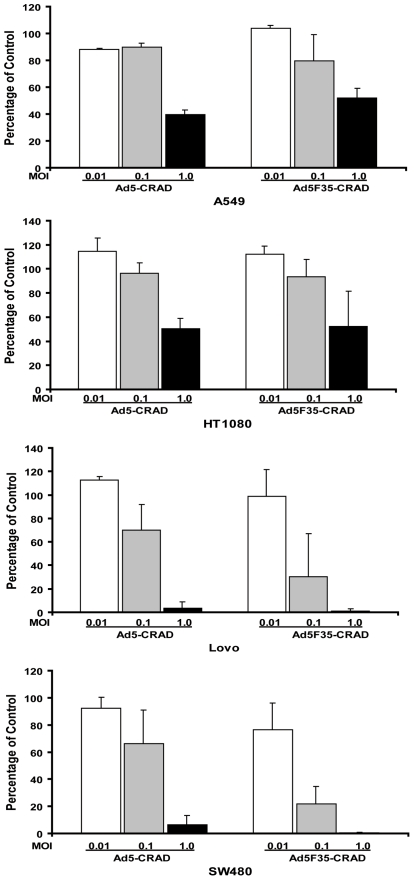
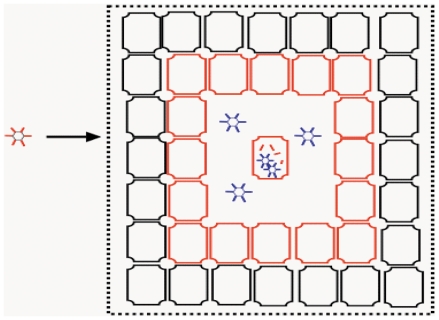
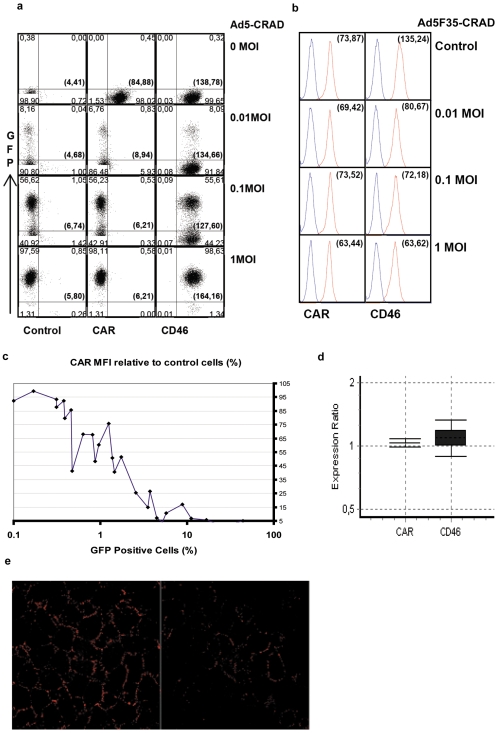
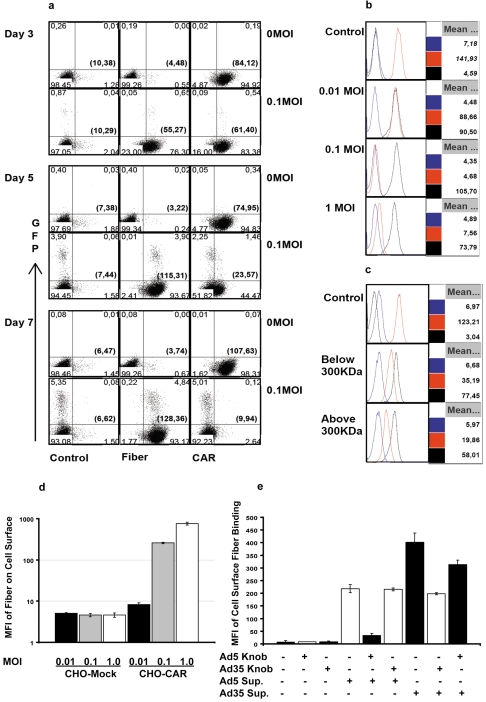
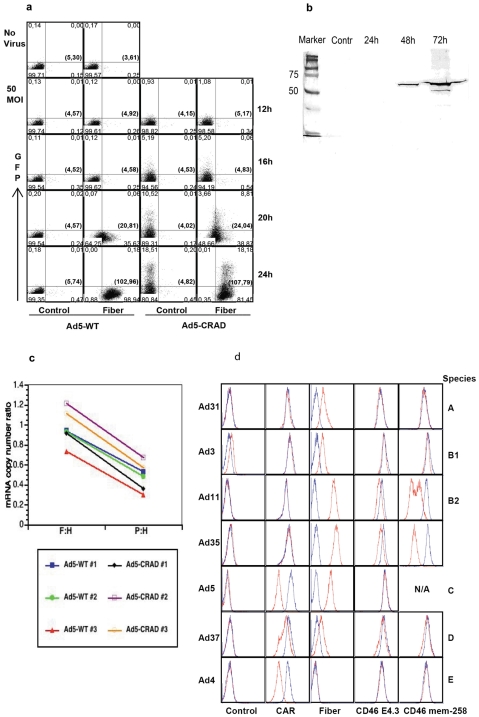
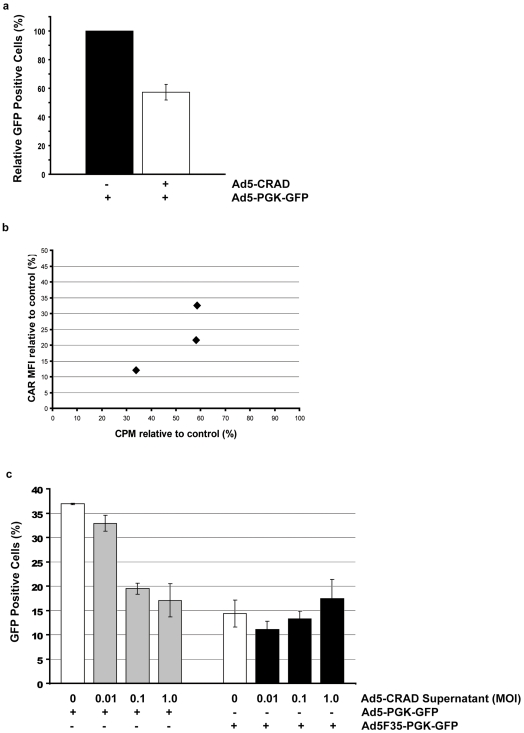
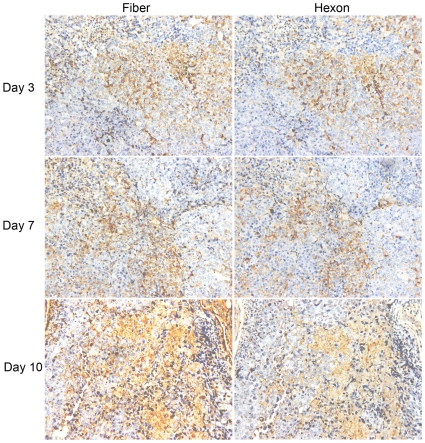
The basic concept of conditionally replicating adenoviruses (CRAD) as oncolytic agents is that progenies generated from each round of infection will disperse, infect and kill new cancer cells. However, CRAD has only inhibited, but not eradicated tumor growth in xenograft tumor therapy, and CRAD therapy has had only marginal clinical benefit to cancer patients. Here, we found that CRAD propagation and cancer cell survival co-existed for long periods of time when infection was initiated at low multiplicity of infection (MOI), and cancer cell killing was inefficient and slow compared to the assumed cell killing effect upon infection at high MOI. Excessive production of fiber molecules from initial CRAD infection of only 1 to 2% cancer cells and their release prior to the viral particle itself caused a tropism-specific receptor masking in both infected and non-infected bystander cells. Consequently, the non-infected bystander cells were inefficiently bound and infected by CRAD progenies. Further, fiber overproduction with concomitant restriction of adenovirus spread was observed in xenograft cancer therapy models. Besides the CAR-binding Ad4, Ad5, and Ad37, infection with CD46-binding Ad35 and Ad11 also caused receptor masking. Fiber overproduction and its resulting receptor masking thus play a key role in limiting CRAD functionality, but potentially promote adenovirus and host cell co-existence. These findings also give important clues for understanding mechanisms underlying the natural infection course of various adenoviruses.
条件复制腺病毒(CRAD)作为溶瘤剂的基本概念是,每一轮感染产生的后代都会分散、感染和杀死新的癌细胞。然而,CRAD 仅在异种移植肿瘤治疗中抑制了肿瘤生长,而不是根除,并且 CRAD 治疗对癌症患者只有边际的临床益处。在这里,我们发现当以低感染复数(MOI)起始感染时,CRAD 的繁殖和癌细胞的存活会长期共存,与高 MOI 感染时假设的细胞杀伤效应相比,癌细胞杀伤效率低且缓慢。仅初始 CRAD 感染 1%到 2%的癌细胞就会过度产生纤维分子,并且在病毒粒子本身之前释放,这会导致受感染和未受感染的旁观者细胞中的特定趋向性受体被掩盖。因此,非感染的旁观者细胞被 CRAD 后代低效地结合和感染。此外,在异种移植癌症治疗模型中还观察到纤维过度产生和伴随的腺病毒传播受限。除了 CAR 结合的 Ad4、Ad5 和 Ad37 外,CD46 结合的 Ad35 和 Ad11 的感染也会导致受体被掩盖。纤维过度产生及其导致的受体掩盖因此在限制 CRAD 功能方面起着关键作用,但可能促进腺病毒和宿主细胞共存。这些发现也为理解各种腺病毒自然感染过程的机制提供了重要线索。