Section of Virology, Department of Clinical Microbiology, Umeå University, 90185 Umeå, Sweden.
The Laboratory for Molecular Infection Medicine Sweden (MIMS), Umeå University, 90185 Umeå, Sweden.
Viruses. 2021 Feb 14;13(2):298. doi: 10.3390/v13020298.
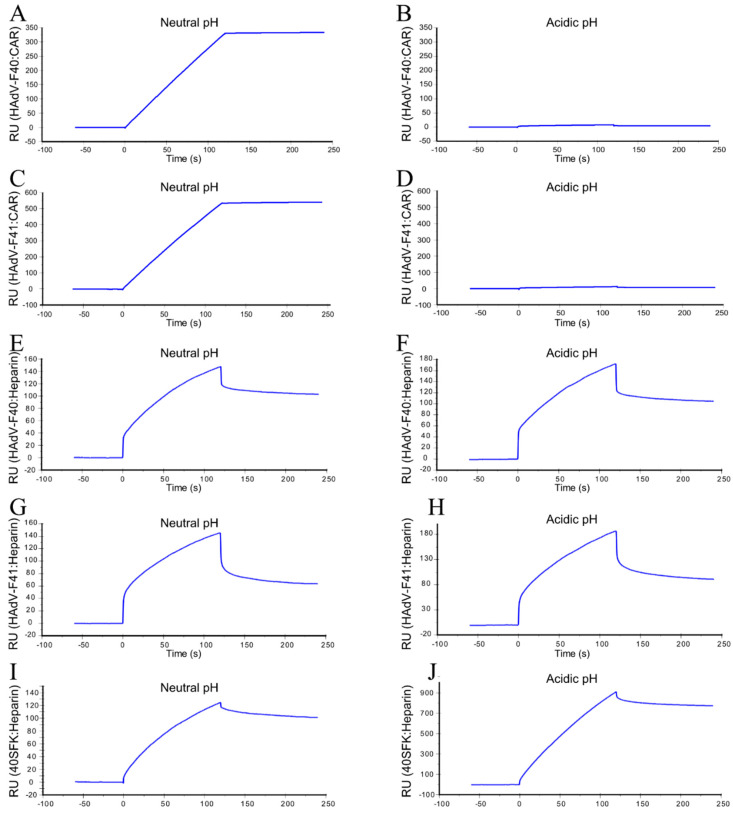
Human adenovirus (HAdV)-F40 and -F41 are leading causes of diarrhea and diarrhea-associated mortality in children under the age of five, but the mechanisms by which they infect host cells are poorly understood. HAdVs initiate infection through interactions between the knob domain of the fiber capsid protein and host cell receptors. Unlike most other HAdVs, HAdV-F40 and -F41 possess two different fiber proteins-a long fiber and a short fiber. Whereas the long fiber binds to the Coxsackievirus and adenovirus receptor (CAR), no binding partners have been identified for the short fiber. In this study, we identified heparan sulfate (HS) as an interaction partner for the short fiber of enteric HAdVs. We demonstrate that exposure to acidic pH, which mimics the environment of the stomach, inactivates the interaction of enteric adenovirus with CAR. However, the short fiber:HS interaction is resistant to and even enhanced by acidic pH, which allows attachment to host cells. Our results suggest a switch in receptor usage of enteric HAdVs after exposure to acidic pH and add to the understanding of the function of the short fibers. These results may also be useful for antiviral drug development and the utilization of enteric HAdVs for clinical applications such as vaccine development.
人腺病毒(HAdV)-F40 和 -F41 是导致五岁以下儿童腹泻和腹泻相关死亡的主要原因,但它们感染宿主细胞的机制尚不清楚。HAdV 通过纤维衣壳蛋白的球状结构域与宿主细胞受体之间的相互作用引发感染。与大多数其他 HAdV 不同,HAdV-F40 和 -F41 具有两种不同的纤维蛋白——长纤维和短纤维。长纤维与柯萨奇病毒和腺病毒受体(CAR)结合,而短纤维尚未鉴定出结合伴侣。在这项研究中,我们确定了硫酸乙酰肝素(HS)是肠道 HAdV 短纤维的相互作用伙伴。我们证明,暴露于模拟胃环境的酸性 pH 值会使肠道腺病毒与 CAR 的相互作用失活。然而,短纤维:HS 相互作用可抵抗甚至增强酸性 pH 值,从而允许与宿主细胞附着。我们的结果表明,肠道 HAdV 在暴露于酸性 pH 值后会切换受体使用,这增加了对短纤维功能的理解。这些结果对于抗病毒药物的开发以及利用肠道 HAdV 进行疫苗开发等临床应用可能也很有用。