
配体感应、构象转换核酶的设计原则。
Design principles for ligand-sensing, conformation-switching ribozymes.
机构信息
Department of Chemistry and Biochemistry, Center for Systems and Synthetic Biology, University of Texas at Austin, Austin, Texas, USA.
出版信息
PLoS Comput Biol. 2009 Dec;5(12):e1000620. doi: 10.1371/journal.pcbi.1000620. Epub 2009 Dec 24.
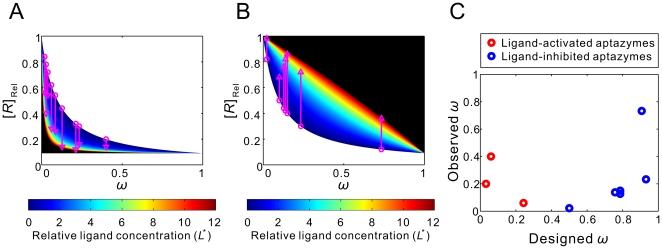
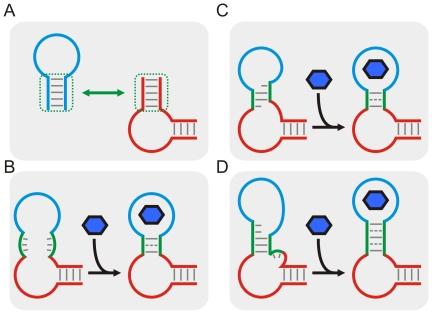
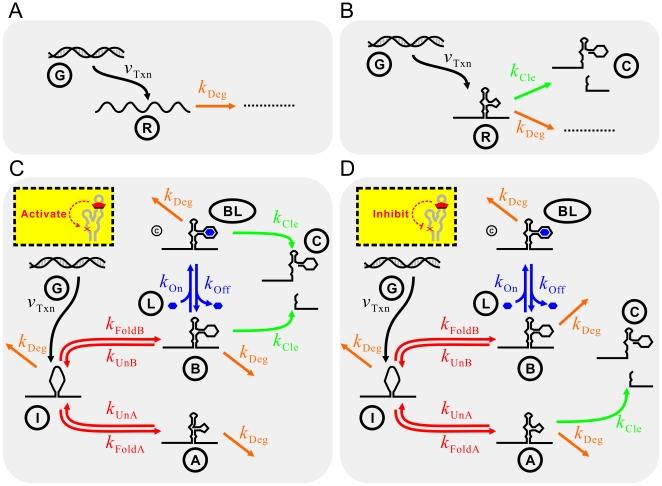
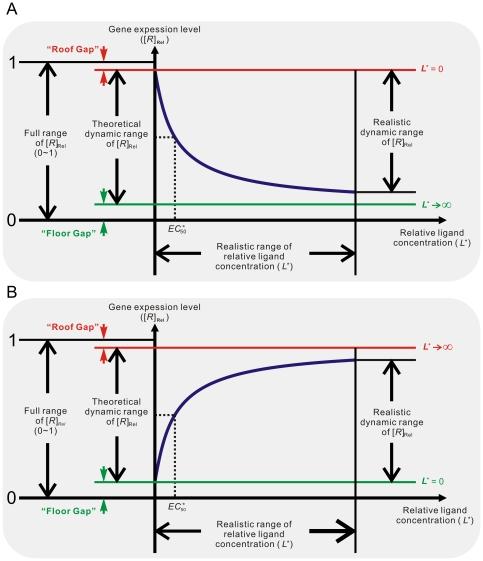
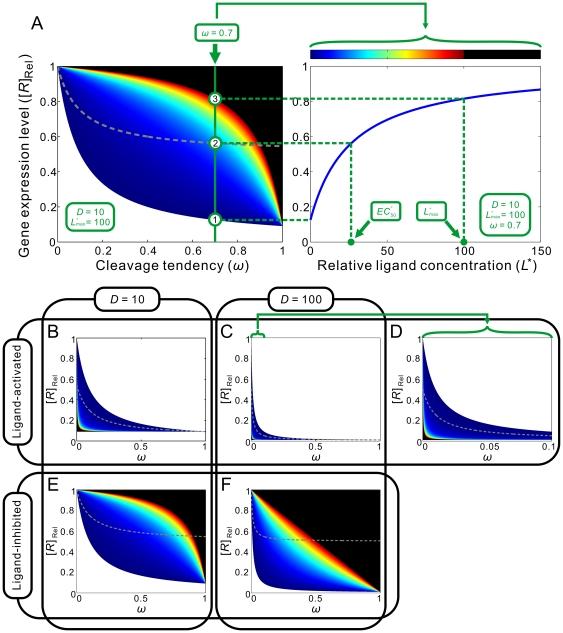
Nucleic acid sensor elements are proving increasingly useful in biotechnology and biomedical applications. A number of ligand-sensing, conformational-switching ribozymes (also known as allosteric ribozymes or aptazymes) have been generated by some combination of directed evolution or rational design. Such sensor elements typically fuse a molecular recognition domain (aptamer) with a catalytic signal generator (ribozyme). Although the rational design of aptazymes has begun to be explored, the relationships between the thermodynamics of aptazyme conformational changes and aptazyme performance in vitro and in vivo have not been examined in a quantitative framework. We have therefore developed a quantitative and predictive model for aptazymes as biosensors in vitro and as riboswitches in vivo. In the process, we have identified key relationships (or dimensionless parameters) that dictate aptazyme performance, and in consequence, established equations for precisely engineering aptazyme function. In particular, our analysis quantifies the intrinsic trade-off between ligand sensitivity and the dynamic range of activity. We were also able to determine how in vivo parameters, such as mRNA degradation rates, impact the design and function of aptazymes when used as riboswitches. Using this theoretical framework we were able to achieve quantitative agreement between our models and published data. In consequence, we are able to suggest experimental guidelines for quantitatively predicting the performance of aptazyme-based riboswitches. By identifying factors that limit the performance of previously published systems we were able to generate immediately testable hypotheses for their improvement. The robust theoretical framework and identified optimization parameters should now enable the precision design of aptazymes for biotechnological and clinical applications.
核酸传感器元件在生物技术和生物医学应用中越来越有用。通过定向进化或合理设计的某种组合,已经产生了许多配体感应、构象转换核酶(也称为变构核酶或适体酶)。此类传感器元件通常将分子识别结构域(适体)与催化信号发生器(核酶)融合在一起。虽然已经开始探索适体酶的合理设计,但尚未在定量框架内检查适体酶构象变化的热力学与适体酶在体外和体内的性能之间的关系。因此,我们开发了一种用于体外适体酶作为生物传感器和体内核酶作为核酶开关的定量和可预测的模型。在这个过程中,我们确定了决定适体酶性能的关键关系(或无量纲参数),并因此建立了精确设计适体酶功能的方程。特别是,我们的分析量化了配体敏感性和活性动态范围之间的固有权衡。我们还能够确定体内参数(例如 mRNA 降解率)如何影响适体酶作为核酶开关使用时的设计和功能。使用这个理论框架,我们能够在我们的模型和已发表的数据之间实现定量一致性。因此,我们能够提出实验指南,以便对基于适体酶的核酶开关的性能进行定量预测。通过确定限制先前发表系统性能的因素,我们能够立即提出针对其改进的可测试假设。稳健的理论框架和确定的优化参数现在应该能够为生物技术和临床应用精确设计适体酶。


 Zotero 插件