Department of Nephrology, University Hospitals Birmingham NHS Foundation Trust, Birmingham, UK.
Am J Kidney Dis. 2010 Feb;55(2):250-8. doi: 10.1053/j.ajkd.2009.10.047. Epub 2009 Dec 31.
Clinical and pathologic features that predict outcome have important potential application in patients with pauci-immune necrotizing glomerulonephritis (usually antineutrophil cytoplasmic antibody-associated vasculitis). This study examines the predictive value of simple quantitative renal histologic measurements in a large cohort with extended follow-up.
Cohort study.
SETTING & PARTICIPANTS: 390 consecutive patients with pauci-immune necrotizing glomerulonephritis at a single hospital (1983-2002); 90 patients underwent repeated kidney biopsy during follow-up.
Age and serum creatinine concentration at biopsy, antineutrophil cytoplasmic antibody specificity, percentage of normal glomeruli, percentage of glomeruli with active lesions, and index of chronic damage (quantitative measurement of established cortical damage) in the initial kidney biopsy for all patients. The same factors were assessed in both biopsy specimens for patients undergoing an additional biopsy.
OUTCOMES & MEASUREMENTS: End-stage renal disease and patient survival.
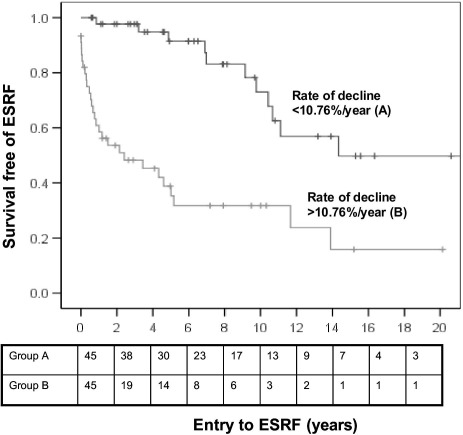
Mortality at 1 and 5 years was 23% and 40%, respectively: standardized mortality ratio, 4.74 (95% CI, 3.62-6.32). End-stage renal disease was reached by 14% and 18% at 1 and 5 years, respectively. In multivariable analysis, serum creatinine level at biopsy and percentage of normal glomeruli in the initial biopsy specimen were the best predictors of kidney survival. C Statistics were 0.80 for creatinine level alone and 0.83 for creatinine level with normal glomeruli. In patients undergoing an additional biopsy, rapid progression in the index of chronic damage and serum creatinine level at the second biopsy were associated with kidney survival in multivariable analysis.
Retrospective analysis. External validity of the index of chronic damage requires further assessment. Selection bias may influence repeated biopsy analyses.
Serum creatinine level at biopsy best predicts kidney survival in patients with pauci-immune necrotizing glomerulonephritis overall.
临床和病理特征可预测结局,这在少免疫性坏死性肾小球肾炎(通常为抗中性粒细胞胞浆抗体相关血管炎)患者中具有重要的潜在应用价值。本研究在一个随访时间较长的大样本中,检验了简单的肾脏组织学定量测量的预测价值。
队列研究。
单家医院的 390 例少免疫性坏死性肾小球肾炎连续患者(1983-2002 年);90 例患者在随访期间接受了重复肾活检。
所有患者的初始肾活检时的年龄和血清肌酐浓度、抗中性粒细胞胞浆抗体特异性、正常肾小球百分比、有活性病变的肾小球百分比和慢性损伤指数(皮质损伤的定量测量)。对接受额外肾活检的患者的两次活检标本均评估了相同的因素。
终末期肾病和患者生存率。
1 年和 5 年的死亡率分别为 23%和 40%:标准化死亡率比为 4.74(95%CI,3.62-6.32)。分别有 14%和 18%的患者在 1 年和 5 年内达到终末期肾病。多变量分析显示,活检时的血清肌酐水平和初始活检标本中的正常肾小球百分比是肾脏生存的最佳预测因素。肌酐水平的 C 统计量为 0.80,肌酐水平加正常肾小球的 C 统计量为 0.83。在接受额外肾活检的患者中,多变量分析显示慢性损伤指数的快速进展和第二次活检时的血清肌酐水平与肾脏生存相关。
回顾性分析。慢性损伤指数的外部有效性需要进一步评估。选择偏倚可能会影响重复活检分析。
总体而言,活检时的血清肌酐水平是预测少免疫性坏死性肾小球肾炎患者肾脏生存的最佳指标。