German Cancer Research Center, Dept. of Imaging and Radiooncology, INF 280, D-69120 Heidelberg, Germany.
Int J Med Sci. 2009 Dec 5;7(1):19-28. doi: 10.7150/ijms.7.19.
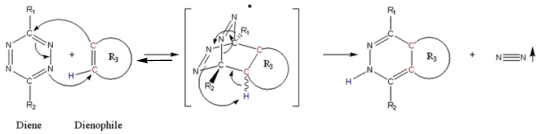
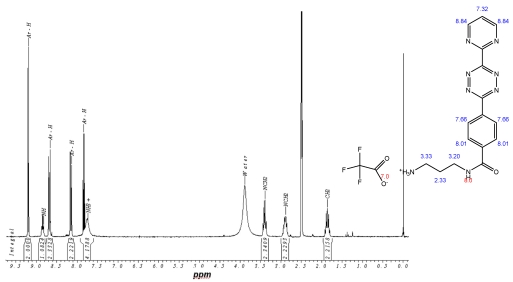
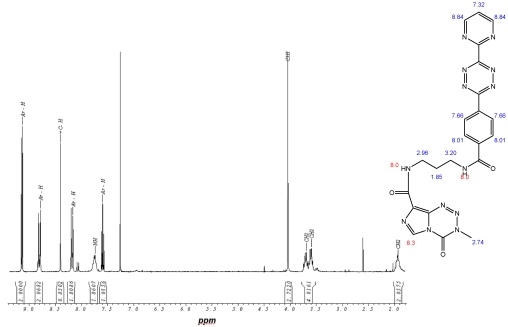
The ligation of active pharmaceutical ingredients (API) for working with image processing systems in diagnostics (MRT) attracts increasing notice and scientific interest. The Diels-Alder ligation Reaction with inverse electron demand (DAR(inv)) turns out to be an appropriate candidate. The DAR(inv) is characterized by a specific distribution of electrons of the diene and the corresponding dienophile counterpart. Whereas the reactants in the classical Diels-Alder Reaction feature electron-rich diene and electron-poor dienophile compounds, the DAR(inv) exhibits exactly the opposite distribution of electrons. Substituents with pushing electrones increase and, with pulling electrons reduce the electron density of the dienes as used in the DAR(inv).We report here that the DAR(inv) is an efficient route for coupling of multifunctional molecules like active peptides, re-formulated drugs or small molecules like the alkyalting agent temozolomide (TMZ). This is an example of our contribution to the "Click chemistry" technology. In this case TMZ is ligated by DAR(inv) as a cargo to transporter molecules facilitating the passage across the cell membranes into cells and subsequently into subcellular components like the cell nucleus by using address molecules. With such constructs we achieved high local concentrations at the desired target site of pharmacological action. The DAR(inv) ligation was carried out using the combination of several technologies, namely: the organic chemistry and the solid phase peptide synthesis which can produce 'tailored' solutions for questions not solely restricted to the medical diagnostics or therapy, but also result in functionalizations of various surfaces qualified amongst others also for array development.We like to acquaint you with the DAR(inv) and we like to exemplify that all ligation products were generated after a rapid and complete reaction in organic solutions at room temperature, in high purity, but also, hurdles and difficulties on the way to the TMZ-BioShuttle conjugate should be mentioned.With this report we would like to stimulate scientists working with the focus on "Click chemistry" to intensify research with this expanding DAR(inv )able to open the door for new solutions inconceivable so far.
将活性药物成分(API)与医学影像学(MRT)系统结合使用的连接方法引起了越来越多的关注和科学兴趣。逆电子需求 Diels-Alder 反应(DAR(inv))是一种合适的候选方法。DAR(inv)的特点是双烯和相应的亲双烯体具有特定的电子分布。在经典的 Diels-Alder 反应中,反应物具有富电子的双烯和缺电子的亲双烯体化合物,而 DAR(inv)则表现出完全相反的电子分布。在 DAR(inv)中使用的双烯的取代基带有推电子基团,增加电子密度,而带有拉电子基团则降低双烯的电子密度。我们在这里报告,DAR(inv)是连接多功能分子如活性肽、重新配方药物或小分子如烷基化剂替莫唑胺(TMZ)的有效途径。这是我们对“点击化学”技术贡献的一个例子。在这种情况下,TMZ 通过 DAR(inv)作为载体连接到转运体分子上,通过使用地址分子促进穿过细胞膜进入细胞,随后进入亚细胞成分如细胞核。通过这种构建,我们在药理学作用的预期靶位实现了高局部浓度。DAR(inv)的连接使用了几种技术的组合,即:有机化学和固相肽合成,它们可以为不仅限于医学诊断或治疗的问题提供“定制”解决方案,还可以对各种表面进行功能化,这些表面也适合用于阵列开发。我们希望向您介绍 DAR(inv),并举例说明所有连接产物都是在室温下在有机溶液中快速且完全反应生成的,具有高纯度,但也提到了在 TMZ-BioShuttle 缀合物的途径上遇到的障碍和困难。通过本报告,我们希望激发专注于“点击化学”的科学家加强研究,扩大 DAR(inv)的应用范围,为迄今为止难以想象的新解决方案打开大门。