Program in Molecular Medicine, University of Massachusetts Medical School, Worcester, MA 01605, USA.
J Cell Biol. 2010 Jan 11;188(1):21-8. doi: 10.1083/jcb.200910096. Epub 2010 Jan 4.
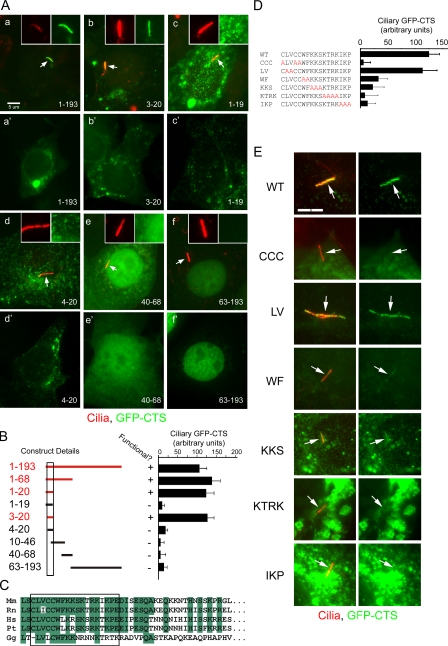
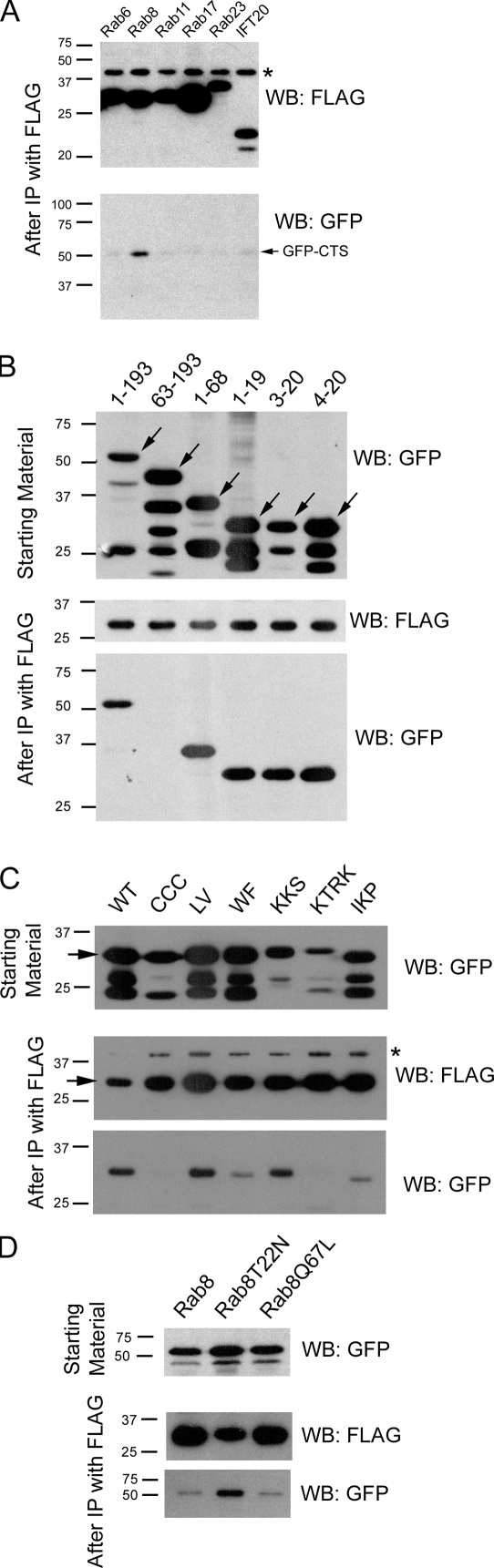
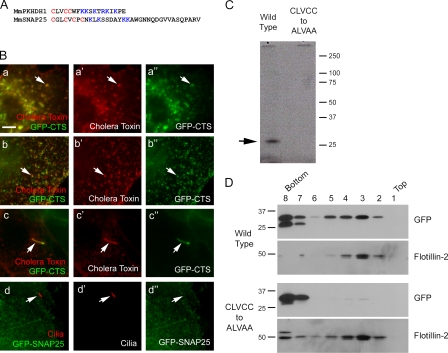
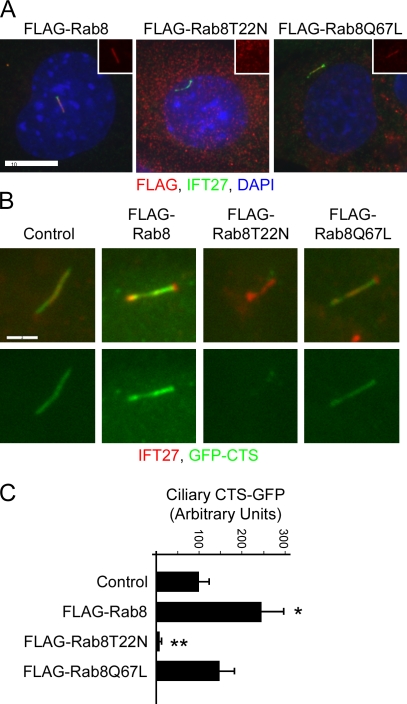
Sensory functions of primary cilia rely on ciliary-localized membrane proteins, but little is known about how these receptors are targeted to the cilium. To further our understanding of this process, we dissected the ciliary targeting sequence (CTS) of fibrocystin, the human autosomal recessive polycystic kidney disease gene product. We show that the fibrocystin CTS is an 18-residue motif localized in the cytoplasmic tail. This motif is sufficient to target green fluorescent protein (GFP) to cilia of ciliated cells and targets GFP to lipid rafts if the cells are not ciliated. Rab8, but not several other Rabs implicated in ciliary assembly, binds to the CTS in a coimmunoprecipitation assay. Dominant-negative Rab8 interacts more strongly than wild-type or constitutively active Rab8, and coexpression of this dominant-negative mutant Rab8 blocks trafficking to the cilium. This suggests that the CTS functions by binding regulatory proteins like Rab8 to control trafficking through the endomembrane system and on to the cilium.
初级纤毛的感觉功能依赖于纤毛定位的膜蛋白,但对于这些受体如何靶向纤毛知之甚少。为了进一步了解这一过程,我们剖析了纤维囊性肾病基因产物纤毛病的纤毛靶向序列 (CTS)。我们表明,纤毛病 CTS 是一个位于细胞质尾部的 18 个残基的基序。如果细胞不纤毛化,该基序足以将绿色荧光蛋白 (GFP) 靶向纤毛细胞的纤毛,并将 GFP 靶向脂筏。在共免疫沉淀测定中,Rab8 而不是其他几个参与纤毛组装的 Rab 与 CTS 结合。显性失活 Rab8 的相互作用比野生型或组成性激活 Rab8 更强,并且这种显性失活突变 Rab8 的共表达会阻止向纤毛的运输。这表明 CTS 通过与 Rab8 等调节蛋白结合来控制通过内质网系统的运输,并到达纤毛。