Morbid Obesity Centre, Vestfold Hospital Trust, Box 2168, 3103, Tønsberg, Norway.
Obes Surg. 2010 Aug;20(8):1142-8. doi: 10.1007/s11695-009-0053-y. Epub 2010 Jan 5.
Bariatric surgery particularly benefits patients with obesity-related comorbidities such as type 2 diabetes and obstructive sleep apnea. We aimed to examine whether the variables that influence treatment choice differ between morbidly obese patients undergoing bariatric surgery and those opting for conservative treatments.
A total of 505 consecutive morbidly obese patients (72% women; mean (SD) age 42 (12) years) who attended our tertiary care center between December 2005 and February 2007 were examined by a multidisciplinary team and offered surgical or conservative treatment. The chi-square test, independent samples t test, and multiple logistic regression were used in the statistical analyses.
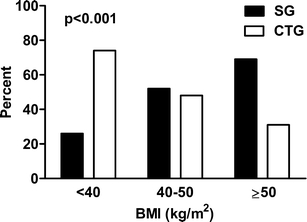
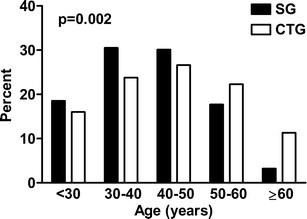
A total of 249 (49%) patients underwent bariatric surgery. When compared to the conservative group of patients, the surgery group was characterized by a significantly higher mean (SD) BMI (46.5(6.2) vs. 43.2(5.5) kg/m(2), p < 0.001), earlier onset of obesity (40% vs. 26% before 12 years of age, p < 0.001), and lower age (41(11) vs. 44(13) years, p = 0.002). In contrast, the groups did not differ significantly with respect to gender or obesity-related comorbidities. After adjustments for gender, age, onset of obesity, and the number of comorbidities, multiple regression revealed that patients with BMI 40-50 or >50 kg/m(2) had between 3 (OR = 3.0; 95% CI 1.9-4.9, p < 0.001) and 6 (OR = 5.7; 95% CI 3.0-11.0, p < 0.001) times the chance of undergoing bariatric surgery when compared to patients with a BMI <40 kg/m(2) (reference).
Our data indicates that increasing BMI rather than obesity-related comorbidities, predicted treatment choice in morbidly obese patients.
减重手术尤其有益于肥胖相关合并症(如 2 型糖尿病和阻塞性睡眠呼吸暂停)的患者。我们旨在研究影响治疗选择的变量在接受减重手术和保守治疗的病态肥胖患者之间是否不同。
2005 年 12 月至 2007 年 2 月期间,我们对 505 名连续的病态肥胖患者(72%为女性;平均(标准差)年龄 42(12)岁)进行了多学科团队检查,并为他们提供了手术或保守治疗。在统计分析中使用了卡方检验、独立样本 t 检验和多元逻辑回归。
共有 249 名(49%)患者接受了减重手术。与保守组患者相比,手术组的平均(标准差)BMI(46.5(6.2)kg/m2 比 43.2(5.5)kg/m2,p <0.001)更高,肥胖发病更早(40%比 26%在 12 岁之前,p <0.001),年龄更小(41(11)岁比 44(13)岁,p = 0.002)。然而,两组在性别或肥胖相关合并症方面没有显著差异。在调整性别、年龄、肥胖发病年龄和合并症数量后,多元回归显示 BMI 为 40-50 或 >50 kg/m2 的患者接受减重手术的机会比 BMI <40 kg/m2 的患者分别增加 3 倍(OR = 3.0;95%CI 1.9-4.9,p <0.001)和 6 倍(OR = 5.7;95%CI 3.0-11.0,p <0.001)。
我们的数据表明,BMI 的增加而不是肥胖相关合并症,预测了病态肥胖患者的治疗选择。