Department of Neurology, Center for Neurologic Diseases, Brigham and Women's Hospital and Harvard Medical School, Boston, MA, USA.
Eur J Immunol. 2010 Mar;40(3):859-66. doi: 10.1002/eji.200939842.
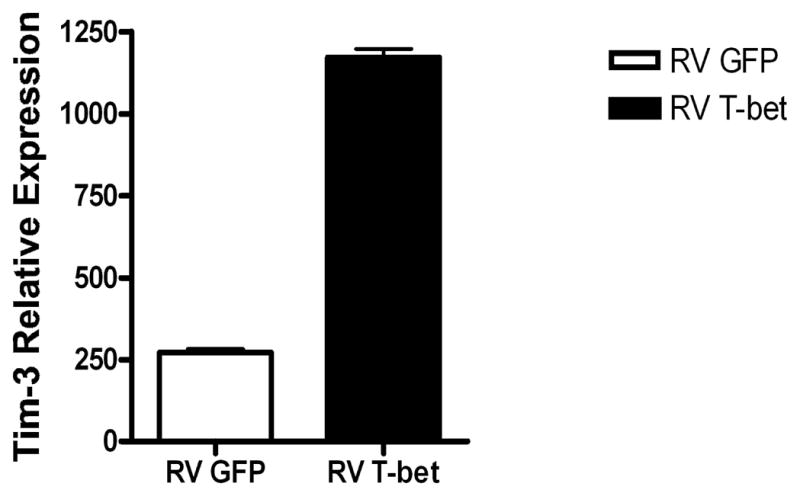
T-cell immunoglobulin, mucin domain-3 (Tim-3) is a membrane protein expressed at late stages of IFN-gamma secreting CD4(+) Th1 cell differentiation and constitutively on DC. Ligation of Tim-3 on Th1 cells terminates Th1 immune responses. In addition, Tim-3 plays a role in tolerance induction, although the mechanism by which this is accomplished has yet to be elucidated. While it is clear that Tim-3 plays an important role in the immune system, little is known regarding the molecular pathways that regulate Tim-3 expression. In the current study, we examine the role of Th1-associated transcription factors in regulating Tim-3 expression. Our experiments reveal that Tim-3 expression is regulated by the Th1-specific transcription factor T-bet. This introduces a novel paradigm into the generation of a Th1 response, whereby a transcription factor responsible for effector Th1 cell differentiation also increases the expression of a specific counter-regulatory molecule to ensure appropriate termination of pro-inflammatory Th1 immune responses.
T 细胞免疫球蛋白黏蛋白结构域 3(Tim-3)是一种在 IFN-γ分泌的 CD4+Th1 细胞分化晚期表达的膜蛋白,在 DC 上持续表达。Tim-3 在 Th1 细胞上的配体结合会终止 Th1 免疫应答。此外,Tim-3 在诱导耐受中发挥作用,尽管其实现机制尚待阐明。虽然 Tim-3 在免疫系统中发挥着重要作用,但对于调节 Tim-3 表达的分子途径知之甚少。在本研究中,我们研究了 Th1 相关转录因子在调节 Tim-3 表达中的作用。我们的实验表明,Tim-3 的表达受到 Th1 特异性转录因子 T-bet 的调控。这为 Th1 反应的产生引入了一个新的范例,即负责效应 Th1 细胞分化的转录因子也增加了特定的负调控分子的表达,以确保适当终止促炎 Th1 免疫应答。