Metabolism Branch, Center for Cancer Research, National Cancer Institute, National Institutes of Health, Bethesda, Maryland 20892, USA.
Nature. 2010 Jan 7;463(7277):88-92. doi: 10.1038/nature08638.
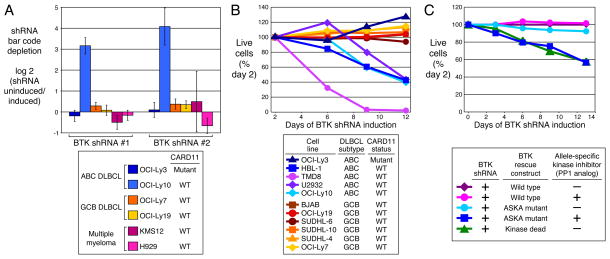
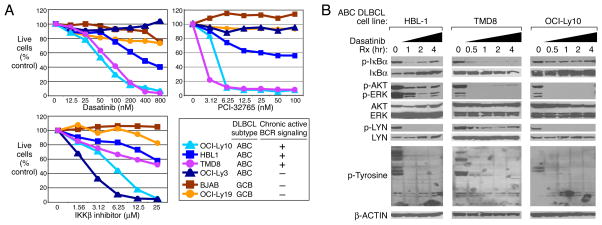
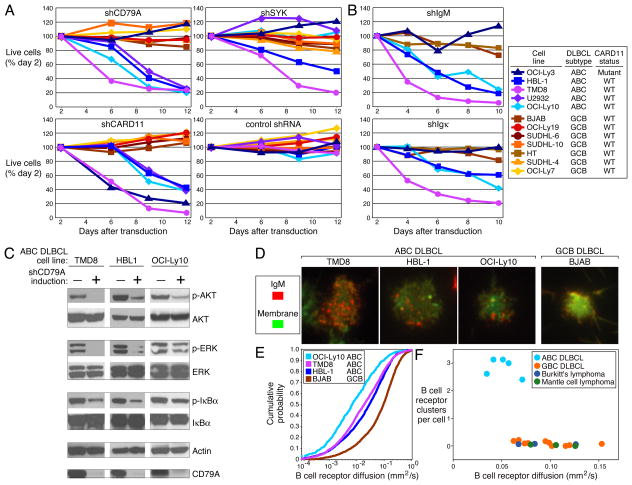
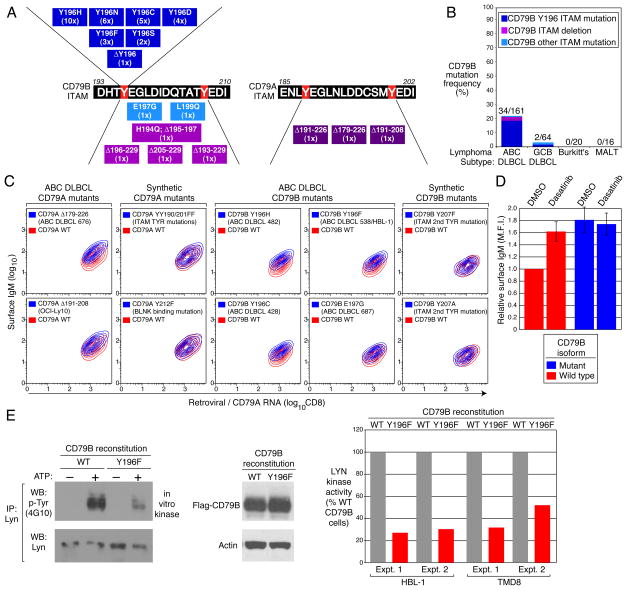
A role for B-cell-receptor (BCR) signalling in lymphomagenesis has been inferred by studying immunoglobulin genes in human lymphomas and by engineering mouse models, but genetic and functional evidence for its oncogenic role in human lymphomas is needed. Here we describe a form of 'chronic active' BCR signalling that is required for cell survival in the activated B-cell-like (ABC) subtype of diffuse large B-cell lymphoma (DLBCL). The signalling adaptor CARD11 is required for constitutive NF-kappaB pathway activity and survival in ABC DLBCL. Roughly 10% of ABC DLBCLs have mutant CARD11 isoforms that activate NF-kappaB, but the mechanism that engages wild-type CARD11 in other ABC DLBCLs was unknown. An RNA interference genetic screen revealed that a BCR signalling component, Bruton's tyrosine kinase, is essential for the survival of ABC DLBCLs with wild-type CARD11. In addition, knockdown of proximal BCR subunits (IgM, Ig-kappa, CD79A and CD79B) killed ABC DLBCLs with wild-type CARD11 but not other lymphomas. The BCRs in these ABC DLBCLs formed prominent clusters in the plasma membrane with low diffusion, similarly to BCRs in antigen-stimulated normal B cells. Somatic mutations affecting the immunoreceptor tyrosine-based activation motif (ITAM) signalling modules of CD79B and CD79A were detected frequently in ABC DLBCL biopsy samples but rarely in other DLBCLs and never in Burkitt's lymphoma or mucosa-associated lymphoid tissue lymphoma. In 18% of ABC DLBCLs, one functionally critical residue of CD79B, the first ITAM tyrosine, was mutated. These mutations increased surface BCR expression and attenuated Lyn kinase, a feedback inhibitor of BCR signalling. These findings establish chronic active BCR signalling as a new pathogenetic mechanism in ABC DLBCL, suggesting several therapeutic strategies.
B 细胞受体 (BCR) 信号在淋巴瘤发生中的作用是通过研究人类淋巴瘤中的免疫球蛋白基因和构建小鼠模型推断出来的,但需要遗传和功能证据来证明其在人类淋巴瘤中的致癌作用。在这里,我们描述了一种“慢性激活”BCR 信号,它是激活 B 细胞样 (ABC) 弥漫性大 B 细胞淋巴瘤 (DLBCL) 亚型细胞存活所必需的。信号适配器 CARD11 是 ABC DLBCL 中组成性 NF-κB 通路活性和存活所必需的。大约 10%的 ABC DLBCL 具有激活 NF-κB 的突变 CARD11 异构体,但其他 ABC DLBCL 中结合野生型 CARD11 的机制尚不清楚。RNA 干扰遗传筛选显示,BCR 信号成分 Bruton 酪氨酸激酶是野生型 CARD11 存活的 ABC DLBCL 的必需成分。此外,敲低近端 BCR 亚基(IgM、Ig-κ、CD79A 和 CD79B)可杀死野生型 CARD11 的 ABC DLBCL,但不能杀死其他淋巴瘤。这些 ABC DLBCL 中的 BCR 在质膜上形成明显的簇,扩散性低,类似于抗原刺激的正常 B 细胞中的 BCR。在 ABC DLBCL 活检样本中经常检测到影响 CD79B 和 CD79A 的免疫受体酪氨酸基激活基序 (ITAM) 信号模块的体细胞突变,但在其他 DLBCL 中很少检测到,在 Burkitt 淋巴瘤或黏膜相关淋巴组织淋巴瘤中从未检测到。在 18%的 ABC DLBCL 中,CD79B 的一个功能关键残基,即第一个 ITAM 酪氨酸,发生了突变。这些突变增加了表面 BCR 表达,并减弱了 Lyn 激酶,BCR 信号的反馈抑制剂。这些发现确立了慢性激活的 BCR 信号作为 ABC DLBCL 的一种新的发病机制,提示了几种治疗策略。