Hu Chaur-Jong, Lee Yueh-Lun, Shih Neng-Yao, Yang Yi-Yuan, Charoenfuprasert Suparat, Dai Yu-Shan, Chang Su-Mei, Tsai Yu-Hui, Tseng How, Liu Chia-Yu, Leu Sy-Jye
Department of Neurology, Taipei Medical University, Taipei 110, Taiwan.
J Biomed Biotechnol. 2009;2009:917837. doi: 10.1155/2009/917837. Epub 2010 Jan 4.
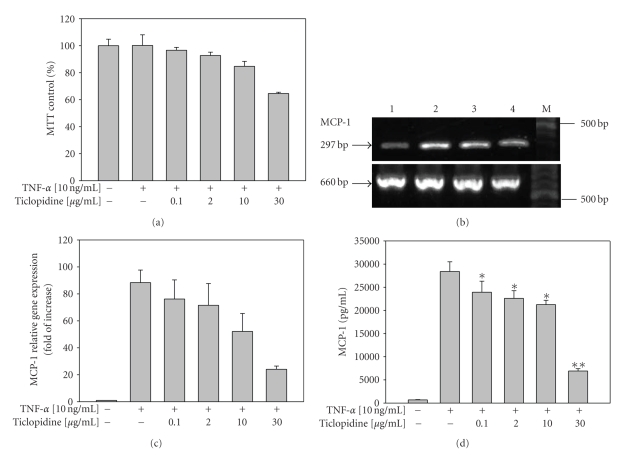
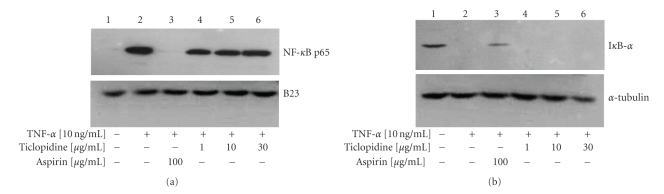
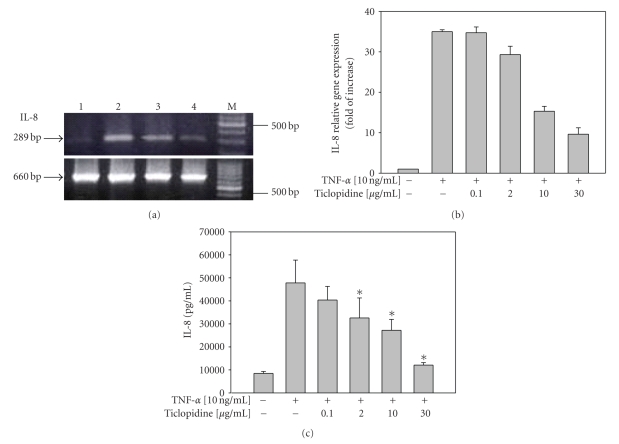
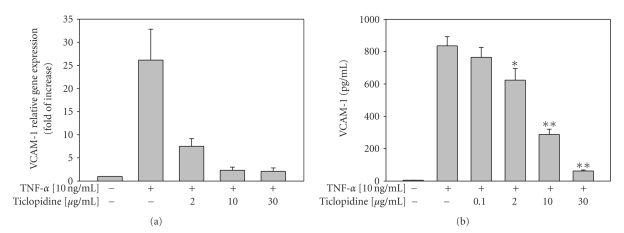
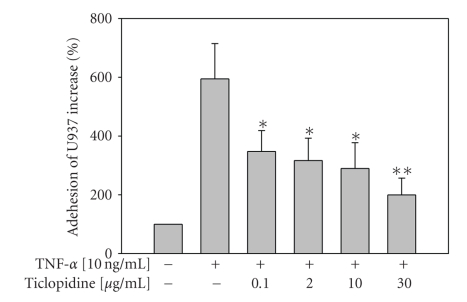
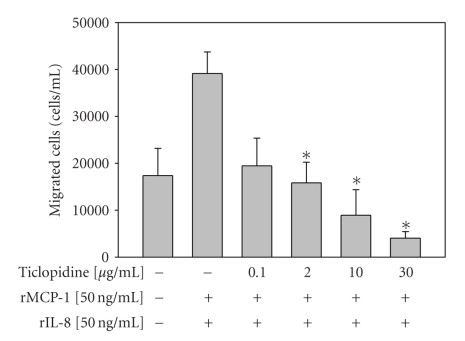
Atherosclerosis and its associated complications represent major causes of morbidity and mortality in the industrialized or Western countries. Monocyte chemoattractant protein-1 (MCP-1) is critical for the initiating and developing of atherosclerotic lesions. Interleukin-8 (IL-8), a CXC chemokine, stimulates neutrophil chemotaxis. Ticlopidine is one of the antiplatelet drugs used to prevent thrombus formation relevant to the pathophysiology of atherothrombosis. In this study, we found that ticlopidine dose-dependently decreased the mRNA and protein levels of TNF-alpha-stimulated MCP-1, IL-8, and vascular cell adhesion molecule-1 (VCAM-1) in human umbilical vein endothelial cells (HUVECs). Ticlopidine declined U937 cells adhesion and chemotaxis as compared to TNF-alpha stimulated alone. Furthermore, the inhibitory effects were neither due to decreased HUVEC viability, nor through NF-kB inhibition. These results suggest that ticlopidine decreased TNF-alpha induced MCP-1, IL-8, and VCAM-1 levels in HUVECs, and monocyte adhesion. Therefore, the data provide additional therapeutic machinery of ticlopidine in treatment and prevention of atherosclerosis.
动脉粥样硬化及其相关并发症是工业化国家或西方国家发病和死亡的主要原因。单核细胞趋化蛋白-1(MCP-1)对动脉粥样硬化病变的起始和发展至关重要。白细胞介素-8(IL-8)是一种CXC趋化因子,可刺激中性粒细胞趋化。噻氯匹定是用于预防与动脉粥样硬化血栓形成病理生理学相关的血栓形成的抗血小板药物之一。在本研究中,我们发现噻氯匹定在人脐静脉内皮细胞(HUVECs)中剂量依赖性地降低了肿瘤坏死因子-α(TNF-α)刺激的MCP-1、IL-8和血管细胞黏附分子-1(VCAM-1)的mRNA和蛋白水平。与单独TNF-α刺激相比,噻氯匹定降低了U937细胞的黏附和趋化。此外,这些抑制作用既不是由于HUVEC活力降低,也不是通过抑制核因子-κB(NF-κB)。这些结果表明,噻氯匹定降低了TNF-α诱导的HUVECs中MCP-1、IL-8和VCAM-1水平以及单核细胞黏附。因此,这些数据为噻氯匹定在动脉粥样硬化治疗和预防中的应用提供了额外的治疗机制。