Trier Klaus, Munk Ribel-Madsen Søren, Cui Dongmei, Brøgger Christensen Søren
J Ocul Biol Dis Infor. 2008 Dec;1(2-4):85-93. doi: 10.1007/s12177-008-9013-3. Epub 2008 Nov 4.
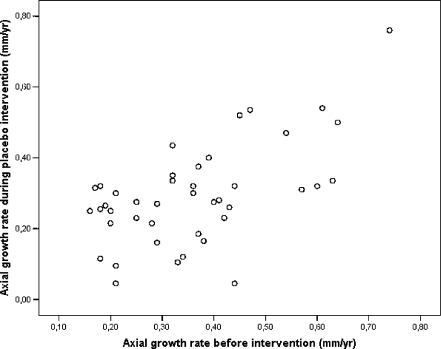
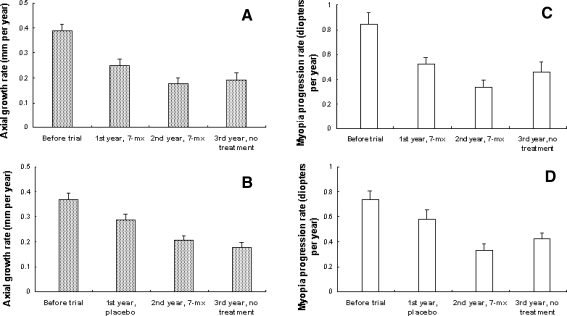
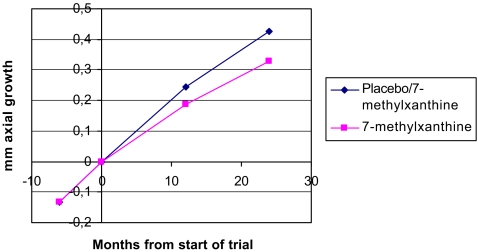
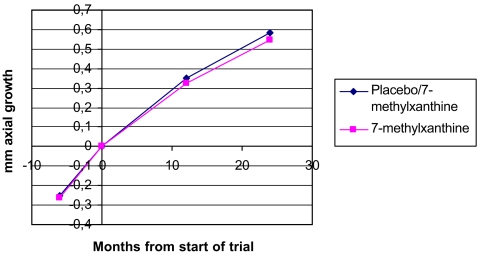
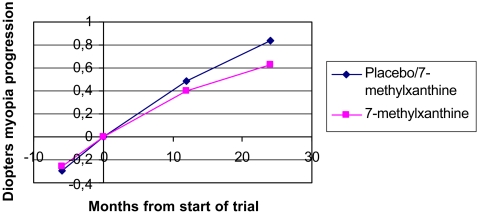
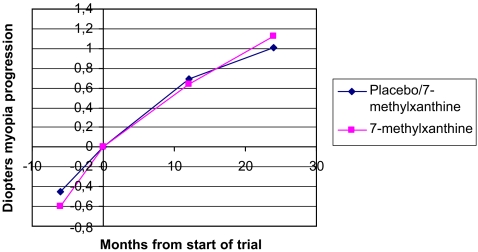
The adenosine antagonist 7-methylxanthine (7-mx) works against myopia in animal models. In a clinical trial, 68 myopic children (mean age 11.3 years) received either placebo or 7-mx tablets for 12 months. All participants subsequently received 7-mx for another 12 months, after which treatment was stopped. Axial length was measured with Zeiss IOL-Master and cycloplegic refraction with Nikon Retinomax at -6, 0, 12, 24, and 36 months. Axial growth was reduced among children treated with 7-mx for 24 months compared with those only treated for the last 12 months. Myopia progression and axial eye growth slowed down in periods with 7-mx treatment, but when the treatment was stopped, both myopia progression and axial eye growth continued with invariable speed. The results indicate that 7-mx reduces eye elongation and myopia progression in childhood myopia. The treatment is safe and without side effects and may be continued until 18-20 years of age when myopia progression normally stops.
腺苷拮抗剂7-甲基黄嘌呤(7-MX)在动物模型中对近视有抑制作用。在一项临床试验中,68名近视儿童(平均年龄11.3岁)接受了为期12个月的安慰剂或7-MX片剂治疗。随后,所有参与者又接受了12个月的7-MX治疗,之后停止治疗。在第-6、0、12、24和36个月时,使用蔡司IOL-Master测量眼轴长度,使用尼康Retinomax进行睫状肌麻痹验光。与仅在最后12个月接受治疗的儿童相比,接受7-MX治疗24个月的儿童眼轴生长减缓。在7-MX治疗期间,近视进展和眼轴生长放缓,但停止治疗后,近视进展和眼轴生长均以不变的速度继续。结果表明,7-MX可减少儿童近视中的眼轴伸长和近视进展。该治疗安全且无副作用,可持续至18 - 20岁,此时近视进展通常会停止。