Mitsuhashi Masato, Peel David, Ziogas Argyrios, Anton-Culver Hoda
Hitachi Chemical Research Center, Inc., Irvine, CA, USA.
Biomark Insights. 2009 Dec 22;4:201-9. doi: 10.4137/bmi.s3774.
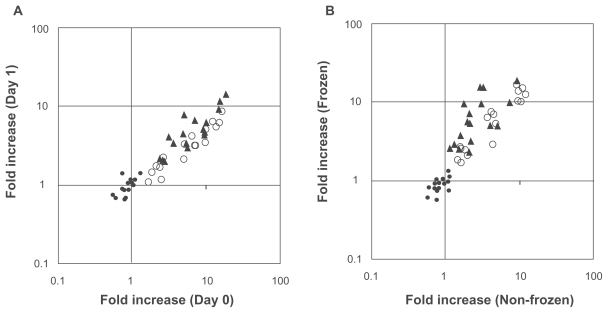
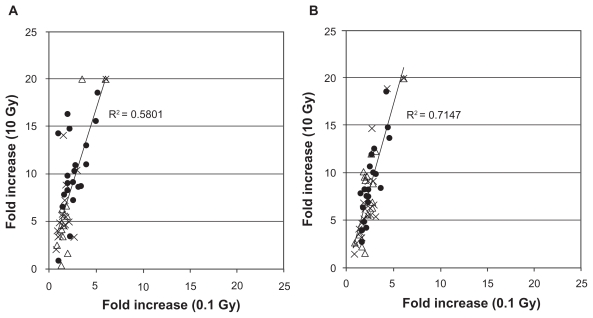
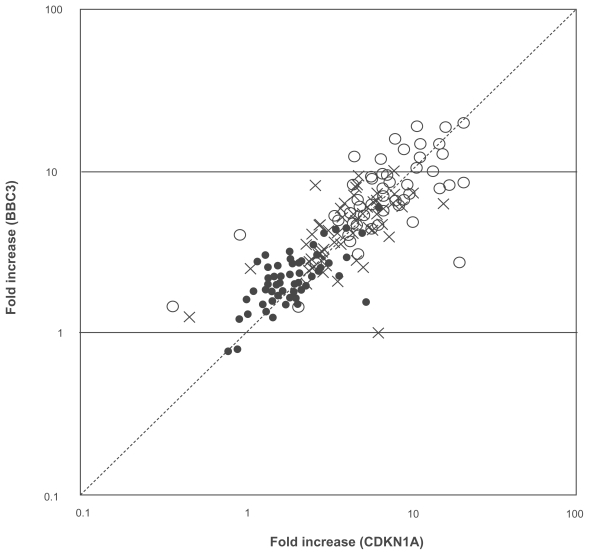
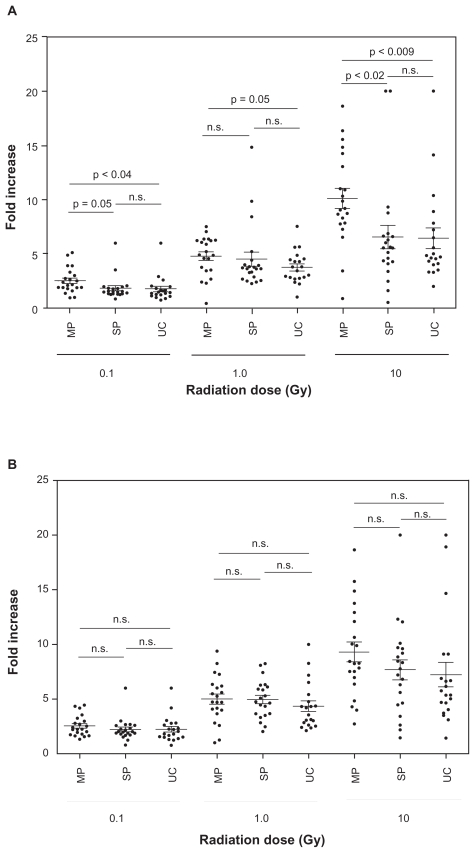
This study was designed to discover blood biomarkers of cancer susceptibility using invasive multiple (n = 21), single primary breast cancer (n = 21), and control subjects (n = 20). Heparinized whole blood was incubated at 37 degrees C for 2 hours after 0-10 Gy of radiation, then cell cycle arrest marker CDKN1A and apoptosis marker BBC3 mRNA were quantified. This epidemiological study was practically feasible because radiation-induced mRNA was preserved for at least 1 day whenever blood was stored at 4 degrees C (r(2) = 0.901). Moreover, blood could be stored frozen after radiation treatment (r(2) = 0.797). Radiation-induced CDKN1A and BBC3 mRNA were dose dependent, and the degree of induction of CDKN1A was correlated with that of BBC3 (r(2) = 0.679). Interestingly, multiple primary cases showed higher induction of CDKN1A mRNA than single primary and control groups, whereas BBC3 did not show such differences. The results suggested that cancer susceptibility represented by the multiple primary breast cancer cases was related to over-reaction of CDKN1A mRNA, not BBC3. The study also suggests that ex vivo gene expression analysis could potentially be used as a new tool in epidemiological studies for cancer and radiation sensitivity research.
本研究旨在利用侵袭性多原发(n = 21)、单原发乳腺癌(n = 21)及对照受试者(n = 20)发现癌症易感性的血液生物标志物。肝素化全血在接受0 - 10 Gy辐射后于37℃孵育2小时,然后对细胞周期阻滞标志物CDKN1A和凋亡标志物BBC3 mRNA进行定量分析。这项流行病学研究切实可行,因为无论血液在4℃储存时,辐射诱导的mRNA至少可保存1天(r² = 0.901)。此外,辐射处理后的血液可以冷冻保存(r² = 0.797)。辐射诱导的CDKN1A和BBC3 mRNA呈剂量依赖性,且CDKN1A的诱导程度与BBC3的诱导程度相关(r² = 0.679)。有趣的是,多原发病例组CDKN1A mRNA的诱导水平高于单原发病例组和对照组,而BBC3未显示出此类差异。结果表明,以多原发乳腺癌病例为代表的癌症易感性与CDKN1A mRNA的过度反应有关,而非BBC3。该研究还表明,体外基因表达分析有可能作为癌症和辐射敏感性研究的流行病学研究中的一种新工具。