Mood and Anxiety Disorders Program, National Institute of Mental Health, National Institutes of Health, Bethesda, Maryland 20892, USA.
Biol Psychiatry. 2010 Mar 1;67(5):432-8. doi: 10.1016/j.biopsych.2009.11.021. Epub 2010 Jan 15.
We previously reported that intravenous (IV) scopolamine administration produced rapid and robust antidepressant effects in a sample consisting of both unipolar and bipolar depressives. The present study aimed to replicate this finding in an independent sample limited to unipolar depressives.
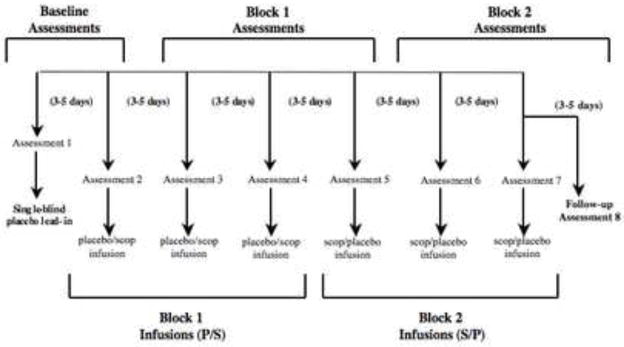
Outpatients with major depressive disorder (MDD; n = 23; 22 were included in analyses) participated in a double-blind, placebo-controlled, crossover trial. Subjects were randomized into either a P/S or S/P sequence (P = block of three placebo sessions; S = block of three scopolamine sessions; [4.0 microg/kg IV]). Sessions occurred 3 to 5 days apart, such that time spent in each block lasted 1.5 to 2 weeks and the interval between blocks was 3 to 5 days. The Montgomery-Asberg Depression Rating Scale (MADRS) served as the primary outcome measure.
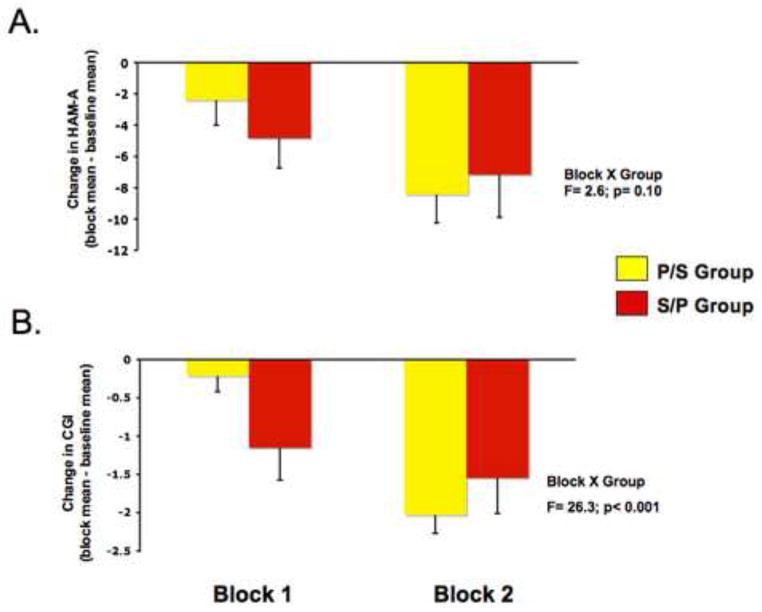
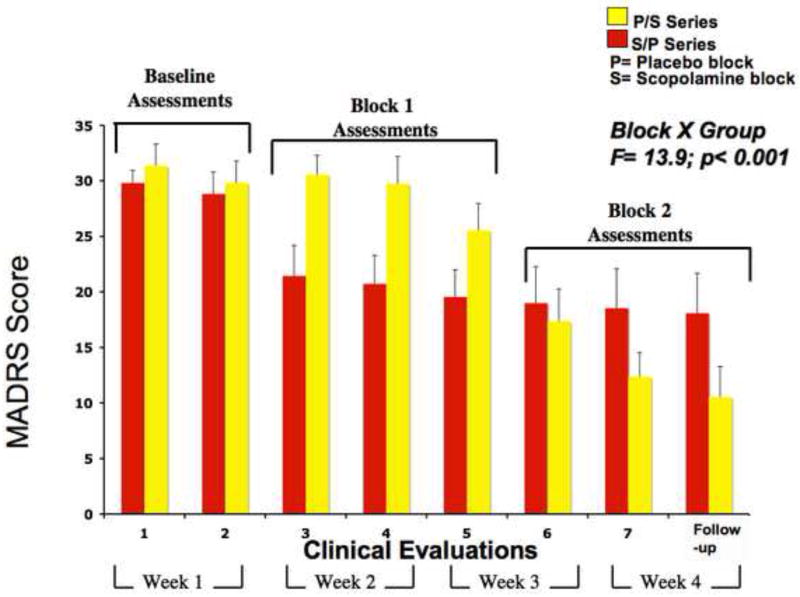
Following the initial block, the group receiving scopolamine first (S/P) showed a 32% reduction in MADRS scores (p < .001), which exceeded the corresponding change of 6.5% under placebo (P/S; p = .009), confirming the a-priori hypothesis. Improvement was significant at the first evaluation that followed scopolamine administration (p = .011). In Block 2, the P/S group showed a 53% reduction in MADRS scores (p = .001) following scopolamine versus placebo, whereas the reduction seen in S/P subjects who received scopolamine during Block 1 persisted as they received placebo during Block 2. Scopolamine induced drowsiness, blurred vision, dry mouth, light-headedness, and reduced blood pressure, which were sufficiently well tolerated that no subject dropped out because of side effects.
These results replicate previous finding that scopolamine produces a rapid and robust antidepressant response.
我们之前的研究报告显示,静脉注射(IV)东莨菪碱在包括单相和双相抑郁症患者在内的样本中产生了快速而显著的抗抑郁作用。本研究旨在在仅包括单相抑郁症患者的独立样本中复制这一发现。
门诊患者患有重度抑郁症(MDD;n = 23;22 人纳入分析)参加了一项双盲、安慰剂对照、交叉试验。受试者被随机分为 P/S 或 S/P 序列(P = 三个安慰剂疗程块;S = 三个东莨菪碱疗程块;[4.0μg/kg IV])。疗程间隔 3 至 5 天,每个疗程块持续 1.5 至 2 周,疗程块之间的间隔为 3 至 5 天。蒙哥马利-阿斯伯格抑郁评定量表(MADRS)作为主要结局测量指标。
在初始块之后,首先接受东莨菪碱治疗的组(S/P)的 MADRS 评分降低了 32%(p <.001),超过了安慰剂(P/S)下的 6.5%的相应变化(p =.009),证实了先验假设。在接受东莨菪碱治疗后的第一次评估中,改善具有统计学意义(p =.011)。在第 2 块中,接受东莨菪碱治疗的 P/S 组的 MADRS 评分降低了 53%(p =.001),而在第 1 块中接受东莨菪碱治疗的 S/P 组的评分降低则持续存在,因为他们在第 2 块中接受了安慰剂。东莨菪碱引起了嗜睡、视力模糊、口干、头晕和血压降低,这些副作用得到了充分的耐受,没有一个患者因为副作用而退出。
这些结果复制了之前的发现,即东莨菪碱产生了快速而显著的抗抑郁反应。