Charité-Universitätsmedizin Berlin, corporate member of Freie Universität Berlin, Humboldt-Universität Berlin, and Berlin Institute of Health, Neuroscience Research Center, 10117 Berlin, Germany.
Charité-Universitätsmedizin Berlin, corporate member of Freie Universität Berlin, Humboldt-Universität Berlin, and Berlin Institute of Health, Neuroscience Research Center, 10117 Berlin, Germany; German Center for Neurodegenerative Diseases (DZNE) Berlin, 10117 Berlin, Germany; Charité-Universitätsmedizin Berlin, corporate member of Freie Universität Berlin, Humboldt-Universität Berlin, and Berlin Institute of Health, Einstein Center for Neuroscience, 10117 Berlin, Germany; Charité-Universitätsmedizin Berlin, corporate member of Freie Universität Berlin, Humboldt-Universität Berlin, and Berlin Institute of Health, NeuroCure Cluster of Excellence, 10117 Berlin, Germany; Humboldt-Universität zu Berlin, Bernstein Center for Computational Neuroscience, Philippstr. 13, 10115 Berlin, Germany.
Neurosci Biobehav Rev. 2024 Feb;157:105538. doi: 10.1016/j.neubiorev.2024.105538. Epub 2024 Jan 12.
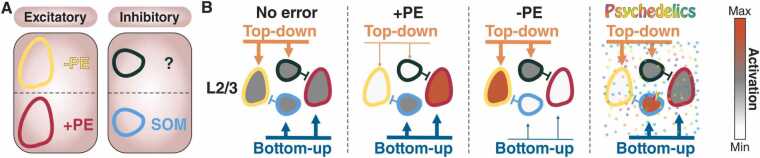
Psychedelic agents, such as LSD and psilocybin, induce marked alterations in consciousness via activation of the 5-HT receptor (5-HTRs). We hypothesize that psychedelics enforce a state of synthetic surprise through the biased activation of the 5-HTRs system. This idea is informed by recent insights into the role of 5-HT in signaling surprise. The effects on consciousness, explained by the cognitive penetrability of perception, can be described within the predictive coding framework where surprise corresponds to prediction error, the mismatch between predictions and actual sensory input. Crucially, the precision afforded to the prediction error determines its effect on priors, enabling a dynamic interaction between top-down expectations and incoming sensory data. By integrating recent findings on predictive coding circuitry and 5-HTRs transcriptomic data, we propose a biological implementation with emphasis on the role of inhibitory interneurons. Implications arise for the clinical use of psychedelics, which may rely primarily on their inherent capacity to induce surprise in order to disrupt maladaptive patterns.
迷幻剂,如 LSD 和裸盖菇素,通过激活 5-羟色胺受体(5-HTRs)引起明显的意识改变。我们假设迷幻剂通过对 5-HTRs 系统的偏置激活强制产生一种合成的惊讶状态。这个想法是基于最近对 5-HT 在信号惊讶中的作用的深入了解。意识的影响可以通过感知的认知可穿透性来解释,可以在预测编码框架内描述,其中惊讶对应于预测误差,即预测与实际感官输入之间的不匹配。至关重要的是,预测误差的精度决定了它对先验的影响,从而使自上而下的期望和传入的感官数据之间能够进行动态交互。通过整合最近关于预测编码电路和 5-HTRs 转录组数据的发现,我们提出了一个具有强调抑制性中间神经元作用的生物学实现。这对迷幻剂的临床应用产生了影响,迷幻剂的临床应用可能主要依赖于其内在的引起惊讶的能力,以打破适应不良的模式。