The Transplant Immunotherapy Program, Comprehensive Transplant Center, Los Angeles, CA 90048, USA.
Pediatr Nephrol. 2010 Oct;25(10):2035-45; quiz 2045-8. doi: 10.1007/s00467-009-1386-4. Epub 2010 Jan 14.
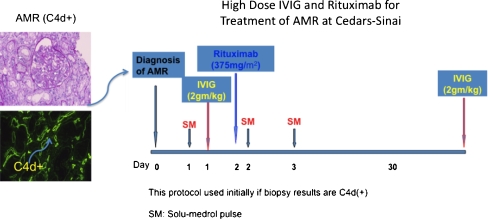
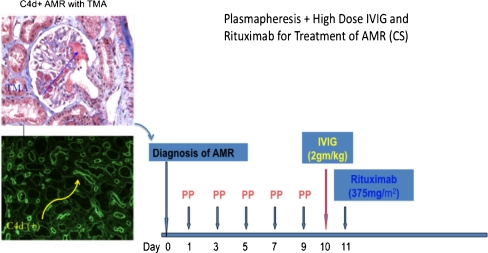
Antibody-mediated rejection (AMR) is a unique, significant, and often severe form of allograft rejection that is not amenable to treatment with standard immunosuppressive medications. Significant advances have occurred in our ability to predict patients at risk for, and to diagnose, AMR. These advances include the development of newer anti-human leukocyte antigen (HLA)-antibody detection techniques and assays for non-HLA antibodies associated with AMR. The pathophysiology of AMR suggests a prime role for antibodies, B cells and plasma cells, but other effector molecules, especially the complement system, point to potential targets that could modify the AMR process. An emerging and potentially larger problem is the development of chronic AMR (CAMR) resulting from de novo donor-specific anti-HLA antibodies (DSA) that emerge more than 100 days posttransplantation. Therapeutic options include: (1) High-dose intravenously administered immunoglobulin (IVIG), which has many potential benefits. (2) The use of IVIG+rituximab (anti-CD20, anti-B cell). (3) The combination of plasmapheresis (PP)+low-dose IVIG with or without rituximab. Data support the efficacy of all of the above approaches. Newer approaches to treating AMR include using the proteosome inhibitor (bortezomib), which induces apoptosis in plasma cells, and eculizumab (anti-C5, anticomplement monoclonal antibody).
抗体介导的排斥反应 (AMR) 是一种独特的、严重的同种异体移植物排斥反应形式,不能用标准的免疫抑制药物治疗。我们在预测 AMR 风险和诊断 AMR 方面的能力取得了重大进展。这些进展包括开发新的抗人白细胞抗原 (HLA) -抗体检测技术和与 AMR 相关的非 HLA 抗体检测技术。AMR 的病理生理学表明抗体、B 细胞和浆细胞起着主要作用,但其他效应分子,尤其是补体系统,提示可能改变 AMR 过程的潜在靶点。一个新出现的、潜在的更大问题是由于移植后 100 天以上出现的新的供体特异性 HLA 抗体 (DSA) 而导致的慢性 AMR (CAMR) 的发展。治疗选择包括:(1) 高剂量静脉注射免疫球蛋白 (IVIG),它具有许多潜在的益处。(2) 使用 IVIG+利妥昔单抗 (抗 CD20,抗 B 细胞)。(3) 血浆置换 (PP)+低剂量 IVIG 联合或不联合利妥昔单抗。所有上述方法的数据都支持其疗效。治疗 AMR 的新方法包括使用蛋白酶体抑制剂 (硼替佐米),它诱导浆细胞凋亡,和依库珠单抗 (抗 C5,抗补体单克隆抗体)。