Department of Cell Biology and Genetics, University of Alcalá; 28871 Alcalá de Henares, Madrid, Spain.
BMC Cancer. 2010 Jan 15;10:18. doi: 10.1186/1471-2407-10-18.
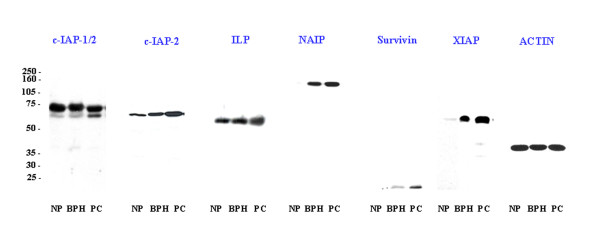
In this study was investigate IAPs in normal human prostate (NP), benign prostatic hyperplasia (BPH), prostatic intraepithelial neoplasia (PIN) and prostatic carcinoma (PC), and their involvement in apoptosis/proliferation via NF-kB (TNF-alpha, IL-1) stimulation.
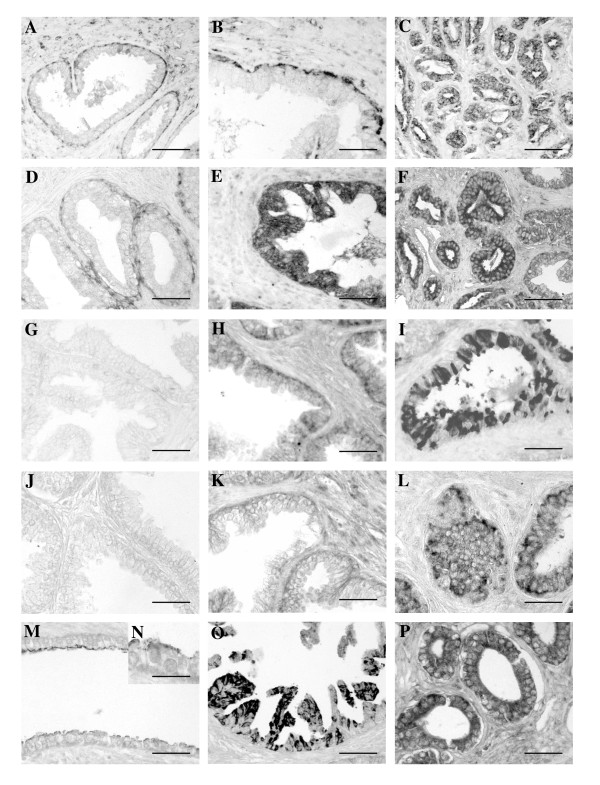
Immunohistochemical and Western blot analyses were performed in 10 samples of normal prostates, 35 samples of BPH, 27 samples diagnosis of PIN (with low-grade PIN or high-grade PIN) and 95 samples of PC (with low, medium or high Gleason grades).
In NP, cytoplasm of epithelial cells were positive to c-IAP1/2 (80% of samples), c-IAP-2 (60%), ILP (20%), XIAP (20%); negative to NAIP and survivin. In BPH, epithelial cells were immunostained to c-IAP1/2 (57.57%), c-IAP-2 (57.57%), ILP (66.6%), NAIP (60.6%), XIAP (27.27%), survivin (9.1%). Whereas low-grade PIN showed intermediate results between NP and BPH; results in high-grade PIN were similar to those found in PC. In PC, epithelial cells were immunostained to c-IAP1/2, c-IAP-2, ILP, NAIP, XIAP (no Gleason variation) and survivin (increasing with Gleason).
IAPs could be involved in prostate disorder (BPH, PIN and PC) development since might be provoke inhibition of apoptosis and subsequently cell proliferation. At the same time, different transduction pathway such as IL-1/NIK/NF-kB or TNF/NF-kB (NIK or p38) also promotes proliferation. Inhibitions of IAPs, IL-1alpha and TNFalpha might be a possible target for PC treatment since IAPs are the proteins that inhibited apoptosis (favour proliferation) and IL-1alpha and TNFalpha would affect all the transduction pathway involucrate in the activation of transcription factors related to survival or proliferation (NF-kB, Elk-1 or ATF-2).
本研究旨在探讨正常前列腺组织(NP)、良性前列腺增生(BPH)、前列腺上皮内瘤变(PIN)和前列腺癌(PC)中凋亡/增殖相关的内源性凋亡抑制蛋白(IAPs)及其在核因子-kB(NF-kB)(TNF-α、IL-1)刺激下的作用。
对 10 例正常前列腺组织、35 例 BPH、27 例低级别 PIN 和 95 例高级别 PIN、95 例不同 Gleason 分级的 PC 组织进行免疫组化和 Western blot 分析。
在 NP 中,上皮细胞的细胞质对 c-IAP1/2(80%的样本)、c-IAP-2(60%)、ILP(20%)、XIAP(20%)呈阳性,对 NAIP 和 survivin 呈阴性。在 BPH 中,上皮细胞对 c-IAP1/2(57.57%)、c-IAP-2(57.57%)、ILP(66.6%)、NAIP(60.6%)、XIAP(27.27%)、survivin(9.1%)呈免疫染色阳性。低级别 PIN 介于 NP 和 BPH 之间,而高级别 PIN 的结果与 PC 相似。在 PC 中,上皮细胞对 c-IAP1/2、c-IAP-2、ILP、NAIP、XIAP(无 Gleason 变化)和 survivin(随 Gleason 增加)呈免疫染色阳性。
IAPs 可能参与前列腺疾病(BPH、PIN 和 PC)的发生发展,因为它们可能引发凋亡抑制,进而促进细胞增殖。同时,不同的转导通路,如 IL-1/NIK/NF-kB 或 TNF/NF-kB(NIK 或 p38),也可促进增殖。IAPs、IL-1α 和 TNFα 的抑制可能是 PC 治疗的一个潜在靶点,因为 IAPs 是抑制凋亡(促进增殖)的蛋白质,而 IL-1α 和 TNFα 将影响所有涉及转录因子激活的转导通路,这些转录因子与存活或增殖(NF-kB、Elk-1 或 ATF-2)相关。