Department of Microbiology, Mount Sinai Hospital, Toronto, Ontario, M5G 1X5, Canada.
Ann Clin Microbiol Antimicrob. 2010 Jan 18;9:3. doi: 10.1186/1476-0711-9-3.
The objective of this study was to examine Streptococcus pneumoniae isolates collected from a longitudinal surveillance program in order to determine their susceptibility to currently used fluoroquinolones and of the frequency and type of mutations in the quinolone-resistant determining regions (QRDRs) of their parC and gyrA genes.
The Canadian Bacterial Surveillance Network has been collecting clinical isolates of S. pneumoniae from across Canada since 1988. Broth microdilution susceptibility testing was carried out according to the Clinical and Laboratory Standards Institute guidelines. The QRDRs of the parC and gyrA genes were sequenced for all isolates with ciprofloxacin MIC > or = 4 mg/L, and a large representative sample of isolates (N = 4,243) with MIC < or = 2 mg/L.
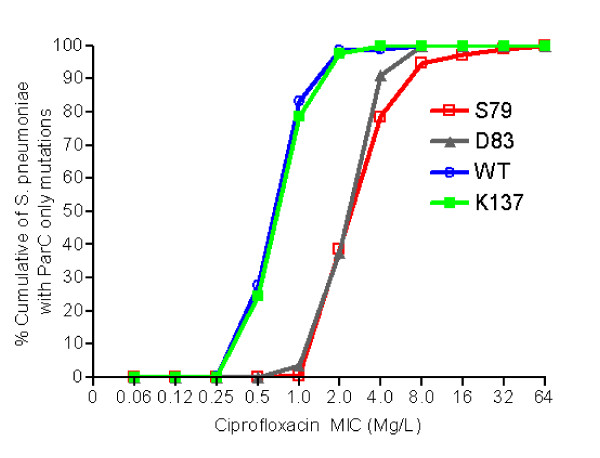
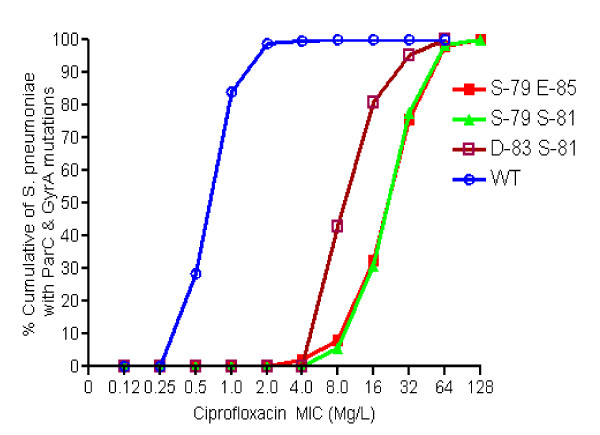
A total of 4,798 out of 30,111 isolates collected from 1988, and 1993 to 2007 were studied. Of those isolates that were successfully sequenced, 184 out of 1,032 with mutations in parC only, 11 out of 30 with mutations in gyrA only, and 292 out of 298 with mutations in parC and gyrA were considered resistant to ciprofloxacin (MIC > or = 4 mg/L). The most common substitutions in the parC were at positions 137 (n = 722), 79 (n = 209), and 83 (n = 56), of which substitutions at positions 79 and 83 were associated with 4-fold increase in MIC to ciprofloxacin, whereas substitutions at position 137 had minimal effect on the ciprofloxacin MIC. A total of 400 out of 622 isolates with Lys-137 parC mutation belonged to serotypes 1, 12, 31, 7A, 9V, 9N and 9L, whereas only 49 out of 3064 isolates with no mutations belonged to these serotypes. Twenty-one out of 30 isolates with substitutions at position 81 of the gyrA gene had an increased MIC to ciprofloxacin. Finally, we found that isolates with mutations in both parC and gyrA were significantly associated with increased MIC to fluoroquinolones.
Not all mutations, most frequently Lys-137, found in the QRDRs of the parC gene of S. pneumoniae is associated with an increased MIC to fluoroquinolones. The high prevalence of Lys-137 appears to be due to its frequent occurrence in common serotypes.
本研究旨在对纵向监测项目中收集的肺炎链球菌分离株进行检测,以确定其对目前使用的氟喹诺酮类药物的敏感性,以及其 parC 和 gyrA 基因喹诺酮耐药决定区(QRDR)中突变的频率和类型。
自 1988 年以来,加拿大细菌监测网络一直在从加拿大各地收集肺炎链球菌的临床分离株。根据临床和实验室标准协会的指南进行肉汤微量稀释药敏试验。对所有环丙沙星 MIC≥4mg/L 的分离株和 MIC≤2mg/L 的大量代表性分离株(N=4243)的 parC 和 gyrA 基因 QRDR 进行测序。
对 1988 年至 1993 年至 2007 年间收集的 30111 个分离株中的 4798 个进行了研究。在成功测序的分离株中,有 184 个仅有 parC 突变,11 个仅有 gyrA 突变,292 个同时有 parC 和 gyrA 突变,这些分离株对环丙沙星(MIC≥4mg/L)耐药。parC 中最常见的取代是位置 137(n=722)、79(n=209)和 83(n=56),其中位置 79 和 83 的取代与环丙沙星 MIC 增加 4 倍有关,而位置 137 的取代对环丙沙星 MIC 的影响最小。有 Lys-137 parC 突变的 622 个分离株中有 400 个属于 1、12、31、7A、9V、9N 和 9L 血清型,而 3064 个无突变的分离株中只有 49 个属于这些血清型。gyrA 基因位置 81 的 30 个取代中有 21 个对环丙沙星的 MIC 增加。最后,我们发现同时存在 parC 和 gyrA 基因突变的分离株与氟喹诺酮类药物 MIC 的增加显著相关。
并非 parC 基因 QRDR 中发现的所有突变,最常见的是 Lys-137,都与氟喹诺酮类药物 MIC 的增加有关。Lys-137 的高流行率似乎是由于其在常见血清型中的频繁发生。