Department of Human Development and Family Studies, Auburn University, AL 36849, USA.
J Pers Soc Psychol. 2010 Feb;98(2):190-200. doi: 10.1037/a0017991.
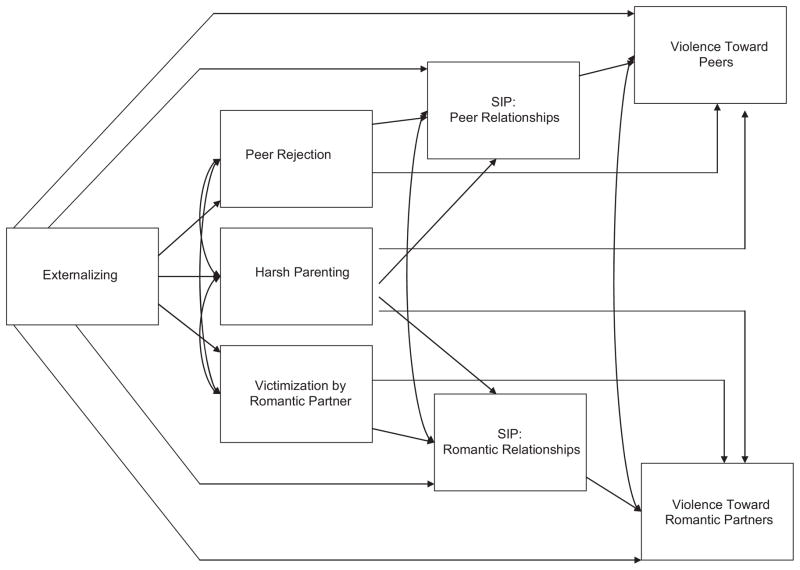
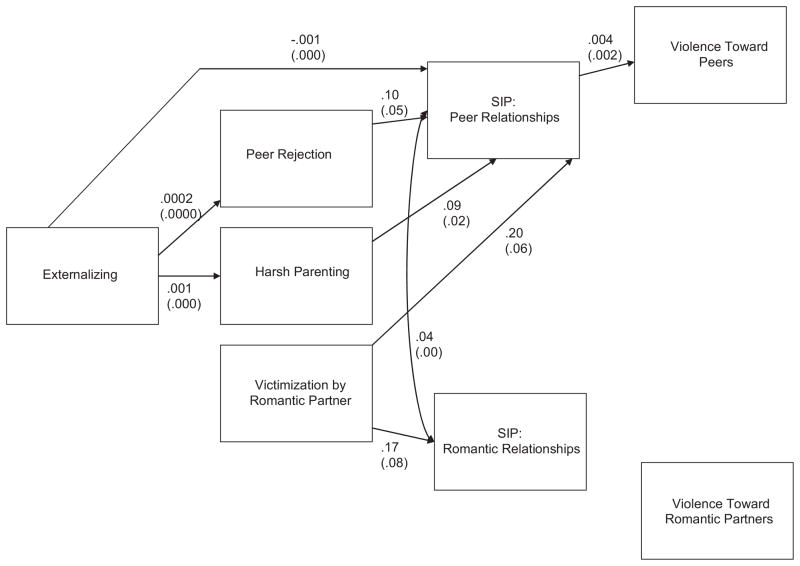
Using prospective longitudinal data, we tested 5 hypotheses: (a) that the relation between earlier developmental experiences (peer social rejection and victimization in a romantic relationship) and adult violent behavior toward peers and romantic partners is specific to relationship domain; (b) that the relation between social-information processing (SIP) biases and subsequent violence is also specific to relational domain (romantic partner vs. peer); (c) that the relation between developmental experiences and SIP biases is domain specific; (d) that domain-specific SIP mediates the impact of earlier developmental experiences on later violent behavior; and (e) that harsh parenting early in life is a domain-general predictor of SIP and later violent behavior. Harsh parenting was assessed through interviews with parents when their children were age 5 years. Classroom sociometric assessments indexing peer rejection were completed in elementary school, and self-report of victimization by romantic partners was provided at age 18 years. SIP was assessed via interview at age 22 years, and violent behavior was measured via self- and partner report at ages 23 years and 24 years. Structural equation analyses revealed specificity in the relation between developmental experiences and violence and in the prediction to and from SIP in the peer domain, but not in the romantic-relationship domain. The impact of early harsh treatment on violence toward peers was mediated by SIP biases in the peer domain. These findings provide support for domain specificity in the peer domain but for cross-domain generality in the romantic relationship domain in the development of violent behavior in early adulthood.
使用前瞻性纵向数据,我们检验了 5 个假设:(a)先前发展经历(恋爱关系中的同伴社交拒绝和受害)与成年后对同伴和恋爱伴侣的暴力行为之间的关系是特定于关系领域的;(b)社会信息加工(SIP)偏差与随后的暴力之间的关系也是特定于关系领域的(恋爱伴侣与同伴);(c)发展经历和 SIP 偏差之间的关系是特定于领域的;(d)特定领域的 SIP 中介了早期发展经历对后期暴力行为的影响;以及(e)早年严厉的育儿方式是 SIP 和后期暴力行为的一般领域预测因子。严厉的育儿方式是通过孩子 5 岁时父母的访谈来评估的。在小学阶段通过课堂社会计量评估来评估同伴拒绝指数,并在 18 岁时自我报告恋爱伴侣的受害情况。SIP 通过 22 岁时的访谈进行评估,暴力行为通过 23 岁和 24 岁时的自我报告和伴侣报告进行测量。结构方程分析显示,发展经历与暴力之间的关系以及在同伴领域中从 SIP 预测到暴力的关系具有特异性,但在恋爱关系领域中没有。早期严厉对待对同伴暴力行为的影响是由同伴领域中 SIP 偏差中介的。这些发现为同伴领域的特定领域提供了支持,但在恋爱关系领域为跨领域的普遍性提供了支持,即在成年早期发展暴力行为方面。