Institute of Human Nutrition, School of Medicine, University of Southampton, IDS Building, MP887 Southampton General Hospital, Tremona Road, Southampton, SO16 6YD, UK.
Crit Care. 2010;14(1):R5. doi: 10.1186/cc8844. Epub 2010 Jan 19.
The effect of parenteral fish oil in septic patients is not widely studied. This study investigated the effects of parenteral fish oil on plasma phospholipid fatty acids, inflammatory mediators, and clinical outcomes.
Twenty-five patients with systemic inflammatory response syndrome or sepsis, and predicted to need parenteral nutrition were randomized to receive either a 50:50 mixture of medium-chain fatty acids and soybean oil or a 50:40:10 mixture of medium-chain fatty acids, soybean oil and fish oil. Parenteral nutrition was administrated continuously for five days from admission. Cytokines and eicosanoids were measured in plasma and in lipopolysaccharide-stimulated whole blood culture supernatants. Fatty acids were measured in plasma phosphatidylcholine.
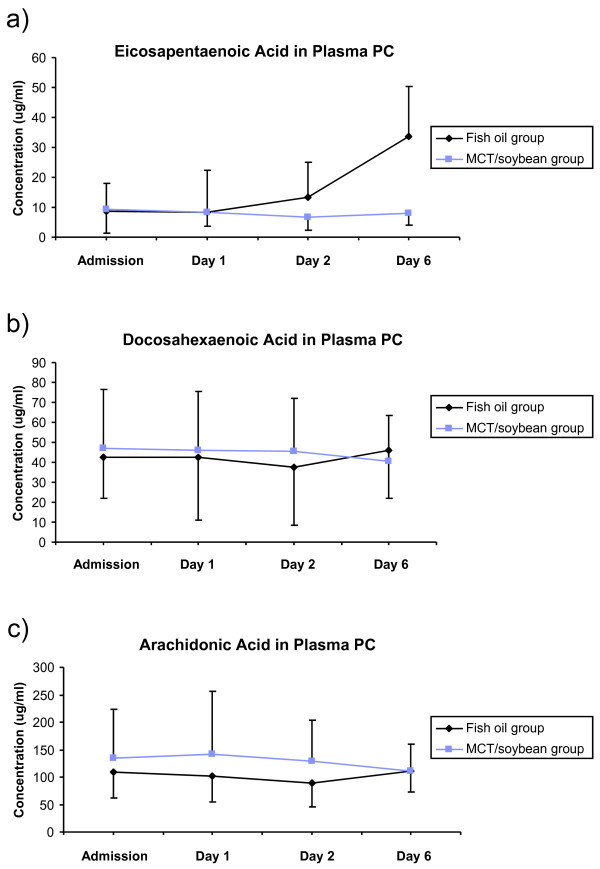
Fish oil increased eicosapentaenoic acid in plasma phosphatidylcholine (P < 0.001). Plasma interleukin (IL)-6 concentration decreased significantly more, and IL-10 significantly less, in the fish oil group (both P < 0.001). At Day 6 the ratio PO2/FiO2 was significantly higher in the fish oil group (P = 0.047) and there were fewer patients with PO2/FiO2 <200 and <300 in the fish oil group (P = 0.001 and P = 0.015, respectively). Days of ventilation, length of intensive care unit (ICU) stay and mortality were not different between the two groups. The fish oil group tended to have a shorter length of hospital stay (22 +/- 7 vs. 55 +/- 16 days; P = 0.079) which became significant (28 +/- 9 vs. 82 +/- 19 days; P = 0.044) when only surviving patients were included.
Inclusion of fish oil in parenteral nutrition provided to septic ICU patients increases plasma eicosapentaenoic acid, modifies inflammatory cytokine concentrations and improves gas exchange. These changes are associated with a tendency towards shorter length of hospital stay.
Clinical Trials Registration Number ISRCTN89432944.
鱼油对脓毒症患者的影响尚未得到广泛研究。本研究旨在探讨鱼油对脓毒症患者血浆磷脂脂肪酸、炎症介质和临床结局的影响。
25 名全身炎症反应综合征或脓毒症患者,预计需要接受肠外营养支持,随机分为接受中链脂肪酸和大豆油(50:50)或中链脂肪酸、大豆油和鱼油(50:40:10)混合的肠外营养组。肠外营养从入院起持续输注 5 天。在血浆和脂多糖刺激的全血培养上清液中测量细胞因子和类二十烷酸。在血浆磷脂酰胆碱中测量脂肪酸。
鱼油显著增加了血浆磷脂酰胆碱中的二十碳五烯酸(EPA)(P<0.001)。鱼油组的血浆白细胞介素(IL)-6 浓度显著下降(P<0.001),IL-10 浓度显著升高(P<0.001)。第 6 天,鱼油组的氧分压/吸入氧浓度(PO2/FiO2)比值显著升高(P=0.047),PO2/FiO2<200 和<300 的患者比例也显著减少(P=0.001 和 P=0.015)。两组患者的通气天数、重症监护病房(ICU)住院时间和死亡率无差异。与对照组相比,鱼油组的住院时间有缩短的趋势(22±7 天比 55±16 天;P=0.079),当仅纳入存活患者时,这种趋势更加明显(28±9 天比 82±19 天;P=0.044)。
在脓毒症 ICU 患者的肠外营养中添加鱼油可增加血浆二十碳五烯酸,调节炎症细胞因子浓度,并改善气体交换。这些变化与住院时间缩短有关。
临床试验注册号 ISRCTN89432944。