Robker Rebecca L, Akison Lisa K, Russell Darryl L
The Robinson Institute, School of Paediatrics and Reproductive Health, University of Adelaide, SA, Australia.
Nucl Recept Signal. 2009 Dec 31;7:e012. doi: 10.1621/nrs.07012.
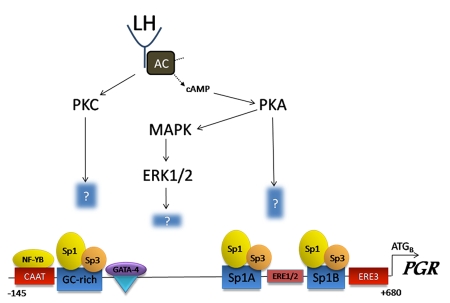
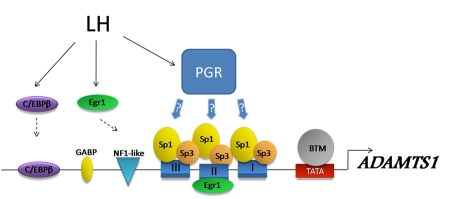
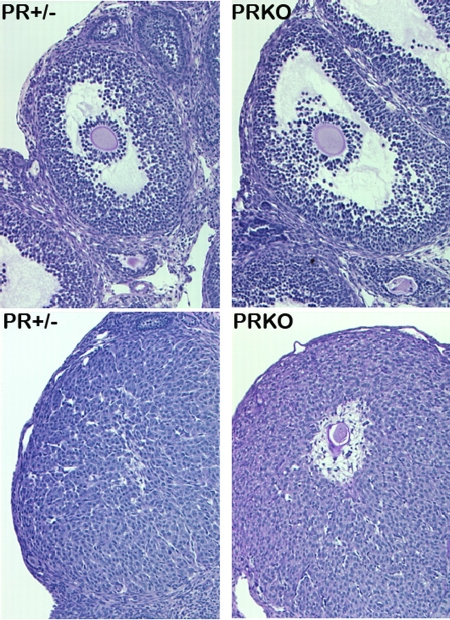
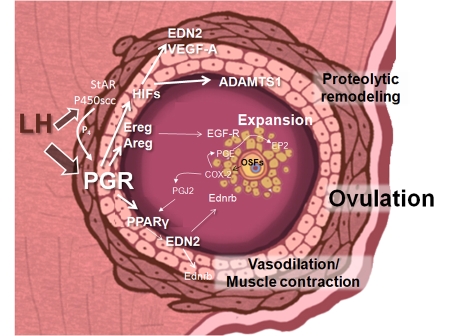
The progesterone receptor (PGR) is a nuclear receptor transcription factor that is essential for female fertility, in part due to its control of oocyte release from the ovary, or ovulation. In all mammals studied to date, ovarian expression of PGR is restricted primarily to granulosa cells of follicles destined to ovulate. Granulosa cell expression of PGR is induced by the pituitary Luteinizing Hormone (LH) surge via mechanisms that are not entirely understood, but which involve activation of Protein Kinase A and modification of Sp1/Sp3 transcription factors on the PGR promoter. Null mutations for PGR or treatment with PGR antagonists block ovulation in all species analyzed, including humans. The cellular mechanisms by which PGR regulates ovulation are currently under investigation, with several downstream pathways having been identified as PGR-regulated and potentially involved in follicular rupture. Interestingly, none of these PGR-regulated genes has been demonstrated to be a direct transcriptional target of PGR. Rather, in ovarian granulosa cells, PGR may act as an inducible coregulator for constitutively bound Sp1/Sp3 transcription factors, which are key regulators for a discrete cohort of ovulatory genes.
孕酮受体(PGR)是一种核受体转录因子,对雌性生育能力至关重要,部分原因在于它控制着卵巢中卵母细胞的释放,即排卵过程。在迄今为止研究的所有哺乳动物中,PGR在卵巢中的表达主要局限于注定要排卵的卵泡的颗粒细胞。垂体促黄体生成素(LH)峰通过尚未完全了解的机制诱导颗粒细胞表达PGR,这些机制涉及蛋白激酶A的激活以及PGR启动子上Sp1/Sp3转录因子的修饰。PGR的无效突变或用PGR拮抗剂处理会阻断所有已分析物种(包括人类)的排卵。目前正在研究PGR调节排卵的细胞机制,已确定有几个下游途径受PGR调节并可能参与卵泡破裂。有趣的是,这些受PGR调节的基因中没有一个被证明是PGR的直接转录靶点。相反,在卵巢颗粒细胞中,PGR可能作为组成性结合的Sp1/Sp3转录因子的诱导性共调节因子,而Sp1/Sp3转录因子是一组离散的排卵基因的关键调节因子。