Department of Medicine, Indiana University School of Medicine, Indianapolis, Indiana, USA.
J Surg Res. 2011 Jun 1;168(1):e61-9. doi: 10.1016/j.jss.2009.09.053. Epub 2009 Oct 23.
The toll-like receptor (TLR) family serves an important regulatory role in the innate immune system, and recent evidence has implicated TLR signaling in the pro-inflammatory response of a variety of endogenous and exogenous stimuli within the kidney. The role of TLR signaling in fibrotic renal injury, however, remains unknown.
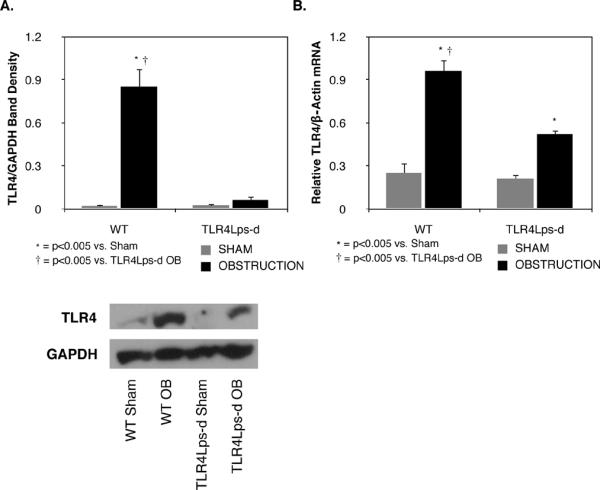
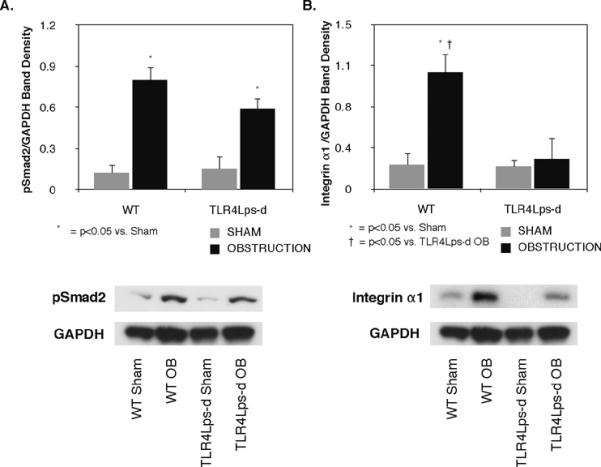
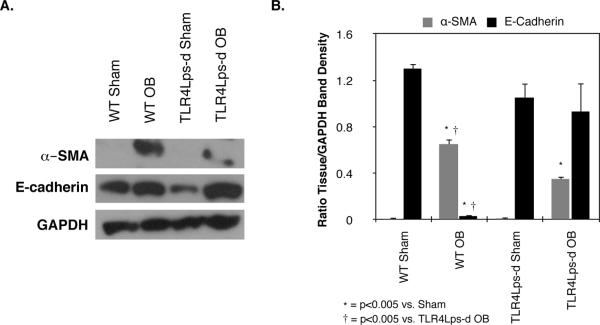
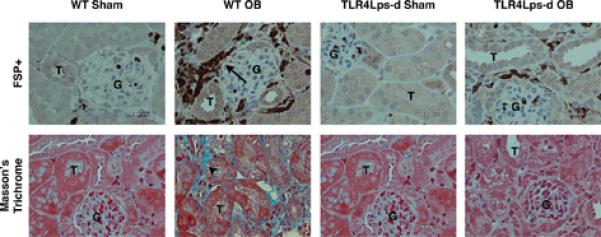
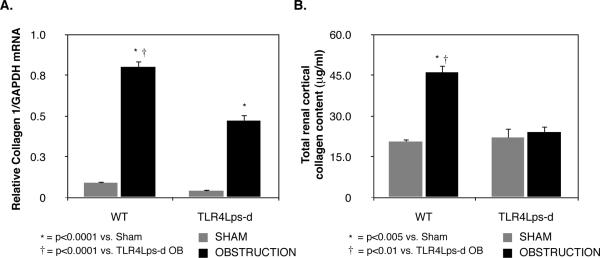
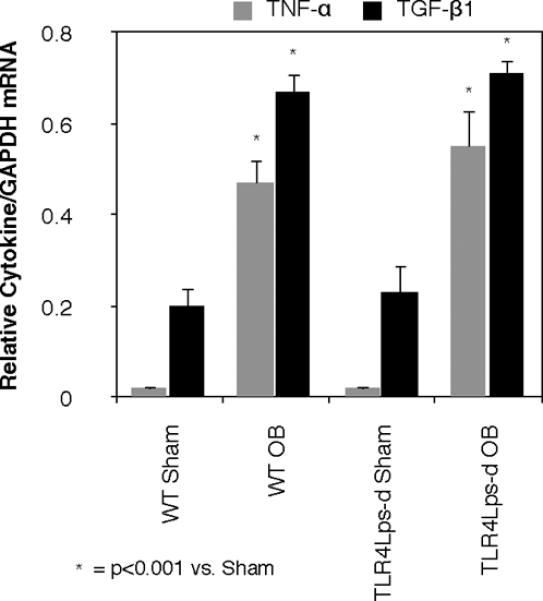
C3H/HeJ TLR4 hyporesponsive mice (TLR4(Lps-d)) or WT controls (C3H/HeOu/J) underwent either sham operation or 1 wk of unilateral ureteral obstruction (UUO). The kidneys were harvested and tissues were analyzed for TLR4 expression (Western blot; RTPCR), E-cadherin and alpha smooth muscle actin (α-SMA) expression (Western blot), fibroblast accumulation (fibroblast specific protein (FSP-1+) staining), renal fibrosis (collagen I RTPCR, total collagen assay, Masson's trichrome staining), cytokine gene expression (tumor necrosis factor-alpha (TNF-α) and transforming growth factor-beta1 (TGF-β1) RTPCR), and pSMAD2 and integrin α1 expression (Western blot).
Mice with intact TLR4 signaling demonstrate a significant increase in TLR4 expression, α-SMA expression, fibroblast accumulation, collagen deposition, and interstitial fibrosis, and a significant decrease in E-cadherin expression in response to UUO. TLR4 deficient mice, however, exhibit a significant reduction in obstruction-induced α-SMA expression, fibroblast accumulation, and renal fibrosis, with preservation of E-cadherin expression. TLR4's influence on fibroblast accumulation and renal fibrosis occurred independent of any alterations in TNF-α, TGF-β1, or pSMAD2 expression, but did involve alterations integrin α1 expression.
TLR4 appears to be a significant mediator of fibrotic renal injury. While TLR4 signaling is recognized as a critical component of the innate immune response, this is the first study to demonstrate a novel role for TLR4 in renal fibroblast accumulation and tubulointerstitial fibrosis.
Toll 样受体(TLR)家族在先天免疫系统中起着重要的调节作用,最近的证据表明 TLR 信号转导参与了肾脏内各种内源性和外源性刺激的促炎反应。然而,TLR 信号转导在纤维性肾损伤中的作用尚不清楚。
C3H/HeJ TLR4 低反应性小鼠(TLR4(Lps-d))或 WT 对照(C3H/HeOu/J)接受假手术或单侧输尿管梗阻(UUO)1 周。收获肾脏组织,分析 TLR4 表达(Western blot;RT-PCR)、E-钙黏蛋白和α平滑肌肌动蛋白(α-SMA)表达(Western blot)、成纤维细胞积累(成纤维细胞特异性蛋白(FSP-1+)染色)、肾纤维化(胶原 I RT-PCR、总胶原测定、Masson 三色染色)、细胞因子基因表达(肿瘤坏死因子-α(TNF-α)和转化生长因子-β1(TGF-β1)RT-PCR)和 pSMAD2 和整合素α1 表达(Western blot)。
具有完整 TLR4 信号的小鼠在 UUO 后表现出 TLR4 表达、α-SMA 表达、成纤维细胞积累、胶原沉积和间质纤维化显著增加,E-钙黏蛋白表达显著降低。然而,TLR4 缺陷小鼠表现出梗阻诱导的α-SMA 表达、成纤维细胞积累和肾纤维化显著减少,同时 E-钙黏蛋白表达得到保留。TLR4 对成纤维细胞积累和肾纤维化的影响独立于 TNF-α、TGF-β1 或 pSMAD2 表达的任何改变,但确实涉及整合素α1 表达的改变。
TLR4 似乎是纤维性肾损伤的重要介质。虽然 TLR4 信号转导被认为是先天免疫反应的关键组成部分,但这是第一项证明 TLR4 在肾成纤维细胞积累和肾小管间质纤维化中的新作用的研究。