Department of Genetics, Biology and Biochemistry, University of Torino, Torino, Italy.
PLoS One. 2010 Jan 15;5(1):e8725. doi: 10.1371/journal.pone.0008725.
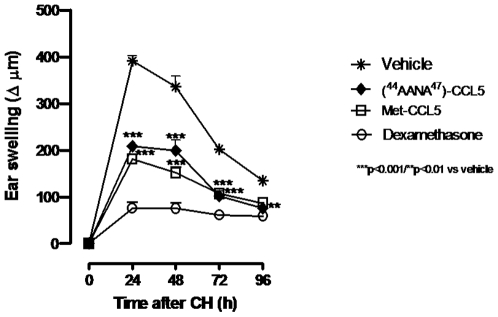
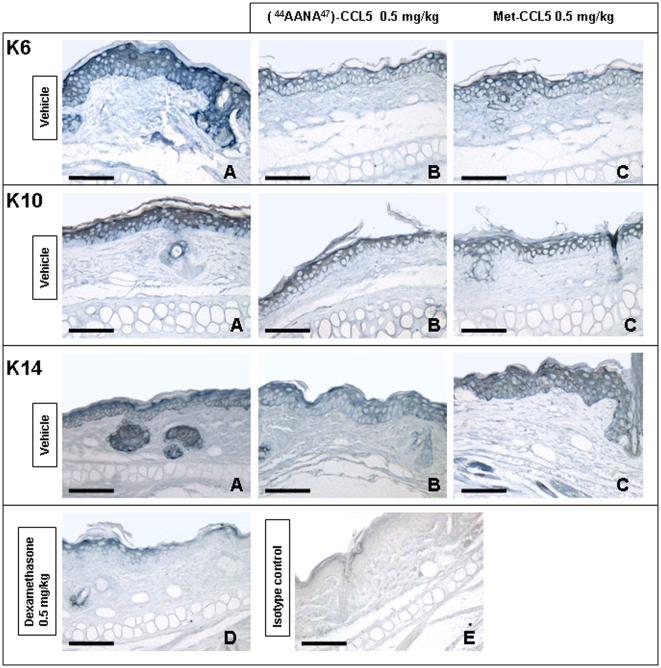
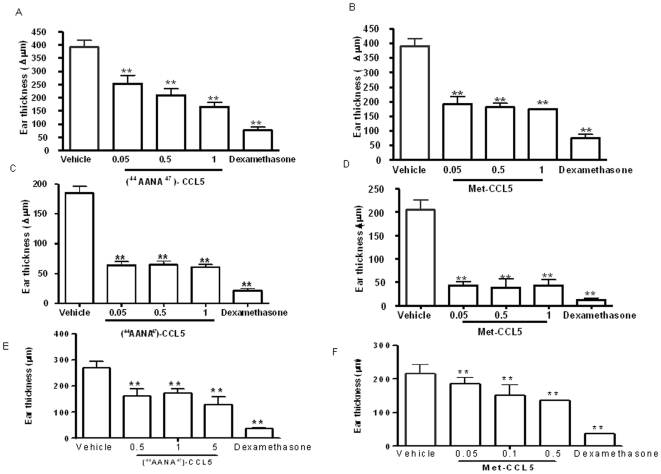
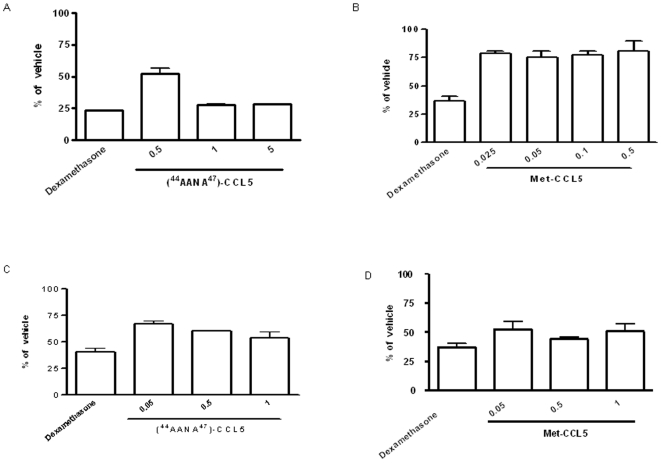
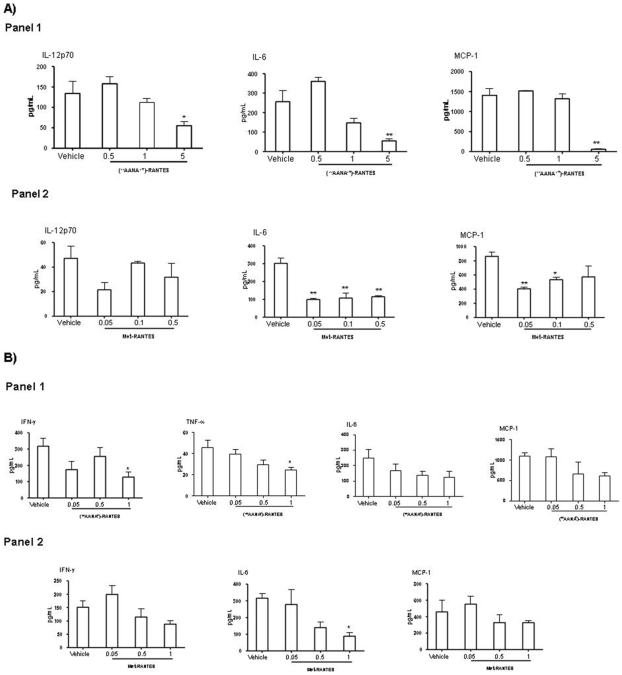
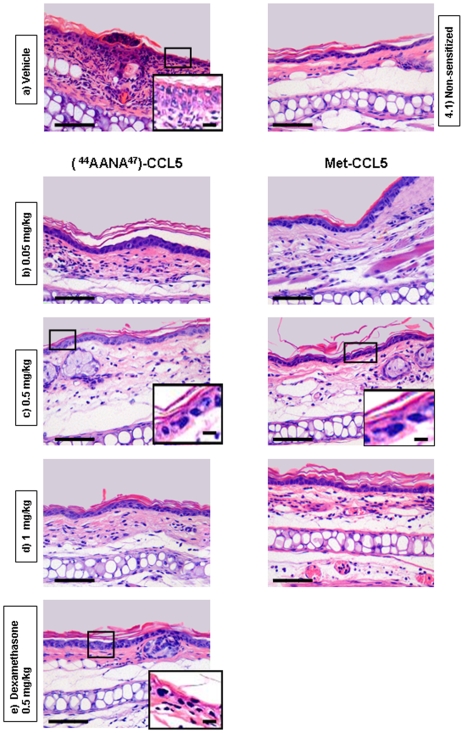
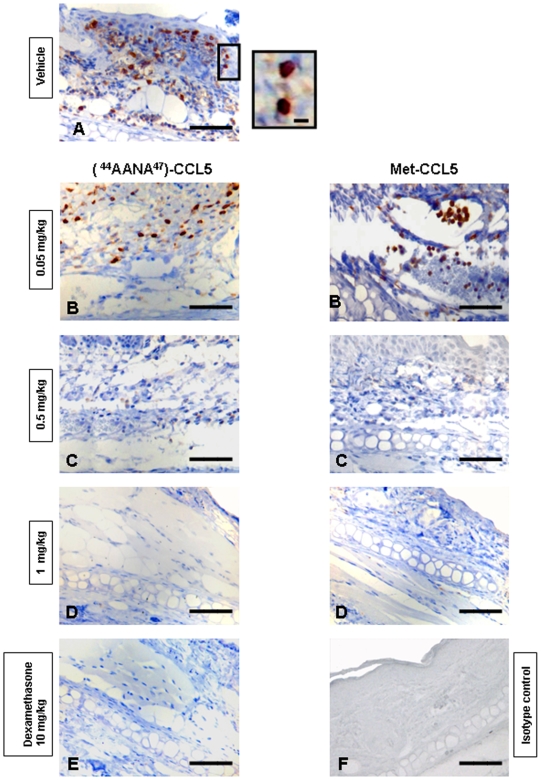
Skin-infiltrating T-cells play a predominant role in allergic and inflammatory skin diseases such as atopic dermatitis, psoriasis and allergic contact dermatitis. These T-cells are attracted by several chemotactic factors including the chemokine CCL5/RANTES, a CC chemokine inducing both the migration and activation of specific leukocyte subsets. CCL5 has been found to be associated with various cell-mediated hypersensitive disorders such as psoriasis, atopic dermatitis and irritant contact dermatitis. We have used two antagonists, the first, Met-CCL5, a dual CCR1/CCR5 antagonist and the second, a variant in which GAG binding is abrogated, (44)AANA(47)-CCL5, which acts as a dominant negative inhibitor of CCL5. The antagonists were tested in two models of contact skin reaction. The first, irritant contact dermatitis (ICD) is a pathological non-specific inflammatory skin condition arising from the release of pro-inflammatory cytokines by keratinocytes in response to haptens, usually chemicals. The second, contact hypersensitivity (CHS) is a T-cell dependent model, mimicking in part the T-cell-mediated skin diseases such as psoriasis. In both models, the CCL5 antagonists showed therapeutic efficacy by reducing swelling by 50% as well as the reduction of soluble mediators in homogenates derived from challenged ears. These results demonstrate that blocking the receptor or the ligand are both effective strategies to inhibit skin inflammation.
皮肤浸润 T 细胞在特应性皮炎、银屑病和变应性接触性皮炎等过敏性和炎症性皮肤病中发挥主要作用。这些 T 细胞被几种趋化因子吸引,包括趋化因子 CCL5/RANTES,一种诱导特定白细胞亚群迁移和激活的 CC 趋化因子。已经发现 CCL5 与各种细胞介导的超敏疾病有关,如银屑病、特应性皮炎和刺激性接触性皮炎。我们使用了两种拮抗剂,第一种是 Met-CCL5,一种双重 CCR1/CCR5 拮抗剂,第二种是 GAG 结合被废除的变体,(44)AANA(47)-CCL5,它作为 CCL5 的显性负抑制剂起作用。拮抗剂在两种接触性皮炎模型中进行了测试。第一种是刺激性接触性皮炎(ICD),这是一种由角质形成细胞对半抗原(通常是化学物质)释放促炎细胞因子引起的非特异性炎症性皮肤病。第二种是接触超敏反应(CHS),这是一种 T 细胞依赖性模型,部分模拟了银屑病等 T 细胞介导的皮肤病。在这两种模型中,CCL5 拮抗剂通过将肿胀减少 50%以及减少来自受挑战耳朵的匀浆中可溶性介质的水平,显示出治疗效果。这些结果表明,阻断受体或配体都是抑制皮肤炎症的有效策略。