Division of Gastroenterology and Hematology/Oncology, Department of Medicine, Asahikawa Medical College, Asahikawa, Japan.
PLoS One. 2010 Jan 21;5(1):e8824. doi: 10.1371/journal.pone.0008824.
The hedgehog (Hh) pathway has been implicated in the pathogenesis of cancer including pancreatic ductal adenocarcinoma (PDAC). Recent studies have suggested that the oncogenic function of Hh in PDAC involves signaling in the stromal cells rather than cell autonomous effects on the tumor cells. However, the origin and nature of the stromal cell type(s) that are responsive to Hh signaling remained unknown. Since Hh signaling plays a crucial role during embryonic and postnatal vasculogenesis, we speculated that Hh ligand may act on tumor vasculature specifically focusing on bone marrow (BM)-derived cells.
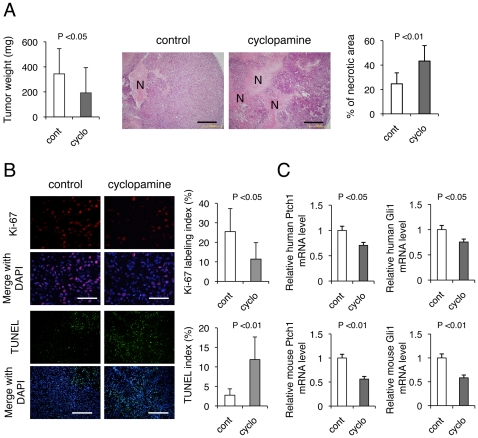
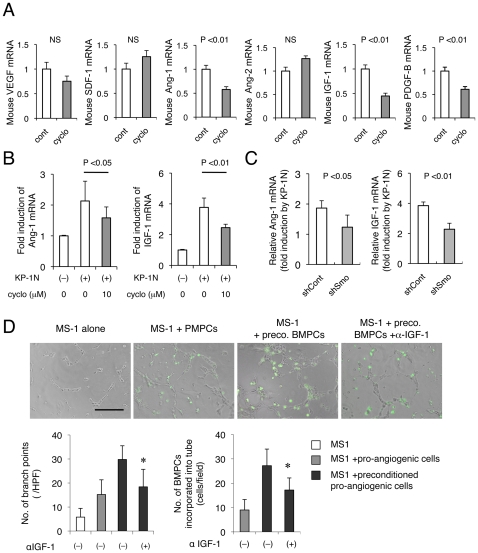
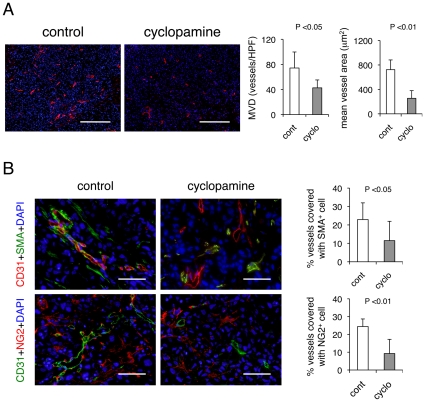
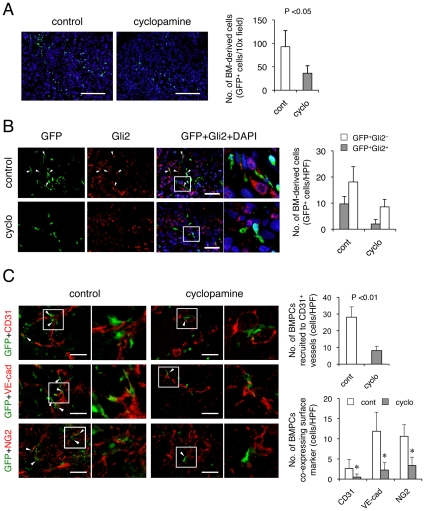
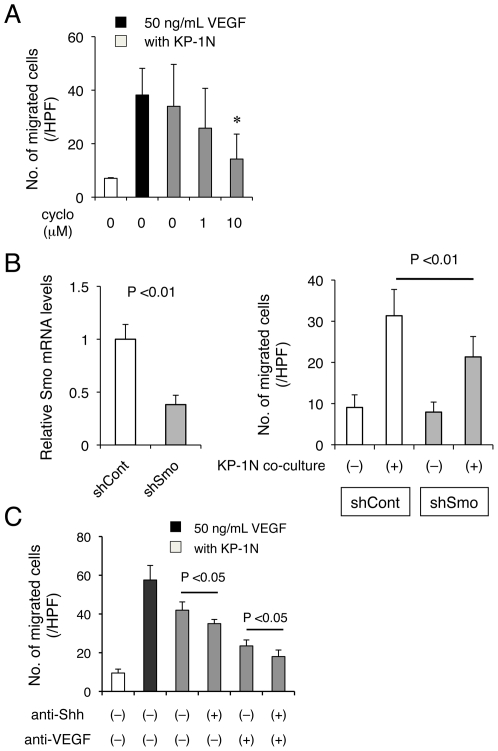
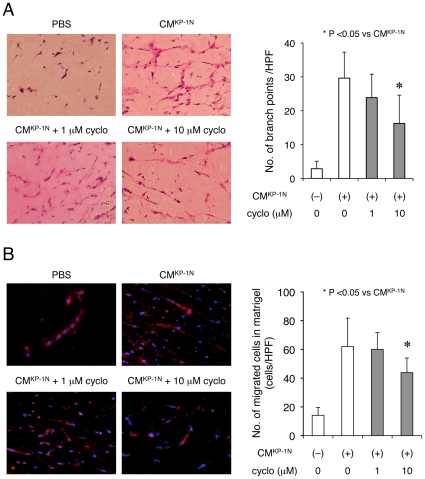
METHODOLOGY/PRINCIPAL FINDINGS: Cyclopamine was utilized to inhibit the Hh pathway in human PDAC cell lines and their xenografts. BM transplants, co-culture systems of tumor cells and BM-derived pro-angiogenic cells (BMPCs) were employed to assess the role of tumor-derived Hh in regulating the BM compartment and the contribution of BM-derived cells to angiogenesis in PDAC. Cyclopamine administration attenuated Hh signaling in the stroma rather than in the cancer cells as reflected by decreased expression of full length Gli2 protein and Gli1 mRNA specifically in the compartment. Cyclopamine inhibited the growth of PDAC xenografts in association with regression of the tumor vasculature and reduced homing of BM-derived cells to the tumor. Host-derived Ang-1 and IGF-1 mRNA levels were downregulated by cyclopamine in the tumor xenografts. In vitro co-culture and matrigel plug assays demonstrated that PDAC cell-derived Shh induced Ang-1 and IGF-1 production in BMPCs, resulting in their enhanced migration and capillary morphogenesis activity.
CONCLUSIONS/SIGNIFICANCE: We identified the BMPCs as alternative stromal targets of Hh-ligand in PDAC suggesting that the tumor vasculature is an attractive therapeutic target of Hh blockade. Our data is consistent with the emerging concept that BM-derived cells make important contributions to epithelial tumorigenesis.
刺猬(Hh)信号通路与包括胰腺导管腺癌(PDAC)在内的癌症的发病机制有关。最近的研究表明,Hh 在 PDAC 中的致癌功能涉及到基质细胞中的信号传递,而不是对肿瘤细胞的自主效应。然而,对响应 Hh 信号的基质细胞类型的起源和性质仍不清楚。由于 Hh 信号在胚胎和出生后血管生成过程中发挥着至关重要的作用,我们推测 Hh 配体可能作用于肿瘤血管系统,特别是针对骨髓(BM)来源的细胞。
方法/主要发现:利用环巴胺抑制人 PDAC 细胞系及其异种移植物中的 Hh 通路。进行 BM 移植、肿瘤细胞和 BM 来源的促血管生成细胞(BMPC)的共培养系统,以评估肿瘤衍生的 Hh 在调节 BM 区室以及 BM 来源的细胞对 PDAC 血管生成的贡献中的作用。环巴胺处理在基质中而非在癌细胞中减弱了 Hh 信号,这反映在全长 Gli2 蛋白和 Gli1 mRNA 的表达在该区室中特异性下降。环巴胺抑制 PDAC 异种移植物的生长与肿瘤血管的退化以及 BM 来源的细胞向肿瘤的归巢减少有关。肿瘤异种移植物中的宿主衍生的 Ang-1 和 IGF-1 mRNA 水平被环巴胺下调。体外共培养和基质胶塞实验表明,PDAC 细胞衍生的 Shh 诱导 BMPC 中 Ang-1 和 IGF-1 的产生,导致其迁移和毛细血管形态发生活性增强。
结论/意义:我们确定了 BMPC 是 PDAC 中 Hh 配体的替代基质靶标,这表明肿瘤血管是 Hh 阻断的一个有吸引力的治疗靶点。我们的数据与新兴的观点一致,即 BM 来源的细胞对上皮肿瘤发生有重要贡献。