University of Missouri-Saint Louis, Department of Psychology, Saint Louis, MO 63121, USA.
Behav Res Ther. 2010 May;48(5):394-401. doi: 10.1016/j.brat.2010.01.001. Epub 2010 Jan 11.
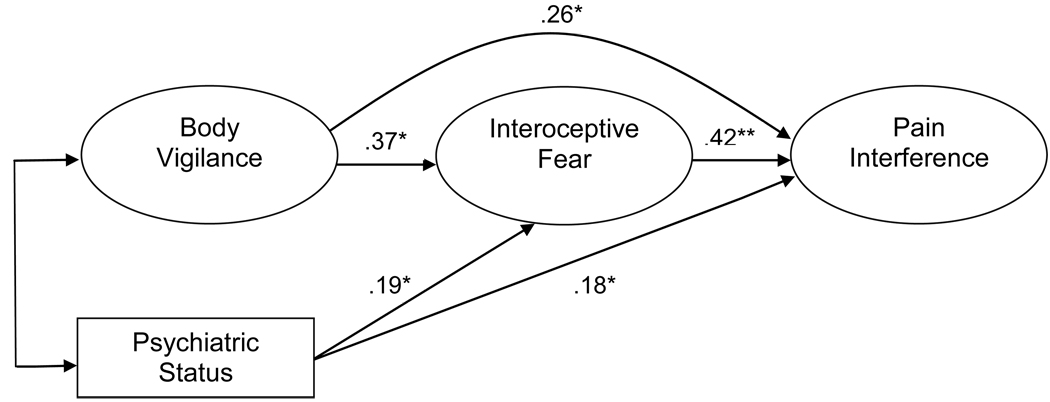
We investigated body vigilance, cardiac anxiety, and the mediating role of interoceptive fear on pain in patients with non-cardiac chest pain (NCCP; a syndrome of chest pain in the absence of identifiable organic etiology). Patients were more attentive to cardiac-congruent sensations than cardiac-incongruent sensations (e.g., gastrointestinal, cognitive dyscontrol; p's < .001). Patients with a DSM-IV Axis I anxiety or mood disorder were more body vigilant compared to patients who did not have a disorder (p's < .05). Patients with anxiety disorders were particularly vigilant to and fearful of cardiac sensations relative to patients without anxiety disorders. Latent variable path models examined the extent that interoceptive fear mediated the association between body vigilance and cardiac anxiety on chest pain. Within each model, diagnostic status, body vigilance, and cardiac anxiety were exogenous and predicted interoceptive fear that in turn predicted pain. Separate models examined body vigilance and cardiac anxiety, and both models fit the data well. Findings showed partial mediation for the body vigilance factor, and full mediation for the cardiac anxiety factor. Interoceptive fear played a mediating role in both models. The syndrome of NCCP may persist partly due to conscious hypervigilance to and fear of cardiac-congruent body sensations, particularly among anxious patients.
我们研究了非心源性胸痛(NCCP;一种无明显器质性病因的胸痛综合征)患者的身体警觉、心脏焦虑以及内脏恐惧对疼痛的中介作用。与心脏不相关的感觉(例如胃肠道、认知失控)相比,患者对心脏相关感觉更警觉(p 值<.001)。与无障碍患者相比,患有 DSM-IV 轴 I 焦虑或情绪障碍的患者身体警觉度更高(p 值<.05)。与无焦虑障碍的患者相比,焦虑障碍患者对心脏感觉特别警觉和恐惧。潜在变量路径模型检验了身体警觉与心脏焦虑对胸痛的关联中内脏恐惧的中介程度。在每个模型中,诊断状态、身体警觉和心脏焦虑都是外生的,并预测了内脏恐惧,而内脏恐惧又预测了疼痛。分别对身体警觉和心脏焦虑进行了模型检验,两个模型都很好地拟合了数据。结果表明,身体警觉因素存在部分中介,心脏焦虑因素存在完全中介。内脏恐惧在两个模型中都起中介作用。NCCP 综合征的持续存在部分可能是由于对与心脏相关的身体感觉有意识的过度警觉和恐惧,尤其是在焦虑患者中。