Department of Microbiology, University of Washington, Seattle, WA 98195, USA.
Cell Host Microbe. 2010 Jan 21;7(1):25-37. doi: 10.1016/j.chom.2009.12.007.
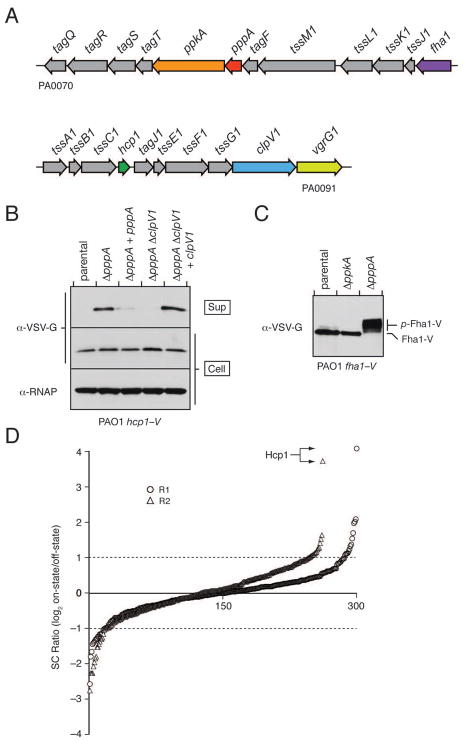
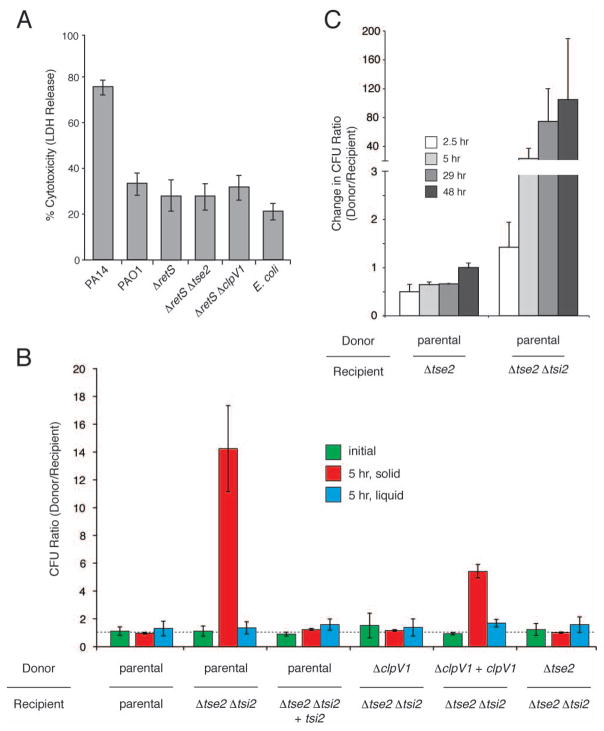
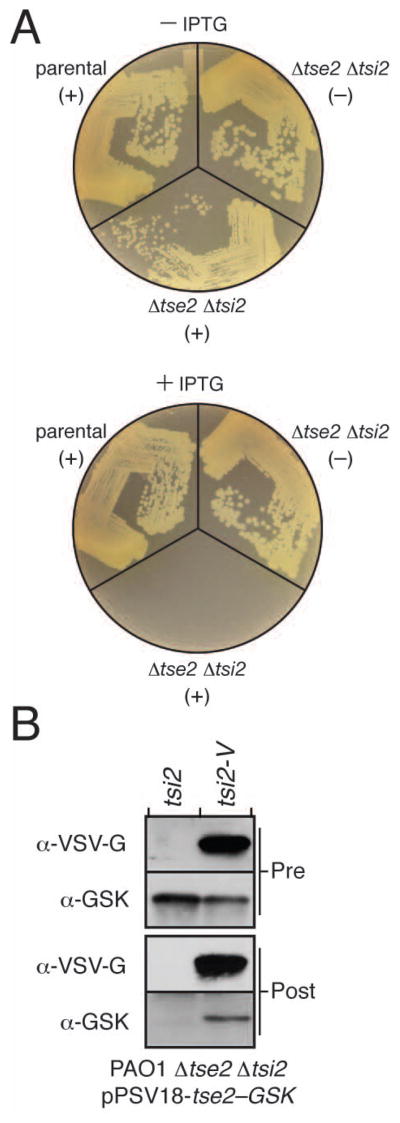
The functional spectrum of a secretion system is defined by its substrates. Here we analyzed the secretomes of Pseudomonas aeruginosa mutants altered in regulation of the Hcp Secretion Island-I-encoded type VI secretion system (H1-T6SS). We identified three substrates of this system, proteins Tse1-3 (type six exported 1-3), which are coregulated with the secretory apparatus and secreted under tight posttranslational control. The Tse2 protein was found to be the toxin component of a toxin-immunity system and to arrest the growth of prokaryotic and eukaryotic cells when expressed intracellularly. In contrast, secreted Tse2 had no effect on eukaryotic cells; however, it provided a major growth advantage for P. aeruginosa strains, relative to those lacking immunity, in a manner dependent on cell contact and the H1-T6SS. This demonstration that the T6SS targets a toxin to bacteria helps reconcile the structural and evolutionary relationship between the T6SS and the bacteriophage tail and spike.
分泌系统的功能谱由其底物定义。在这里,我们分析了调控 Hcp 分泌岛-I 编码的 VI 型分泌系统(H1-T6SS)的铜绿假单胞菌突变体的分泌组。我们鉴定了该系统的三个底物,即 Tse1-3 蛋白(六种类型的外排 1-3),它们与分泌装置共调控,并受严格的翻译后控制分泌。发现 Tse2 蛋白是毒素-免疫系统的毒素成分,当在细胞内表达时会阻止原核和真核细胞的生长。相比之下,分泌的 Tse2 对真核细胞没有影响;然而,它为铜绿假单胞菌菌株提供了相对于缺乏免疫的菌株的主要生长优势,这与细胞接触和 H1-T6SS 有关。这一证明表明 T6SS 将毒素靶向细菌,有助于调和 T6SS 与噬菌体尾部和刺突之间的结构和进化关系。