Johnson Brian R
Department of Environmental Science, Policy, and Management, University of California, Berkeley, 245 Hilgard Hall, MC3114, Berkeley, CA 94720-3114 USA.
Behav Ecol Sociobiol. 2010 Jan;64(3):305-316. doi: 10.1007/s00265-009-0874-7. Epub 2009 Nov 10.
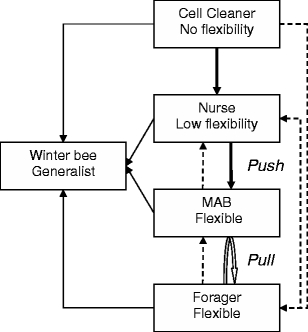
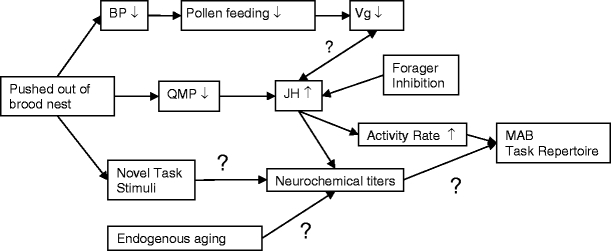
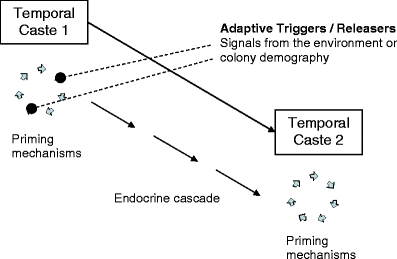
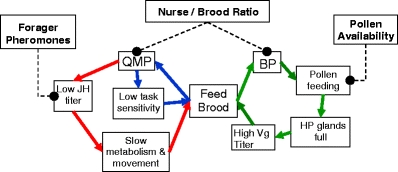
Honeybees exhibit two patterns of organization of work. In the spring and summer, division of labor is used to maximize growth rate and resource accumulation, while during the winter, worker survivorship through the poor season is paramount, and bees become generalists. This work proposes new organismal and proximate level conceptual models for these phenomena. The first half of the paper presents a push-pull model for temporal polyethism. Members of the nursing caste are proposed to be pushed from their caste by the development of workers behind them in the temporal caste sequence, while middle-aged bees are pulled from their caste via interactions with the caste ahead of them. The model is, hence, an amalgamation of previous models, in particular, the social inhibition and foraging for work models. The second half of the paper presents a model for the proximate basis of temporal polyethism. Temporal castes exhibit specialized physiology and switch caste when it is adaptive at the colony level. The model proposes that caste-specific physiology is dependent on mutually reinforcing positive feedback mechanisms that lock a bee into a particular behavioral phase. Releasing mechanisms that relate colony level information are then hypothesized to disrupt particular components of the priming mechanisms to trigger endocrinological cascades that lead to the next temporal caste. Priming and releasing mechanisms for the nursing caste are mapped out that are consistent with current experimental results. Less information-rich, but plausible, mechanisms for the middle-aged and foraging castes are also presented.
蜜蜂展现出两种工作组织模式。在春季和夏季,分工用于使生长速率和资源积累最大化,而在冬季,度过恶劣季节时工蜂的生存至关重要,蜜蜂会成为多面手。这项研究为这些现象提出了新的个体层面和近端层面的概念模型。论文的前半部分提出了一个关于时间多型行为的推拉模型。育幼蜂群的成员被认为是在时间序列中被其身后发育的工蜂从该蜂群中“推”出,而中年蜜蜂则是通过与前方蜂群的相互作用被“拉”出其蜂群。因此,该模型是先前模型的融合,特别是社会抑制模型和工作觅食模型。论文的后半部分提出了一个关于时间多型行为近端基础的模型。时间蜂群表现出特殊的生理特征,并在群体层面适应时转换蜂群。该模型提出,特定蜂群的生理特征依赖于相互强化的正反馈机制,这种机制将一只蜜蜂锁定在特定的行为阶段。然后推测与群体层面信息相关的释放机制会破坏引发机制的特定组成部分,从而触发导致下一阶段时间蜂群的内分泌级联反应。绘制出了与当前实验结果一致的育幼蜂群的引发和释放机制。还提出了中年和觅食蜂群信息较少但合理的机制。