Department of Biological Sciences, Indian Institute of Science Education and Research, Kolkata, Mohanpur, Nadia 741252, West Bengal, India.
BMC Genomics. 2010 Feb 2;11:83. doi: 10.1186/1471-2164-11-83.
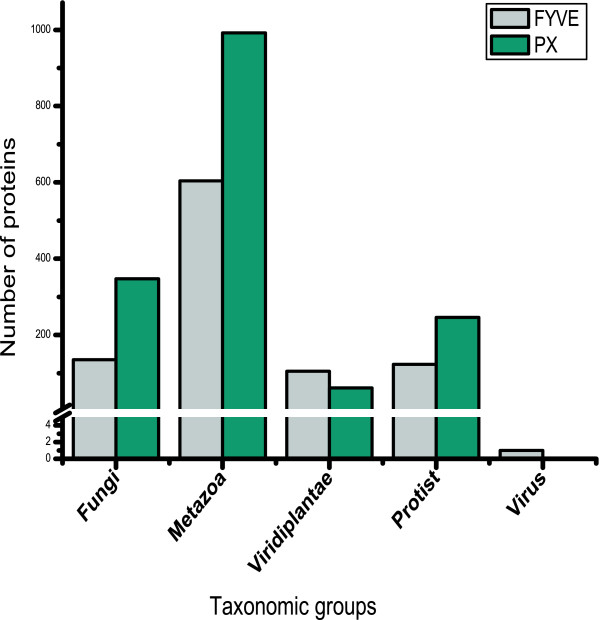
Phosphatidylinositol 3-phosphate is involved in regulation of several key cellular processes, mainly endocytosis, signaling, nuclear processes, cytoskeletal remodelling, cell survival, membrane trafficking, phagosome maturation and autophagy. In most cases effector proteins bind to this lipid, using either FYVE or PX domain. These two domains are distributed amongst varied life forms such as virus, protists, fungi, viridiplantae and metazoa. As the binding ligand is identical for both domains, the goal of this study was to understand if there is any selectivity for either of these domains in different taxa. Further, to understand the different cellular functions that these domains may be involved in, we analyzed the taxonomic distribution of additional domains that associate with FYVE and PX.
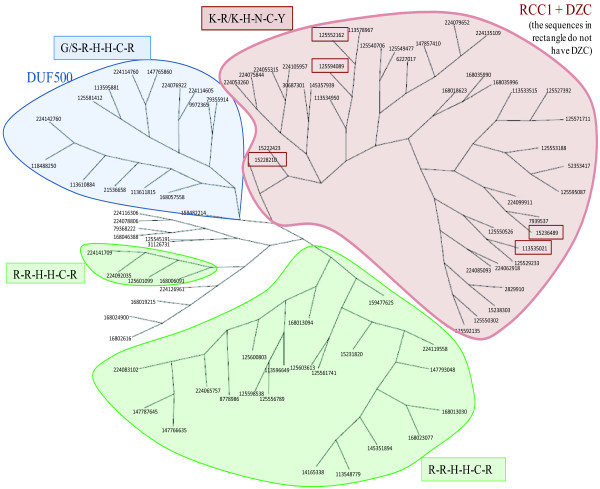
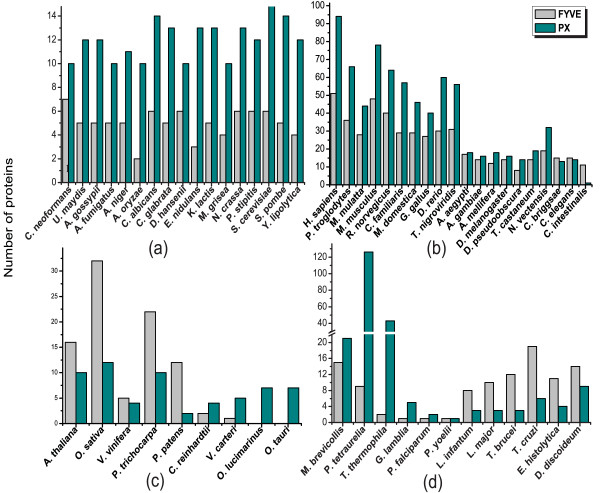
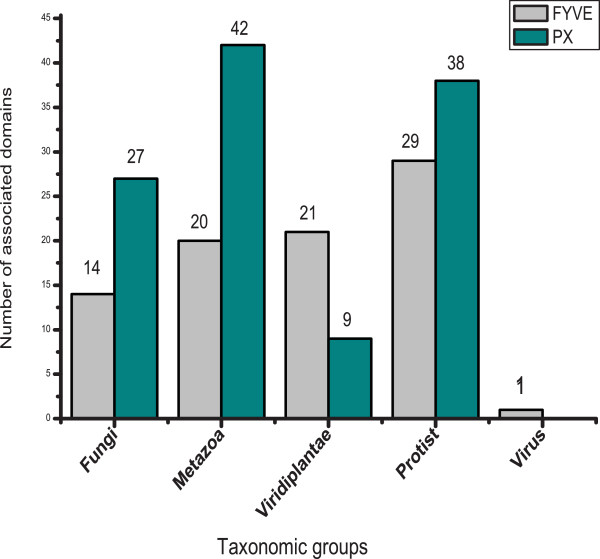
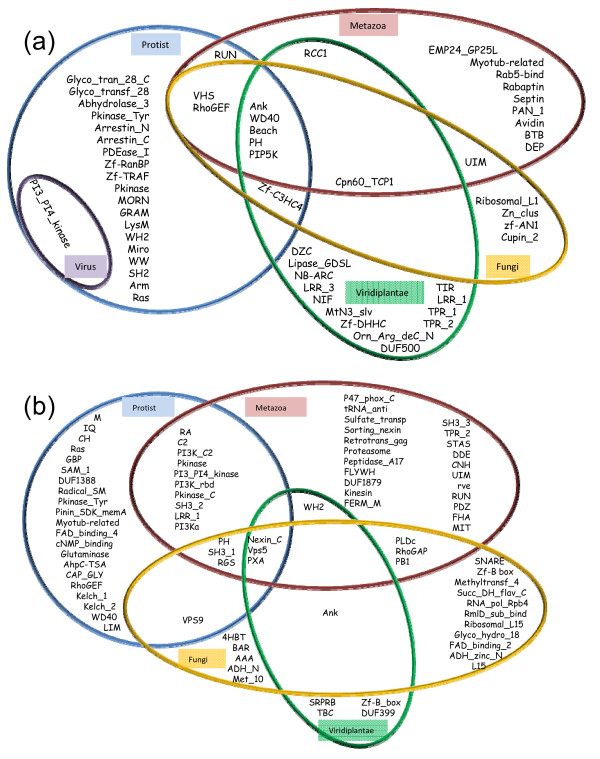
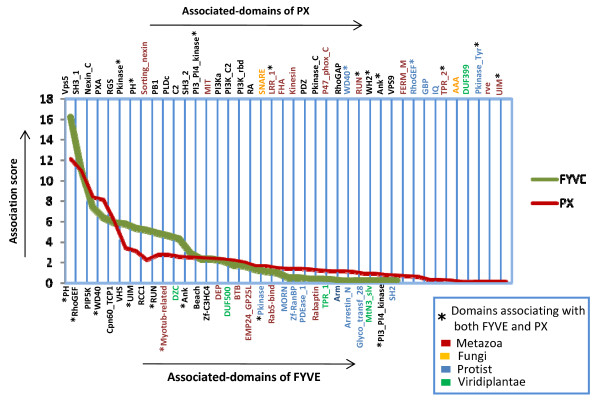
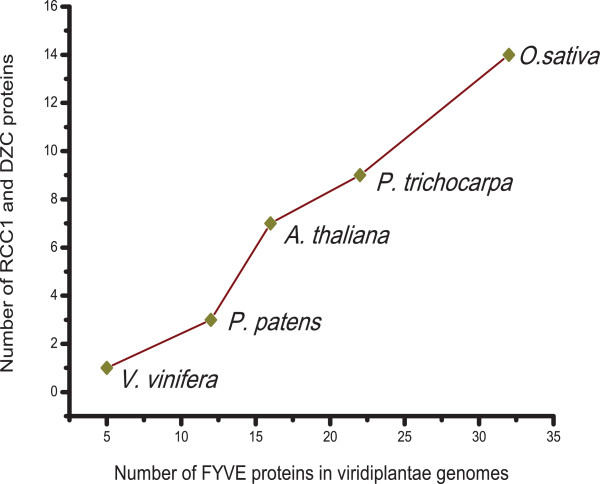
There is selectivity for either FYVE or PX in individual genomes where both domains are present. Fungi and metazoa encode more PX, whereas streptophytes in viridiplantae encode more FYVE. Excess of FYVE in streptophytes results from proteins containing RCC1and DZC domains and FYVE domains in these proteins have a non-canonical ligand-binding site. Within a taxonomic group the selected domain associates with a higher number of other domains and is thus expected to discharge a larger number of cellular functions. Also, while certain associated domains are present in all taxonomic groups, most of them are unique to a specific group indicating that while certain common functions are discharged by these domains in all taxonomic groups, some functions appear to be group specific.
Although both FYVE and PX bind to PtdIns(3)P, genomes of different taxa show distinct selectivity of encoding either of the two. Higher numbers of taxonomic group specific domains co-occur with the more abundant domain (FYVE/PX) indicating that group-specific rare domain architectures might have emerged to accomplish certain group-specific functions.
磷脂酰肌醇 3-磷酸参与调节几个关键的细胞过程,主要是内吞作用、信号转导、核过程、细胞骨架重塑、细胞存活、膜运输、吞噬体成熟和自噬。在大多数情况下,效应蛋白使用 FYVE 或 PX 结构域与这种脂质结合。这两个结构域分布在病毒、原生生物、真菌、绿色植物和后生动物等各种生命形式中。由于这两个结构域的结合配体相同,因此本研究的目的是了解这两个结构域在不同分类群中是否存在选择性。此外,为了了解这些结构域可能参与的不同细胞功能,我们分析了与 FYVE 和 PX 相关的其他结构域的分类分布。
在同时存在这两个结构域的单个基因组中,存在对 FYVE 或 PX 的选择性。真菌和后生动物编码更多的 PX,而绿色植物中的石松类植物编码更多的 FYVE。石松类植物中 FYVE 的过剩是由于含有 RCC1 和 DZC 结构域的蛋白质造成的,这些蛋白质中的 FYVE 结构域具有非典型的配体结合位点。在一个分类群中,所选结构域与更多其他结构域相关联,因此预计可以执行更多的细胞功能。此外,虽然某些相关结构域存在于所有分类群中,但大多数结构域仅存在于特定组中,这表明虽然这些结构域在所有分类群中都执行某些共同功能,但某些功能似乎是特定于组的。
虽然 FYVE 和 PX 都与 PtdIns(3)P 结合,但不同分类群的基因组显示出对编码这两种结构域之一的明显选择性。与更丰富的结构域(FYVE/PX)共同出现的分类群特异性结构域数量更多,这表明可能出现了特定于组的罕见结构域架构,以完成某些特定于组的功能。